
Electronic Signature
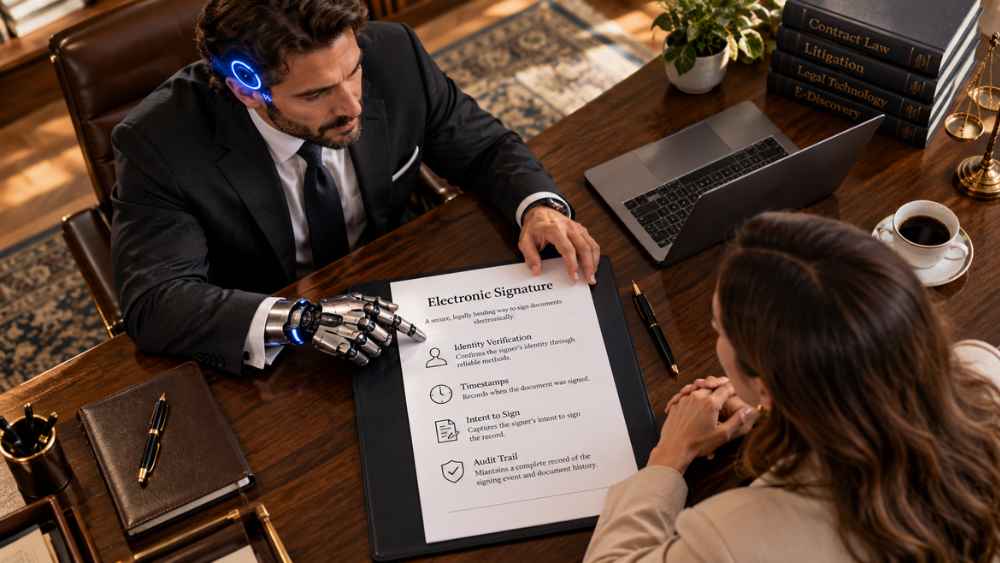
“The parties used an Electronic Signature platform that recorded identity checks, timestamps, assent, document versions, and a final audit trail.”
What Is an Electronic Signature?
An Electronic SignatureDigital SignatureA digital signature is a cryptographic form of electronic signature used to authenticate a signer and verify the integrity of an electronic record.View definition , or e-signatureContract Lifecycle ManagementContract Lifecycle Management, or CLM, manages contracts from request and drafting through negotiation, approval, execution, storage, obligation tracking, renewal, and termination. CLM software can automate workflows, metadata, alerts, reporting, and integrations.View definition , is an electronic sound, symbol, or process adopted with intent to sign a record.
Under the federal E-SIGN Act, electronic signatures generally cannot be denied legal effect solely because they are electronic.
See 15 U.S.C. § 7001.
Standard Electronic Signature — Sample Contract Language
Suppose a customer receives a service agreementService AgreementA service agreement is a contract in which one party agrees to perform services for another party in exchange for payment or other consideration. It commonly covers scope, fees, deliverables, service levels, intellectual...View definition through an online signing platform.
What Does E-Signature Mean?
An e-signature can take many forms when the signer intends to authenticate or adopt a record.
Examples include typed names, click-to-sign processes, stylus signatures, and some digital-signature systems.
Therefore, legal validity usually depends on more than the visual appearance of the mark.
What Is the E-SIGN Act?
The Electronic Signatures in Global and National Commerce Act is a federal electronic-transactions law. It applies broadly to interstate and foreign commerce.
It prevents discriminationWorkplace HarassmentWorkplace harassment is unwelcome conduct that can violate employment law when it is based on a protected characteristic or protected activity. Federal law generally requires a qualifying job action or conduct severe or...View definition against contracts and signatures solely because they use electronic form.
Therefore, electronic contracting has broad federal legal support.
What Is UETA?
The Uniform Electronic Transactions Act, or UETA, is a model state law addressing electronic recordsBest Evidence RuleThe Best Evidence Rule generally requires an original writing, recording, or photograph when a party seeks to prove its content. Federal Evidence Rules 1001–1008 define originals and duplicates, permit reliable copies, and provide...View definition and signatures.
Most states have adopted UETA or substantially similar electronic-transactions legislationStatutory LawStatutory law is written law enacted by a legislative body through the formal lawmaking process. Federal and state statutes can create rights, duties, prohibitions, causes of action, procedures, penalties, and remedies, and courts...View definition .
See Uniform Law Commission UETA materials.
Electronic Signature vs. Digital Signature
An electronic signature is the broader legal concept.
A digital signature usually refers to a cryptographic method that can verify identity, integrity, or document changes.
Therefore, every digital signature can be electronic, but not every electronic signature uses cryptography.
What Is Intent to Sign?
Intent to sign means the person adopts the electronic act as a signature.
A platform can show intent through an “I agree” button, signature field, confirmation step, or similar action.
Therefore, evidence of intent is a core part of enforceability.
What Is Consent to Use Electronic Records?
Parties generally are not forced to use electronic records merely because E-SIGN recognizes them.
Consumer transactions can also require special consent procedures for electronic disclosures.
Therefore, electronic-signature workflows should distinguish contract assent from disclosure consent.
What Consumer Consent Rules Apply?
E-SIGN contains special requirements when another law requires information to be provided to a consumer in writing.
Those requirements can include affirmative consent and disclosures about paper options, withdrawal, and hardware or software needs.
Therefore, consumer e-delivery deserves separate compliance reviewCompliance AuditA compliance audit is a structured test of whether laws, policies, contractual obligations, and internal controls are being followed in practice.View definition .
What Is an Electronic Record?
An electronic record is information created, generated, sent, communicated, received, or stored electronically.
Examples include PDFs, emails, web forms, and digital agreements.
Therefore, an electronic signature usually attaches to or associates with an electronic record.
Can Electronic Contracts Be Enforceable?
Yes. E-SIGN states that a contract cannot be denied legal effect solely because an electronic signature or record was used.
However, ordinary contract requirements still apply.
Therefore, offerOffer and AcceptanceOffer and Acceptance describes how parties manifest mutual assent to a contract. A valid offer gives another party power to accept, while acceptance must objectively communicate assent through an authorized method, subject to...View definition , acceptance, considerationContract LawContract law is the body of law that governs enforceable agreements. It explains how contracts form, what duties they create, how courts interpret them, what counts as a breach, and what remedies may...View definition , capacity, legality, and other doctrines remain relevant.
Does E-SIGN Make Every Electronic Contract Valid?
No. E-SIGN removes electronic form as a standalone reason for invalidity.
It does not eliminate defenses such as fraud, duress, mistake, lack of authority, or unconscionabilityUnconscionabilityUnconscionability is a contract doctrine allowing courts to refuse or limit enforcement of extremely unfair agreements or clauses. Courts commonly examine procedural unfairness in the bargaining process and substantive unfairness in the terms,...View definition .
Therefore, e-signature law works alongside ordinary contract law.
What Is Attribution?
Attribution concerns whether an electronic signature or act can be linked to a particular person.
Evidence can include authenticationAdmissible EvidenceAdmissible Evidence is evidence a court permits the judge or jury to consider. In federal court, admissibility commonly depends on relevance, Rule 403 balancing, authentication, foundation, hearsay rules, privilege, witness competence, and other...View definition methods, audit logs, IP records, email confirmation, device information, and surrounding conduct.
Therefore, identity evidence can matter when a signature is disputed.
What Is Authentication?
Authentication verifies that a user is who the system claims.
Methods can include passwords, multi-factor authentication, identity verificationVerified ComplaintA verified complaint is a complaint accompanied by a sworn verification or declaration under penalty of perjury confirming specified factual allegations.View definition , or certificate-based credentials.
Therefore, stronger authentication can reduce impersonation disputes.
What Is an Audit Trail?
An audit trail records events associated with signing.
It can capture timestamps, authentication steps, document versions, consent events, and completion status.
Therefore, audit trails can support proof of execution.
What Is a Certificate of Completion?
A certificate of completion is a platform-generated record summarizing signature events and transaction details.
Its evidentiary weight depends on reliability and context.
Therefore, certificates should supplement rather than replace a sound signing process.
What Is Document Integrity?
Document integrity means the signed record has not been improperly altered after execution.
Hashing, tamper-evident seals, version controlLegal Document ManagementLegal document management controls how legal work product is stored, searched, versioned, secured, shared, and retained across matters and teams.View definition , and access controls can support integrity.
Therefore, integrity is important when the exact signed text later matters.
Can a Typed Name Be an Electronic Signature?
Potentially. A typed name can function as an e-signature when it is adopted with intent to sign.
Context matters because typing a name for identification alone may not show signature intent.
Therefore, the surrounding workflow should make the signing act clear.
Can Clicking “I Agree” Create an Electronic Signature?
Potentially. ClickwrapTerms of ServiceTerms of Service are online contractual rules governing access to and use of a website, application, platform, or digital service.View definition processes can create enforceable assent when users receive appropriate notice and take an affirmative action.
However, enforceability depends on presentation and surrounding facts.
Therefore, interface design matters.
What Is Clickwrap?
Clickwrap requires a user to take an affirmative action agreeing to stated terms.
The user typically clicks a button near a link or display of the agreement.
Therefore, well-designed clickwrap often provides stronger assent evidence than passive browsewrapTerms and ConditionsTerms and Conditions are contractual rules governing use of a website, app, service, or commercial offering. They can address accounts, payments, acceptable use, intellectual property, disclaimers, liability, suspension, termination, and dispute procedures.View definition .
What Is Browsewrap?
Browsewrap attempts to bind users through website termsWebsite Terms and ConditionsWebsite Terms and Conditions are online contractual rules governing access to and use of a website or digital service.View definition without an explicit acceptance action.
Courts often scrutinize whether users had actual or constructive noticeConstructive NoticeConstructive notice is legally imputed knowledge arising from a recognized notice method, such as public recording or other circumstances that the law treats as sufficient notice.View definition .
Therefore, browsewrap can present greater enforceability risk.
What Is Sign-In Wrap?
Sign-in wrap presents terms near a button used for account creation, login, or another action.
Its enforceability depends heavily on notice and interface design.
Therefore, visual clarity matters.
Can E-Signatures Be Used for Employment Documents?
Often, yes. Employers commonly use e-signatures for offer letters, policies, acknowledgments, and arbitrationAlternative Dispute ResolutionAlternative Dispute Resolution, or ADR, includes negotiation, mediation, arbitration, settlement conferences, and other processes used outside ordinary trial adjudication. Each method differs in neutrality, confidentiality, party control, binding effect, cost, and review.View definition agreements.
However, state-law and document-specific requirements can apply.
Therefore, employers should preserve evidence of notice and assent.
Can E-Signatures Be Used for Real Estate Documents?
Often, yes, subject to state law and document-specific formalities.
NotarizationNotary PublicA notary public is a state-commissioned official who verifies identity and performs authorized notarial acts such as acknowledgments, jurats, and oaths.View definition , recording, witness, or county filing rules can require additional steps.
Therefore, transaction-specific requirements should be checked.
Can E-Signatures Be Notarized?
Electronic notarizationElectronic NotarizationElectronic notarization is a legally authorized notarial act performed on an electronic record using electronic signatures and technology, subject to state-specific notary rules.View definition is possible where applicable law permits it.
E-SIGN recognizes electronic notarization when required information and the authorized person’s electronic signature are properly associated with the record.
Therefore, state notary law still controls many procedural details.
What Is Remote Online Notarization?
Remote Online Notarization, or RON, allows a notary and signer to interact through approved remote technology where law permits.
Identity proofing, audiovisual recording, and platform standards can apply.
Therefore, RON rules vary significantly by state.
Can Wills Be Electronically Signed?
Electronic-will rules vary by state.
E-SIGN excludes certain testamentary records from its general federal rule.
Therefore, estate-planning documents require specialized state-law review.
What Records Are Excluded From E-SIGN?
E-SIGN contains exclusions for specified documents and notices.
Examples include certain wills, family-law documents, court documents, and specified consumer notices.
Therefore, the general rule should not be applied without checking statutory exceptions.
What Is Electronic Record Retention?
E-SIGN allows qualifying electronic retention when the record accurately reflects the information and remains accessible for the required period.
The record also must be reproducible for later reference.
Therefore, signing systems should preserve durable records rather than only images.
Can an Electronic Record Satisfy an Original Requirement?
Potentially. E-SIGN can satisfy certain original-form requirements when electronic retention standards are met.
However, specialized statutesPrimary AuthorityPrimary Authority is law issued by an institution with official power to create or state legal rules. Constitutions, statutes, regulations, court decisions, and court rules can be primary authority, while binding effect depends...View definition and excluded documents can require different treatment.
Therefore, original-document rules should be checked by transaction type.
What Is an Electronic Signature Platform?
An electronic signature platform manages electronic execution workflows.
Features can include authentication, templates, routing, timestamps, audit logs, and document storage.
Therefore, platform selection should consider both legal and security requirements.
What Security Features Matter?
Useful controls can include multi-factor authentication, encryption, tamper evidence, access controls, logging, and secure retention.
The required level depends on transaction risk.
Therefore, a low-risk acknowledgment and a major financing agreement need not use identical controls.
Can an Electronic Signature Be Forged?
Yes. Electronic signatures can be misused through credential theft, impersonation, malware, or unauthorized account access.
Strong authentication and audit evidence can reduce risk.
Therefore, electronic form does not eliminate fraud concerns.
How Are E-Signatures Proved in Court?
Parties can use testimony, platform records, metadataRequest for ProductionA Request for Production is a civil discovery request for documents, electronically stored information, tangible things, or inspection access. In federal court, Rule 34 governs requests to parties and sets requirements for particularity,...View definition , authentication logs, emails, and surrounding conduct.
Evidence rules govern admissibilityRelevanceRelevance asks whether evidence tends to make a consequential fact more or less probable. Federal Rules 401 and 402 establish the basic threshold, while Rule 403 permits exclusion when specified dangers substantially outweigh probative value.View definition and authentication.
Therefore, organizations should preserve the full execution record.
Electronic Signature Example
Suppose a customer receives a service agreement through an online signing platform.
The customer verifies identity, reviews the agreement, clicks a signature field, and confirms completion.
The platform stores the signed record and audit trail.
Why Does an Electronic Signature Matter?
Electronic signatures make remote contracting faster while preserving legally meaningful evidence of assent.
However, enforceability still depends on intent, authority, notice, authentication, document rules, and applicable law.
The key questions are practical. Did the signer intend to sign? Can identity be proved? Was the record preserved? Do special formalities apply?