
RegTech
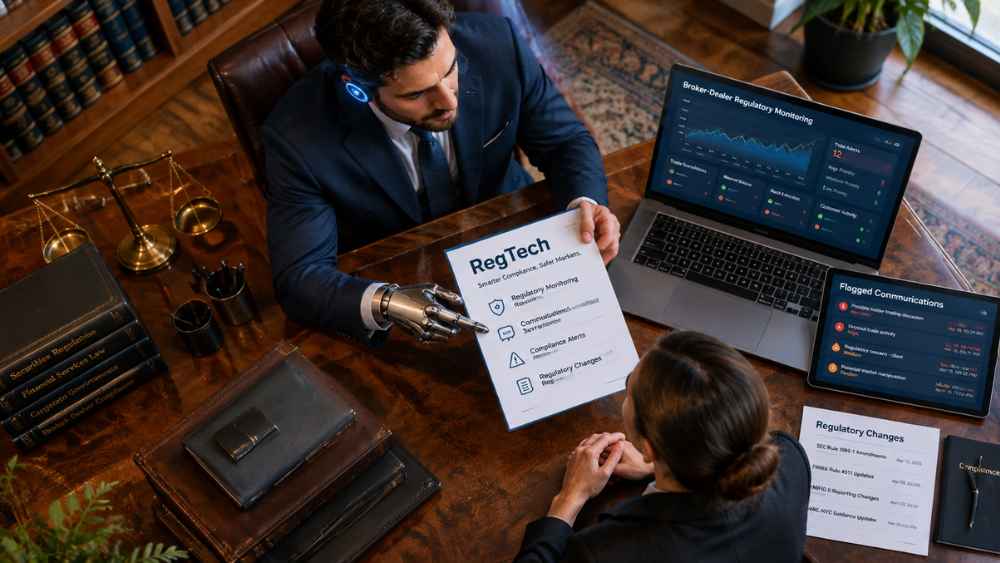
“The broker-dealer deployed RegTech to monitor communications, screen customers, track regulatory changes, and route compliance alerts for human review.”
What Is RegTech?
RegTech means technology used to support regulatory complianceRegulatory ComplianceRegulatory compliance means following the laws, regulations, rules, and official requirements that apply to an organization or activity. Effective compliance programs identify obligations, assign responsibility, implement controls, monitor performance, and correct problems.View definition , monitoring, reporting, and risk management.
The term is especially common in financial services.
Therefore, RegTech connects compliance obligations with software and data. See FINRA RegTech Report.
Standard RegTech — Sample Contract Language
Suppose a broker-dealer screens communications and routes alerts to compliance staff.
Is RegTech the Same as FinTech?
RegTech is often treated as a subset of financial technology focused on compliance.
FinTech also includes payments, lending, trading, banking, and other financial innovation.
Therefore, the categories overlap but are not identical.
What Problems Does RegTech Address?
RegTech can help organizations identify rules, monitor conduct, screen customers, produce reports, and document controls.
It can also reduce manual compliance work.
Therefore, common use cases span the compliance lifecycle.
What Is Regulatory Intelligence?
Regulatory intelligence systems track new laws, rules, guidance, and enforcement developments.
They can map changes to internal obligations.
Therefore, RegTech can help teams manage regulatory change.
What Is Compliance Monitoring?
Compliance monitoring tests transactions, communications, workflows, and controls for possible violations.
Alerts can trigger human review.
Therefore, technology can expand monitoring scale.
What Is Regulatory Reporting?
Regulatory reporting tools collect, validate, transform, and submit required data to authorities.
They can also maintain audit evidence.
Therefore, data quality is central to automated reporting.
How Does RegTech Support AML?
RegTech can support customer identification, transaction monitoring, sanctions screening, and suspicious-activity workflows.
Financial institutions remain responsible for legal compliance.
Therefore, software does not transfer regulatory accountability.
How Does RegTech Support Surveillance?
Systems can detect unusual trading, communications, conflicts, or policy breaches.
Rules and models generate alerts for investigation.
Therefore, surveillance design should control false positives and missed risk.
What Is Know Your Customer Technology?
KYC tools verify identity, collect due-diligence information, and assess customer risk.
Automation can connect public records and screening sources.
Therefore, identity accuracy and privacy controls both matter.
Can RegTech Use AI?
Yes. AI can classify documents, detect patterns, prioritize alerts, and extract obligations.
AI introduces model, bias, explainability, and validationTechnology Assisted ReviewTechnology Assisted Review (TAR) uses technology and human judgment to prioritize, classify, and review documents in legal discovery. TAR can include predictive coding, continuous active learning, statistical sampling, validation, and other analytics designed...View definition risks.
Therefore, governance should match the system impact.
What Is Robotic Process Automation?
Robotic process automation performs repetitive rule-based tasks across existing applications.
It can reduce manual copying and reconciliation.
Therefore, RPA is useful when the process is stable and structured.
What Is Compliance Automation?
Compliance automation embeds controls into workflows so required checks happen consistently.
Examples include approval gates, retention rules, attestations, and reporting triggers.
Therefore, compliance can move closer to business operations.
What Is a Regulatory Rule Engine?
A rule engine converts legal or policy requirements into machine-executable conditions.
Rules can evaluate transactions or user actions.
Therefore, legal interpretation should be documented before coding.
What Is Model Validation?
Model validation tests whether analytical or AI systems perform as intended.
It can assess accuracy, stability, assumptions, and failure modes.
Therefore, high-impact RegTech needs ongoing evaluation.
What Is Auditability?
Auditability means the system can show what rule, data, model, and action produced a compliance outcome.
Good logs support investigation and examination.
Therefore, black-box automation creates governance risk.
What Are Data Quality Risks?
Incorrect, incomplete, or stale data can make RegTech outputs unreliable.
Automated decisions can scale those errors rapidly.
Therefore, data controls are part of compliance controls.
What Are Vendor Risks?
Third-party RegTech can create cybersecurity, privacy, resilience, and dependency risks.
Contract terms should address security, support, data use, and audit rightsLicensing AgreementA Licensing Agreement is a contract granting permission to use specified property, technology, or intellectual property while the licensor generally retains ownership. Key terms commonly address scope, exclusivity, territory, term, royalties, sublicensing, quality...View definition .
Therefore, vendor due diligenceVendor ComplianceVendor compliance manages legal, contractual, ethics, security, and regulatory risks created by suppliers and other third parties.View definition remains necessary.
Does RegTech Guarantee Compliance?
No. FINRA has emphasized that technology does not replace a firm’s legal obligations.
Organizations remain responsible for supervision and control effectiveness.
Therefore, software should support rather than substitute governance.
What Is SupTech?
Supervisory technology, or SupTech, usually describes technology used by regulators for oversight.
RegTech more often describes tools used by regulated organizations.
Therefore, the two terms identify related but different users.
RegTech Example
Suppose a broker-dealer screens communications and routes alerts to compliance staff.
The firm validates models and records reviewer decisions.
Therefore, RegTech augments rather than replaces human supervision.
Why Does RegTech Matter?
RegTech can make complex compliance programs faster, more consistent, and more measurable.
It can also magnify bad rules or bad data.
Therefore, successful RegTech combines technology with legal judgmentCivil LawsuitA civil lawsuit is a noncriminal court action in which a plaintiff seeks a legal remedy from a defendant. The process can include jurisdiction, pleadings, service, discovery, motions, settlement, trial, judgment, enforcement, and...View definition and governance.