
Contract Amendment
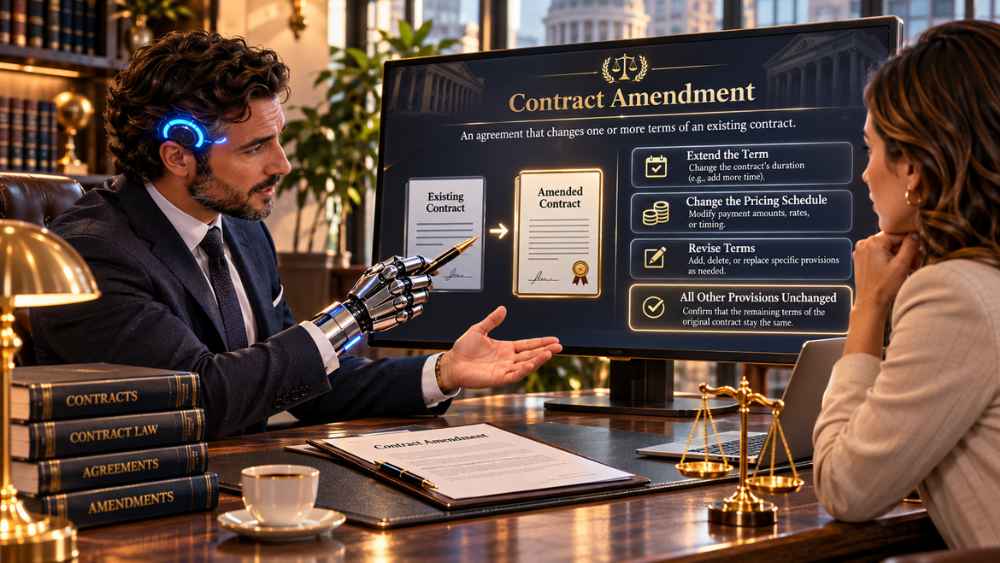
“The parties signed a Contract Amendment extending the term, changing the pricing schedule, and confirming that all other provisions remained unchanged.”
What Is a Contract Amendment?
A Contract Amendment is an agreement that changes one or more terms of an existing contract.
It can add, delete, replace, or revise provisions.
Therefore, the original contract remains in force except as changed. See Cornell LII on contract modification.
Standard Contract Amendment — Sample Contract Language
Suppose a services agreement runs for one year and the parties agree to extend it for two more years.
Who Must Agree to an Amendment?
The parties whose contractual rights or obligations change generally must assent to the amendment.
Authority rules also matter for entities.
Therefore, signature and approval requirements should be confirmed.
Does an Amendment Need Consideration?
Common-law contract modifications can require considerationContract LawContract law is the body of law that governs enforceable agreements. It explains how contracts form, what duties they create, how courts interpret them, what counts as a breach, and what remedies may...View definition or another recognized basis.
State doctrines vary.
Therefore, non-UCC amendments should be analyzed under governing lawBoilerplate ClauseA boilerplate clause is standardized contract language addressing recurring legal mechanics such as notice, assignment, governing law, waiver, severability, and integration.View definition .
What Does UCC Section 2-209 Provide?
For contracts governed by UCC Article 2, a modification needs no new consideration to be binding.
Good-faith and other statutory requirements still apply.
Therefore, sales-contract amendments follow a special rule. See UCC § 2-209.
Can a Contract Require Written Amendments?
Yes. Many contracts state that amendments must be in a signed writing.
UCC Section 2-209 addresses such clauses for covered sales contracts.
Therefore, the original amendment clause should be reviewed first.
Can an Oral Change Still Matter?
Sometimes. Waiver, estoppelEstoppelEstoppel is a family of doctrines preventing a party from asserting a position when law treats that position as unfair, inconsistent, or already resolved. Major forms include equitable, promissory, collateral, judicial, and silence-based...View definition , reliance, or other doctrines can affect attempted oral modifications.
The result depends on governing law and contract type.
Therefore, parties should not assume an oral change is harmless.
What Is the Statute of Frauds Issue?
A modification can need a writing if the contract as modified falls within an applicable Statute of Frauds.
UCC Section 2-209 expressly addresses this point.
Therefore, form requirements can change after amendment.
What Should an Amendment Identify?
A strong amendment identifies the original agreement, effective dateStatuteA Statute is a law enacted by a legislative body such as Congress or a state legislature. Federal statutes move from enactment through slip laws and the Statutes at Large, while general and...View definition , provisions changed, replacement language, and continuing effect of unchanged terms.
It should also address priority.
Therefore, precise cross-references reduce ambiguityContract InterpretationContract interpretation is the legal process of determining what contractual language means and how the agreement applies to the parties' dispute.View definition .
Can an Amendment Change Only One Term?
Yes. Parties can amend price, term, scope, service levels, renewal, notice, or another specific provision.
The rest can remain unchanged.
Therefore, a short amendment can be legally significant.
What Is an Amended and Restated Agreement?
An amended and restated agreement incorporates prior changes into a new complete version.
It can improve readability after many amendments.
Therefore, restatementSecondary AuthoritySecondary Authority explains, summarizes, analyzes, or critiques law without creating binding legal rules. Treatises, law reviews, Restatements, legal encyclopedias, practice guides, ALR annotations, and dictionaries can help researchers understand doctrine and locate controlling...View definition is often preferable when document history becomes complex.
How Does an Amendment Affect Incorporated Documents?
Schedules, exhibits, statements of work, and policies can need conforming changes.
Conflict clauses should establish priority.
Therefore, amendment review should cover the entire contract set.
Contract Amendment Example
Suppose a services agreement runs for one year and the parties agree to extend it for two more years.
They sign an amendment changing the term provision.
Therefore, the original agreement continues with the revised duration.
Why Does a Contract Amendment Matter?
A written amendment creates a clear record of negotiated changes without replacing the entire contract.
Poor drafting can create conflicts between versions.
Therefore, amendments should identify exact changes and document hierarchyContract AddendumA Contract Addendum adds supplemental material to an existing contract or completed document. It commonly contains schedules, specifications, disclosures, or additional terms and should address incorporation, signatures, effective date, and priority with the...View definition .