
Data Protection Impact Assessment (DPIA)
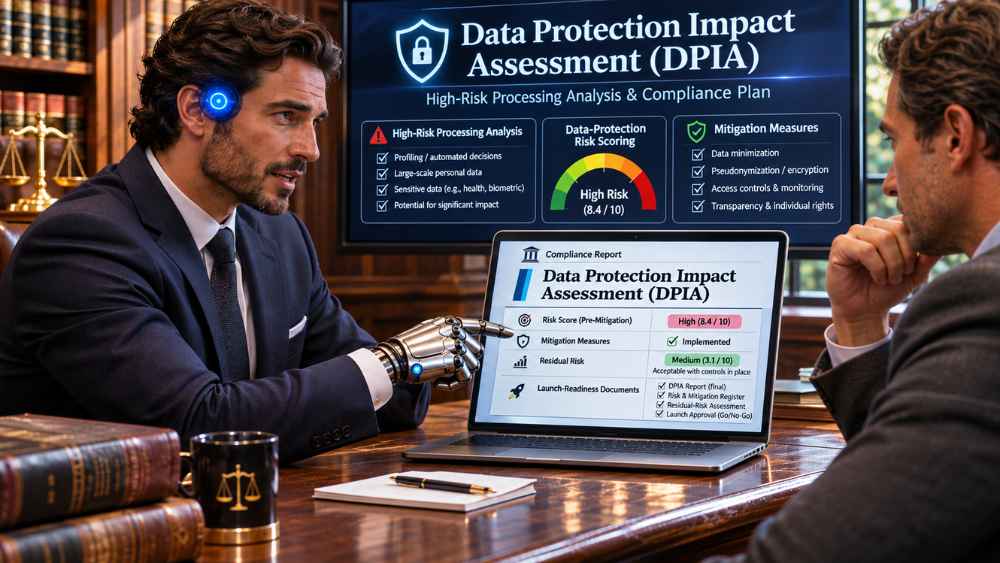
“Because the proposed profiling could create high risks for individuals, the controller completed a DPIA before launch and documented the mitigation measures and residual-risk decision.”
What Is Data Protection Impact Assessment (DPIA)?
A Data ProtectionData PrivacyData privacy concerns how personal information is collected, used, shared, retained, and controlled. It includes transparency, data minimization, individual rights, vendor management, security, retention, and compliance with laws such as GDPR, CCPA, and...View definition Impact Assessment (DPIAGDPRGDPR is the European Union’s General Data Protection Regulation, the main EU framework governing personal-data processing. It gives individuals substantial rights and imposes duties involving lawful processing, transparency, security, governance, breaches, and international...View definition ) is a documented assessment used to identify and reduce data-protection risks before high-risk personal-data processing proceeds. Under GDPR-style rules, a DPIA is particularly associated with processing likely to result in high risk to individuals’ rights and freedoms.
See the ICO guidance on when a DPIA is required.
Standard Data Protection Impact Assessment (DPIA) — Sample Contract Language
An organization plans large-scale profiling using sensitive personal dataSensitive DataSensitive data is information requiring heightened protection because misuse or exposure can create significant privacy, discrimination, financial, or safety risks.View definition . Before deployment, it completes a DPIA describing the processing, evaluates necessityData MinimizationData Minimization limits personal-data collection, use, access, sharing, and retention to what is genuinely needed for defined purposes. GDPR Article 5(1)(c) and California’s CCPA both impose minimization-style requirements, while privacy-by-design controls help operationalize...View definition and proportionalityDiscovery RequestA Discovery Request is a formal litigation request for information, documents, admissions, testimony, or inspection. Federal discovery rules govern scope, proportionality, interrogatories, requests for production, requests for admission, subpoenas, objections, privilege, response deadlines,...View definition , documents risks to individuals, and assigns technical and organizational measuresData Processing Agreement (DPA)A Data Processing Agreement (DPA) is a contract governing how one organization processes personal data for another. GDPR Article 28 requires specific controller-processor terms, while other privacy laws such as the CCPA can...View definition to reduce those risks.
Why Is Data Protection Impact Assessment (DPIA) Important?
A DPIA can determine whether a project should proceed as designed, needs stronger safeguards, or requires consultation with a supervisory authority. It also creates evidence of privacy-by-design and accountability.
How Does Data Protection Impact Assessment (DPIA) Work?
The controllerData SubjectA Data Subject is an identified or identifiable natural person to whom personal data relates under the GDPR. Data subjects can be customers, employees, applicants, users, children, or other individuals, and they receive...View definition describes the planned processing and purposes, evaluates necessity and proportionality, identifies risks to individuals, documents measures to address those risks, and considers the residual risk after mitigationForce MajeureForce Majeure is a contract concept that can excuse or delay performance after extraordinary events covered by the agreement. Relief depends on clause wording, causation, notice, mitigation, exclusions, governing law, and the specific...View definition .
What Rules Govern Data Protection Impact Assessment (DPIA)?
GDPR Article 35 requires a DPIA where processing is likely to result in a high risk to individuals, taking account of nature, scope, context, purposes, and use of new technologies. Supervisory-authority guidance and high-risk lists can provide additional triggers.
How Is Data Protection Impact Assessment (DPIA) Different From Related Concepts?
A DPIA is related to, but more legally specific than, a general Privacy Impact AssessmentPrivacy Impact AssessmentA Privacy Impact Assessment (PIA) analyzes how identifiable information is handled, what privacy risks arise, and what safeguards or alternative processes can reduce those risks before or during a project.View definition . A security risk assessment focuses mainly on threats and controls, while a DPIA also considers lawful purpose, proportionality, rights, and broader individual harm.
What Should Practitioners Check?
Start before deployment, involve privacy, security, product, engineering, procurement, and business owners, document mitigation owners, and revisit the assessment when processing or risk materially changes. Escalate unresolved high residual risk under the applicable regulatory framework.
Can AI Assist With Data Protection Impact Assessment (DPIA)?
AI can help map data flows, compare contracts, summarize questionnaires, and identify inconsistencies across records. Legal triggers, jurisdiction-specific requirements, risk judgments, and final mitigation decisions require accountable human review.
Data Protection Impact Assessment (DPIA) Example
An organization plans large-scale profiling using sensitive personal data. Before deployment, it completes a DPIA describing the processing, evaluates necessity and proportionality, documents risks to individuals, and assigns technical and organizational measures to reduce those risks.
Why Does Data Protection Impact Assessment (DPIA) Matter?
A DPIA is not merely a compliance form. It is a pre-deployment decision process designed to make high-risk personal-data processing more transparent, proportionate, and defensible.