
Data Protection Officer
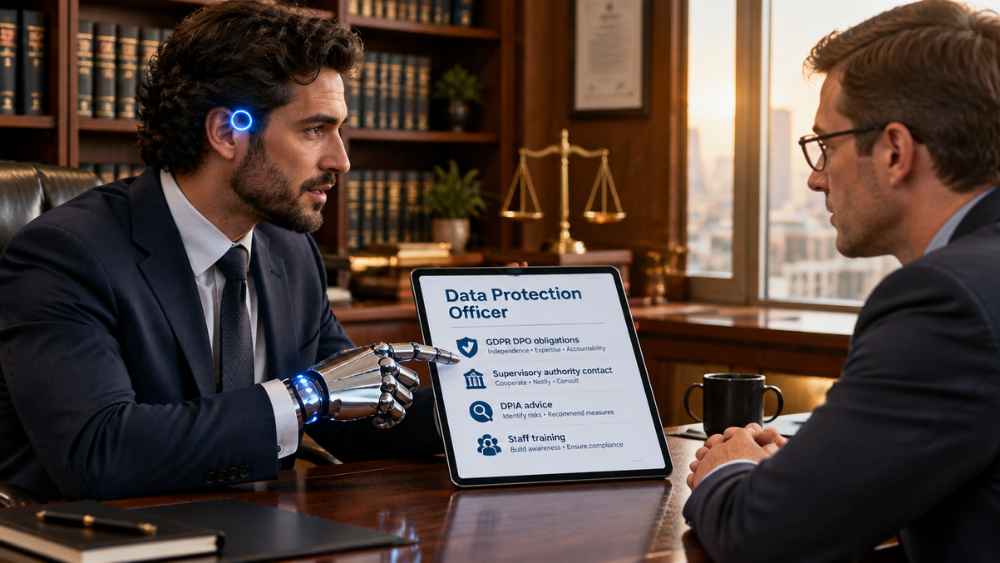
“The company appointed a Data Protection Officer to monitor GDPR compliance, advise on DPIAs, train staff, and serve as a supervisory-authority contact.”
What Is a Data Protection Officer?
A Data ProtectionData PrivacyData privacy concerns how personal information is collected, used, shared, retained, and controlled. It includes transparency, data minimization, individual rights, vendor management, security, retention, and compliance with laws such as GDPR, CCPA, and...View definition Officer, or DPOGDPRGDPR is the European Union’s General Data Protection Regulation, the main EU framework governing personal-data processing. It gives individuals substantial rights and imposes duties involving lawful processing, transparency, security, governance, breaches, and international...View definition , is a privacy professional with duties defined by GDPR Articles 37 through 39.
Some controllers and processors must appoint one.
Therefore, DPO status is a formal legal role under the GDPR. See GDPR Articles 37–39.
Standard Data Protection Officer — Sample Contract Language
Suppose a company’s core service tracks millions of users across websites for behavioral profiling.
When Is a DPO Mandatory?
A DPO is required for many public authorities and bodies.
It is also required for specified large-scale monitoring or sensitive-data processing.
Therefore, organizations should assess core processing activities.
What Is Regular and Systematic Monitoring?
The GDPR uses this concept when determining whether certain private organizations need a DPO.
Online tracking, behavioral monitoring, or structured surveillance can qualify depending on scale.
Therefore, monitoring method and scope matter.
What Is Large-Scale Sensitive Processing?
A DPO can be mandatory when core activities involve large-scale processing of special-category or criminal-offense data.
No single numerical threshold appears in Article 37.
Therefore, context determines scale.
Can a Company Appoint a DPO Voluntarily?
Yes. Organizations can designate a DPO even when Article 37 does not require one.
Voluntary designation can trigger expectations associated with the formal role.
Therefore, titles should be chosen carefully.
Can One DPO Serve a Group?
Yes. A group of undertakings can appoint one DPO if the officer remains easily accessible from each establishment.
Public bodies can also share a DPO in suitable circumstances.
Therefore, centralized privacy oversight is possible.
Can the DPO Be an Employee?
Yes. The DPO can be a staff member or provide services under contract.
Professional expertise and independence remain important.
Therefore, organizations can use internal or external models.
What Are the DPO’s Core Tasks?
Article 39 requires advice, compliance monitoringRegulatory ComplianceRegulatory compliance means following the laws, regulations, rules, and official requirements that apply to an organization or activity. Effective compliance programs identify obligations, assign responsibility, implement controls, monitor performance, and correct problems.View definition , training support, audit involvement, DPIA advice, regulator cooperation, and supervisory-authority contact.
The DPO also considers processing risk.
Therefore, the role combines advice and oversight.
Must the DPO Be Independent?
The controllerData SubjectA Data Subject is an identified or identifiable natural person to whom personal data relates under the GDPR. Data subjects can be customers, employees, applicants, users, children, or other individuals, and they receive...View definition or processor must not instruct the DPO about performing statutory tasks.
The DPO cannot be dismissed or penalized for performing those tasks.
Therefore, operational independence is a core safeguard.
What Is a Conflict of Interest?
A DPO can perform other duties if those duties do not create a conflict.
Roles determining processing purposes and meansData ControllerA Data Controller determines the purposes and essential means of processing personal data under GDPR terminology. Controllers carry broad responsibility for lawful bases, transparency, data-subject rights, privacy by design, security, processor selection, DPIAs,...View definition can present problems.
Therefore, senior operational positions require careful conflict analysis.
Does the DPO Make All Privacy Decisions?
No. The controller or processor remains responsible for GDPR compliance.
The DPO advises and monitors rather than replacing management accountability.
Therefore, responsibility cannot simply be delegated to the DPO.
Must DPO Contact Details Be Published?
Yes. Article 37 requires publication of DPO contact details and communication to the supervisory authority.
A personal name need not always be published.
Therefore, data subjects need an accessible contact point.
What Is the DPO’s Role in a DPIA?
Organizations must seek DPO advice regarding qualifying data protection impact assessments.
The DPO monitors DPIA performance.
Therefore, high-risk projects should involve the DPO early.
Data Protection Officer Example
Suppose a company’s core service tracks millions of users across websites for behavioral profiling.
The company appoints an independent DPO with direct access to senior management.
Therefore, the DPO monitors compliance and advises on high-risk processing.
Why Does a Data Protection Officer Matter?
A DPO provides structured privacy expertise, oversight, regulator contact, and internal accountability.
The formal role carries independence and conflict requirements.
Therefore, organizations should assess both appointment need and organizational placement.