
Legal Chatbot
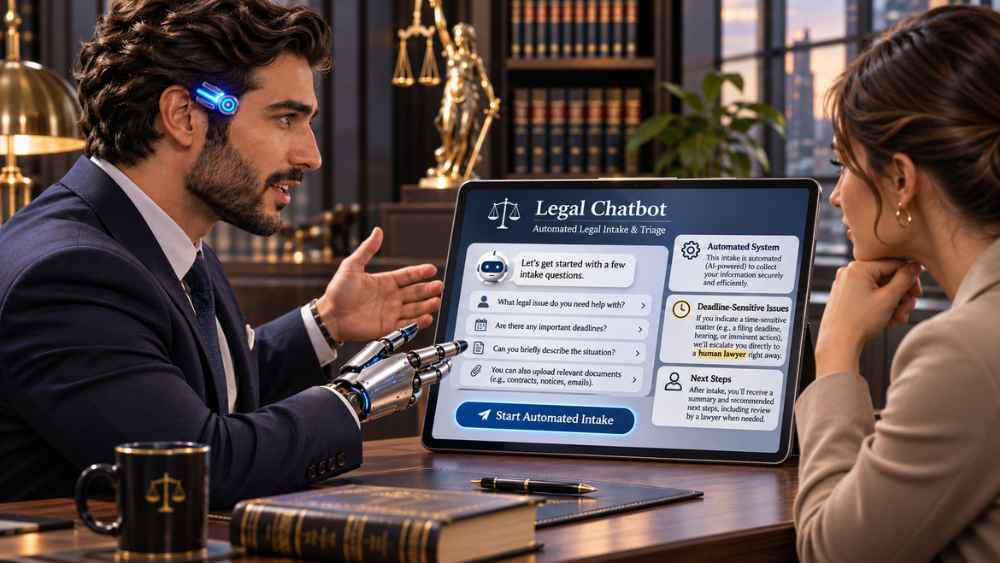
“The firm’s Legal Chatbot collected intake information, disclosed that it was automated, and escalated deadline-sensitive questions to a lawyer.”
What Is a Legal Chatbot?
A Legal ChatbotAI Legal AssistantAn AI legal assistant is software that uses artificial intelligence to support legal tasks such as research, contract review, document analysis, drafting, and matter organization. It assists with legal work but is not...View definition is software that communicates conversationally about legal information, intake, workflow, documents, or services.
It can use rules, retrieval systems, generative AI, or combinations of those technologies.
Therefore, legal chatbots vary widely in capability and risk.
Standard Legal Chatbot — Sample Contract Language
Suppose a law firm chatbot collects intake facts, checks basic conflicts data, and schedules a consultation.
What Can a Legal Chatbot Do?
Common uses include client intake, FAQ responses, document collection, scheduling, triage, drafting assistance, and internal knowledge access.
Some systems also retrieve legal authorityLegal AuthorityLegal authority is a source supporting a proposition of law and can be primary or secondary, binding or persuasive depending on jurisdiction and hierarchy.View definition .
Therefore, the use case should define the technical design.
Is a Legal Chatbot a Lawyer?
No. Software does not become a licensed lawyer merely because it produces legal-sounding answers.
Law firms remain responsible for professional services they provide through technology.
Therefore, users should understand the system’s role.
What Ethical Duties Apply?
Lawyers using generative AI remain subject to competence, confidentialityEmployment ContractAn employment contract is an agreement defining terms of an employer-employee relationship. It can cover duties, compensation, benefits, equity, confidentiality, intellectual property, restrictive covenants, termination, severance, and dispute procedures while remaining subject to...View definition , communication, supervision, candor, and reasonable-fee duties.
Therefore, AI use does not create an ethics exception. See ABA Formal Opinion 512 summary.
What Is the Confidentiality Risk?
Chatbots can receive privileged, confidential, personal, or regulated information.
Vendor retention, model training, access, security, and subprocessors can affect risk.
Therefore, firms should evaluate data handling before deployment.
Should a User Know the Chatbot Is Automated?
Disclosure can be important when a client or prospective client could reasonably believe a human lawyer is responding.
Some bar guidance expressly recommends clear AI disclosure.
Therefore, interface design should avoid deception. See Florida Bar Ethics Opinion 24-1.
Can a Chatbot Create an Attorney-Client Relationship?
Potential relationship questions depend on communications, reliance, jurisdictionLegal DisputeA legal dispute is a disagreement or controversy involving claimed legal rights, duties, liabilities, property, or remedies. It can be resolved through negotiation, mediation, arbitration, administrative proceedings, litigation, or settlement depending on the...View definition , and firm conduct.
A disclaimerDisclaimerA disclaimer is language intended to limit or qualify warranties, representations, responsibility, reliance, or liability, subject to contract and statutory limits.View definition can help but does not control every fact pattern.
Therefore, intake chatbots need careful scope and escalation rules.
What Is Unauthorized Practice Risk?
Public-facing systems can create unauthorized-practice concerns if they provide individualized legal services outside authorized structures.
Rules differ by jurisdiction.
Therefore, chatbot scope should be reviewed before launch.
What Is Hallucination Risk?
Generative systems can produce false legal propositions, nonexistent citations, or outdated law.
Fluent language does not prove accuracy.
Therefore, legal outputs require independent verificationVerified ComplaintA verified complaint is a complaint accompanied by a sworn verification or declaration under penalty of perjury confirming specified factual allegations.View definition .
What Is Human Escalation?
Human escalation routes complex, urgent, conflicted, or high-risk matters to qualified personnel.
Triggers can include litigation deadlines or requests for legal advice.
Therefore, escalation is a core safety feature.
What Should Be Logged?
Organizations can log system version, prompts, sources, outputs, user consent, escalations, and quality reviews subject to privacy rules.
Logs can support auditing.
Therefore, governance should balance traceability with data minimizationPrivacy by DesignPrivacy by Design embeds privacy protections into systems, products, and processes from the beginning through proactive controls, privacy-protective defaults, lifecycle security, and user-centered transparency.View definition .
Legal Chatbot Example
Suppose a law firm chatbot collects intake facts, checks basic conflicts data, and schedules a consultation.
It clearly states that no lawyer has reviewed the matter yet.
Therefore, the chatbot supports intake without pretending to provide final legal advice.
Why Do Legal Chatbots Matter?
Legal chatbots can expand access, speed intake, and reduce repetitive work.
They also create confidentiality, accuracy, advertising, supervision, and relationship risks.
Therefore, responsible deployment requires legal and technical controls.