
Sole Proprietorship
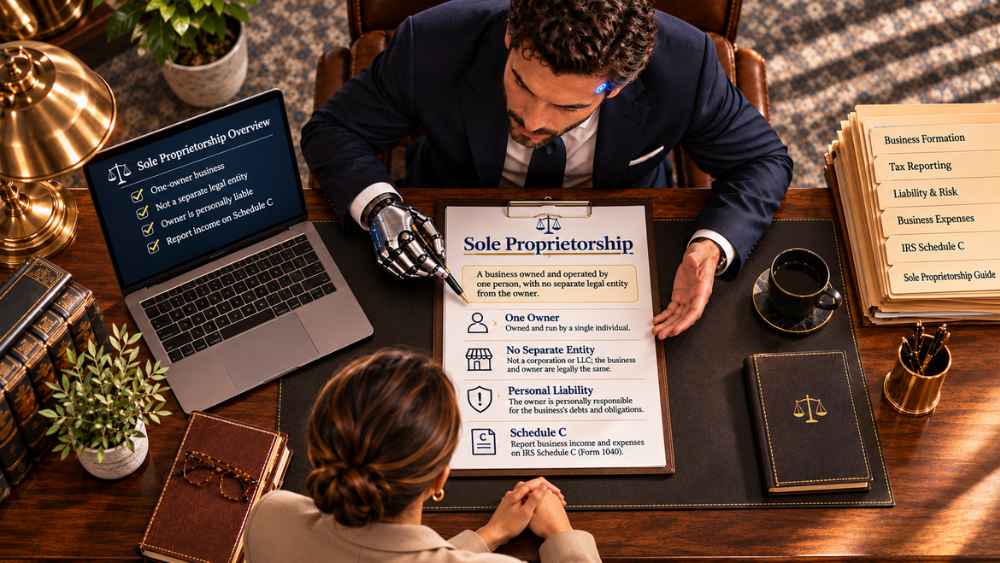
“The consultant operated as a Sole Proprietorship, reported business income on Schedule C, and remained personally liable for business obligations.”
What Is a Sole Proprietorship?
A Sole ProprietorshipBusiness FormationBusiness formation is the legal process of creating and organizing a business entity. It can involve choosing a structure, filing state documents, establishing governance, documenting ownership, obtaining tax identifiers, reviewing licenses, and planning...View definition is an unincorporated business owned by one individual.
It does not create a separate legal entity from the owner.
Therefore, business liabilities can become the owner’s personal liabilities. See IRS Publication 583.
Standard Sole Proprietorship — Sample Contract Language
Suppose one person begins a consulting business without forming an LLC or corporation.
How Is a Sole Proprietorship Formed?
A person generally becomes a sole proprietor by conducting business without forming another entity.
State or local registrations can still apply.
Therefore, easy formation does not mean no compliance duties.
Is the Owner Personally Liable?
Yes. The owner generally bears personal responsibility for business debts and obligations.
Business and personal assets lack entity-level separation.
Therefore, liability risk is a major structural disadvantage.
How Are Federal Taxes Reported?
A sole proprietor commonly reports business income and expenses on Schedule C with the individual return.
Self-employment tax can also apply.
Therefore, the business generally does not file a separate federal income-tax return.
Does a Sole Proprietor Need an EIN?
Some sole proprietors can use a Social Security number for federal tax purposes.
An EIN can be required for employees or other circumstances.
Therefore, federal identification needs depend on operations.
Can a Sole Proprietor Use a DBA?
Yes. A proprietor can use a trade nameTrade NameA trade name identifies a business or vocation. It can also function as a trademark when used to identify the source of particular goods or services.View definition or DBA if local lawOrdinanceAn Ordinance is a law enacted by a municipality or other authorized local government. Local authority depends on state constitutions, statutes, charters, home-rule rules, Dillon’s Rule principles, and preemption, while ordinances commonly govern...View definition permits and required filings occur.
A DBA does not create liability protection.
Therefore, branding and entity status are separate.
Can a Sole Proprietor Hire Employees?
Yes. The owner can hire employees and must comply with payroll, tax, wage, safety, and employment laws.
Employer registrations can apply.
Therefore, sole proprietorship does not mean solo work.
What Licenses Are Required?
Licenses and permits depend on industry, activity, location, and government level.
State and local rules can be extensive.
Therefore, entity simplicity does not eliminate licensing.
How Is Financing Different?
A sole proprietorship cannot sell corporate stock or partnership interests.
Lenders often rely heavily on the owner’s personal credit and guarantees.
Therefore, raising outside equityEquitable ReliefEquitable relief consists of nonmonetary or restorative remedies such as injunctions, specific performance, rescission, and reformation when legal remedies are inadequate.View definition can be harder.
What Happens if the Owner Dies?
The sole proprietorship does not have perpetual entity existence separate from the owner.
Assets and obligations pass through estate rules.
Therefore, succession planning can require a different structure.
Can a Sole Proprietorship Convert to an LLC or Corporation?
Yes. An owner can form a new entity and transfer business operations, contracts, assets, and registrations subject to law.
Tax and consent issues can arise.
Therefore, conversion should be planned rather than assumed automatic.
Sole Proprietorship Example
Suppose one person begins a consulting business without forming an LLC or corporation.
The person reports revenue on Schedule C and remains personally liable.
Therefore, the operation is generally a sole proprietorship.
Why Does a Sole Proprietorship Matter?
The structure is simple and flexible but offers no entity-level liability shield.
Taxes, licenses, contracts, and employment duties still apply.
Therefore, owners should compare simplicity against personal risk.