
Regulatory Compliance
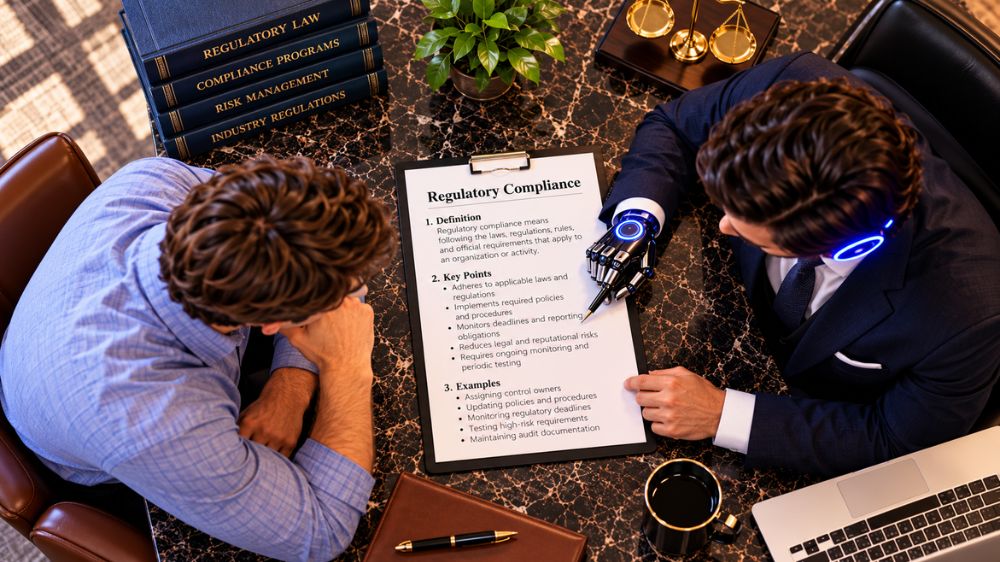
“The company strengthened its regulatory compliance program by assigning control owners, updating policies, monitoring deadlines, and testing high-risk requirements.”
What Is Regulatory Compliance?
Regulatory compliance means following the laws, regulationsPrimary AuthorityPrimary Authority is law issued by an institution with official power to create or state legal rules. Constitutions, statutes, regulations, court decisions, and court rules can be primary authority, while binding effect depends...View definition , rules, and official requirements that apply to an organization or activity. The exact duties depend on the industry and jurisdictionLegal DisputeA legal dispute is a disagreement or controversy involving claimed legal rights, duties, liabilities, property, or remedies. It can be resolved through negotiation, mediation, arbitration, administrative proceedings, litigation, or settlement depending on the...View definition .
Compliance can involve licensing, reporting, cybersecurity, privacy, safety, finance, employment, environmental rules, and many other subjects.
Cornell Law School’s Legal Information Institute explains that regulations are rules created and enforced by authorized government agencies. See Cornell LII’s regulation overview.
Standard Regulatory Compliance — Sample Contract Language
Suppose a payment company enters a new state. It must identify licensing, reporting, cybersecurity, privacy, and consumer-protection requirements.
What Does Regulatory Compliance Mean?
Regulatory compliance means identifying applicable legal requirements and operating within them. It also involves documenting and monitoring compliance over time.
For example, a financial company may face reporting and anti-money-laundering duties. A health care organization may face privacy and security requirements.
Therefore, compliance is usually an ongoing process rather than a one-time project.
Where Do Regulatory Requirements Come From?
Regulatory requirements can come from statutes, regulations, agency orders, licenses, permits, and other legally binding sources.
Congress and state legislatures enact statutes. Administrative agencies then issue many detailed regulations under delegated authorityActual AuthorityActual authority is authority a principal grants to an agent, either expressly or by implication, based on the principal-agent relationship.View definition .
Courts can also interpret those requirements.
What Is a Regulation?
A regulationRegulationA Regulation is a rule issued by a governmental authority, usually an administrative agency, under delegated legal authority. Federal regulations can arise through APA rulemaking, appear first in the Federal Register, and become...View definition is a rule created by an authorized government agency. Regulations often provide detailed requirements for implementing statutes.
For example, an agency can issue recordkeeping or reporting rules for a regulated industry.
Therefore, businesses often need to review statutes and agency regulations together.
What Is a Compliance Program?
A compliance programCompliance PolicyA compliance policy converts legal and ethical requirements into written operational expectations, responsibilities, controls, reporting, and accountability.View definition is an organized system for managing legal and regulatory obligations. It can include policies, training, monitoring, reporting, and corrective action.
For example, a company may assign owners to specific legal requirements. It may also track evidence showing that controls operate as intended.
Therefore, a compliance program turns legal requirements into business processes.
What Is a Compliance Policy?
A compliance policy explains an organization’s required conduct and procedures. It can address both legal rules and internal standards.
For example, a policy may explain gifts, data handling, record retention, or reporting obligations.
However, written policies are effective only when people follow them.
What Is a Compliance Risk Assessment?
A compliance risk assessment identifies legal obligations and evaluates the risk of noncompliance. It helps organizations prioritize resources.
For example, a company can rank risks by likelihood, legal impact, customer harm, and financial exposure.
Therefore, risk assessment can guide control design and monitoring.
What Are Compliance Controls?
Compliance controls are procedures designed to prevent, detect, or correct violations. They can be manual or automated.
Examples include approval workflows, access controls, transaction reviews, reconciliations, and required certifications.
In addition, controls should be tested periodically.
What Is Compliance Monitoring?
Compliance monitoringCompliance AuditA compliance audit is a structured test of whether laws, policies, contractual obligations, and internal controls are being followed in practice.View definition checks whether required controls and procedures continue to operate effectively.
For example, a privacy team may review whether customer deletion requests are completed within required deadlines.
Therefore, monitoring can identify problems before they become larger violations.
What Is a Compliance Audit?
A compliance audit is a structured review of whether an organization meets specified legal or regulatory requirements.
Auditors can review documents, systems, transactions, interviews, and control evidence.
However, a compliance audit differs from an ordinary financial statement audit.
What Is Regulatory Reporting?
Regulatory reportingRegTechRegTech is technology used to support regulatory compliance, monitoring, reporting, and risk management. Common applications include regulatory intelligence, AML and KYC, surveillance, reporting, workflow controls, and AI-assisted compliance, but regulated organizations remain responsible...View definition means submitting required information to a government agency or regulator.
For example, a regulated company may need to file periodic reports, incident notices, or financial information.
Therefore, accuracy and deadlines can be important compliance controls.
What Is Regulatory Recordkeeping?
Recordkeeping means retaining required documents and data for a specified period. Different laws use different retention rules.
For example, employment, tax, financial, and environmental rules can require different records.
Therefore, a retention scheduleData Retention PolicyA Data Retention Policy defines how long records and personal data are kept and when they are deleted, archived, or anonymized. Effective policies connect GDPR storage limitation, CCPA proportionality, legal holds, statutory records...View definition should reflect the organization’s actual legal obligations.
What Is a Regulatory Examination?
A regulatory examination is a review performed by a government regulator. The regulator can request records, interview personnel, and test compliance.
For example, financial regulators regularly examine certain licensed institutions.
Therefore, regulated organizations often maintain examination-readiness procedures.
What Is Regulatory Enforcement?
Regulatory enforcement occurs when an agency investigates or responds to suspected violations. Enforcement tools depend on the agency’s legal authorityLegal AuthorityLegal authority is a source supporting a proposition of law and can be primary or secondary, binding or persuasive depending on jurisdiction and hierarchy.View definition .
Possible outcomes can include warnings, corrective orders, civil penalties, license restrictions, or referrals.
However, not every compliance issue leads to formal enforcement.
What Is a Consent Order?
A consent orderConsent JudgmentA Consent Judgment is a court judgment entered after the parties agree to specified settlement terms. It combines negotiated resolution with judicial approval and can include payments, injunctions, compliance duties, reporting, enforcement mechanisms,...View definition is an agreement or order resolving certain regulatory allegations without full litigation. It can require specific corrective actions.
For example, a company may agree to improve controls and submit periodic reports.
Therefore, regulatory settlements can create continuing compliance obligations.
What Is a Compliance Officer?
A compliance officer helps manage an organization’s regulatory obligations. Duties can include advice, training, monitoring, investigations, and reporting.
However, compliance is not solely the compliance officer’s responsibility.
Business leaders and employees also have operational duties.
What Is Compliance Training?
Compliance training teaches employees about legal requirements and internal policies. Effective training should match the person’s actual role and risks.
For example, sales employees may need training on marketing rules. Engineers may need privacy or security training.
Therefore, one generic training course may not address every risk.
What Is a Compliance Hotline?
A compliance hotline or reporting channel allows employees and others to raise concerns. Organizations can use hotlines to identify potential misconduct early.
However, retaliationEqual Employment Opportunity Commission (EEOC)The Equal Employment Opportunity Commission (EEOC) is the federal agency that enforces major U.S. employment discrimination laws, investigates charges, promotes voluntary resolution, and may litigate violations.View definition protections can apply to certain reports.
Therefore, reporting systems should include appropriate anti-retaliation safeguards.
What Is Regulatory Change Management?
Regulatory change management is the process of tracking new legal requirements and updating business practices.
For example, a new privacy ruleGLBAGLBA is a federal financial privacy and security law requiring covered institutions to explain information-sharing practices, protect customer information, and comply with applicable privacy and safeguards rules.View definition may require changes to contracts, notices, or technical systems.
Therefore, compliance programs must adapt as laws change.
What Is Third-Party Compliance Risk?
Vendors, contractors, distributors, and other third parties can create regulatory risk. An organization can remain responsible for certain outsourced functions.
Therefore, compliance programs often include vendor due diligenceVendor Risk AssessmentA Vendor Risk Assessment evaluates legal, operational, financial, security, privacy, compliance, and resilience risks created by a supplier or service provider.View definition , contract requirements, monitoring, and termination rights.
What Is Due Diligence in Compliance?
Compliance due diligenceLetter of IntentA letter of intent, or LOI, is a document that outlines the main terms of a proposed transaction before the parties sign a final contract. An LOI may contain both binding and nonbinding...View definition evaluates legal and regulatory risks before a transaction or relationship.
For example, a buyer may review licenses, investigations, sanctions exposure, and regulatory violations before an acquisitionMergerA merger is a corporate transaction combining entities under statute so that one survives or a new entity results, with assets and liabilities transferring according to law.View definition .
In addition, companies can screen high-risk third parties before engagement.
What Is an Internal Investigation?
An internal investigationWorkplace InvestigationA workplace investigation is an employer's structured fact-finding process for evaluating allegations of harassment, discrimination, misconduct, or policy violations.View definition examines suspected misconduct or compliance failures. It can involve interviews, document reviewLegal Document ReviewLegal document review is the structured examination of documents for relevant facts, obligations, legal risk, privilege, evidence, and required action.View definition , and data analysis.
However, investigations should consider privilege, employment lawEmployment LawEmployment law is the body of federal, state, and local law that governs relationships between employers and employees. It covers wages, discrimination, harassment, leave, safety, benefits, contracts, employee classification, union rights, and termination.View definition , privacy, and evidence preservationEvidence PreservationEvidence preservation requires reasonable steps to protect potentially relevant information and physical evidence when litigation is pending or reasonably foreseeable.View definition .
Therefore, serious matters often require coordinated legal review.
What Happens After a Compliance Violation?
An organization should assess the facts, stop ongoing harm, and preserve relevant evidenceAdmissible EvidenceAdmissible Evidence is evidence a court permits the judge or jury to consider. In federal court, admissibility commonly depends on relevance, Rule 403 balancing, authentication, foundation, hearsay rules, privilege, witness competence, and other...View definition . It should also determine whether reporting or disclosure is required.
Next, the organization can remediate the root cause and strengthen controls.
Therefore, corrective action should address both the incident and future prevention.
Regulatory Compliance vs. Corporate Compliance
Regulatory compliance focuses on external legal and regulatory requirements. Corporate compliance can include those rules plus internal ethics and governance standards.
Therefore, corporate compliance programs can be broader than regulatory compliance alone.
Regulatory Compliance vs. Risk Management
Risk management addresses many business risks, including legal, financial, operational, and strategic risks. Regulatory compliance focuses on required legal standards.
However, the two functions often overlap.
Therefore, strong organizations coordinate compliance and enterprise risk management.
Regulatory Compliance Example
Suppose a payment company enters a new state. It must identify licensing, reporting, cybersecurity, privacy, and consumer-protection requirements.
The company assigns control owners and updates procedures. It also monitors deadlines and tests key controls.
Therefore, compliance connects legal requirements to everyday operations.
Why Does Regulatory Compliance Matter?
Regulatory compliance helps organizations avoid legal violations, penalties, license problems, and customer harm. It can also strengthen governance and business reliability.
However, compliance duties differ greatly by industry and jurisdiction.
The key questions are practical. Which rules apply? Who owns each requirement? What controls exist? How is compliance tested and documented?