
Ordinance
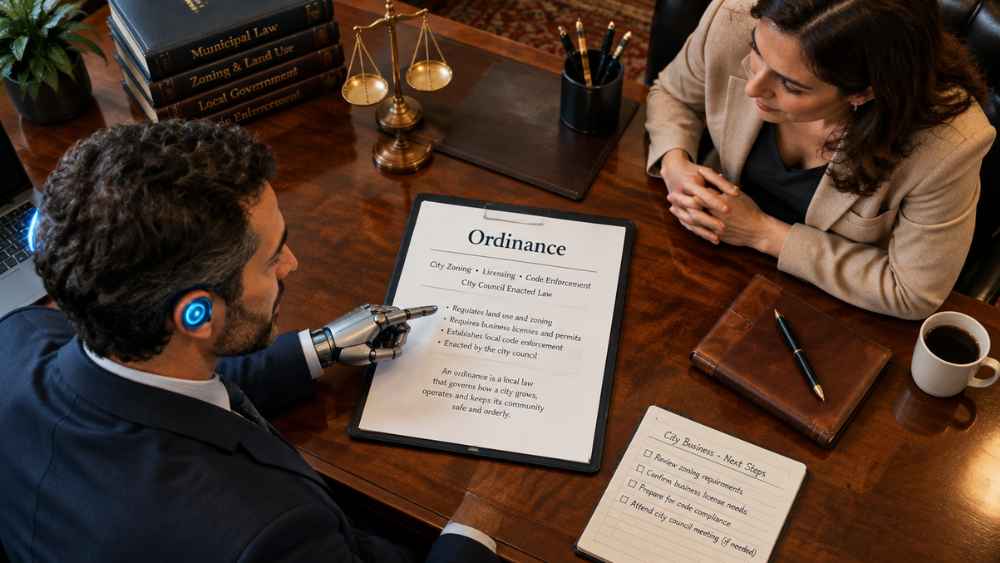
“The city adopted an Ordinance regulating zoning, business licensing, and local code enforcement within the municipality’s state-authorized powers.”
What Is an Ordinance?
An ordinance is a law enacted by a municipality or other authorized local government.
Cities and towns use ordinances to regulate local matters.
See Cornell LII’s ordinance overview.
Standard Ordinance — Sample Contract Language
Suppose a city adopts a zoning ordinance limiting industrial uses near residential districts.
What Is a Municipal Ordinance?
A municipal ordinance is local legislationStatutory LawStatutory law is written law enacted by a legislative body through the formal lawmaking process. Federal and state statutes can create rights, duties, prohibitions, causes of action, procedures, penalties, and remedies, and courts...View definition adopted by a city, town, village, or similar municipality.
Its authority ultimately depends on state law.
Therefore, local legislative power varies among states.
Ordinance vs. Statute
A statute usually comes from Congress or a state legislature.
An ordinance generally comes from a local legislative body.
Therefore, the level of government distinguishes the terms.
Ordinance vs. Regulation
An ordinance is usually enacted by a local legislative body.
A regulationRegulationA Regulation is a rule issued by a governmental authority, usually an administrative agency, under delegated legal authority. Federal regulations can arise through APA rulemaking, appear first in the Federal Register, and become...View definition is commonly issued by an administrative agency under delegated authorityActual AuthorityActual authority is authority a principal grants to an agent, either expressly or by implication, based on the principal-agent relationship.View definition .
Therefore, a city department can issue regulationsPrimary AuthorityPrimary Authority is law issued by an institution with official power to create or state legal rules. Constitutions, statutes, regulations, court decisions, and court rules can be primary authority, while binding effect depends...View definition implementing a city ordinance.
What Gives a City Power to Enact Ordinances?
State constitutions, statutes, charters, and home-rule provisions define municipal authority.
Local governments do not possess identical powers nationwide.
Therefore, state law should be checked first.
What Is Home Rule?
Home rule gives qualifying municipalities greater authority over local affairs under state law.
Its scope varies by state constitution and statute.
See Cornell LII’s home rule overview.
What Is Dillon’s Rule?
Dillon’s Rule limits local governments to powers expressly granted, fairly implied, or essential to granted purposes.
States apply the doctrine differently.
See Cornell LII’s Dillon’s Rule overview.
Home Rule vs. Dillon’s Rule
Home rule can provide broader local autonomy.
Dillon’s Rule emphasizes powers granted by the state.
Therefore, the same ordinance can be valid in one state and unauthorized in another.
What Subjects Can Ordinances Regulate?
Local governments commonly regulate matters with a strong local connection.
However, state preemption can remove local authority.
- Zoning and land use.
- Noise.
- Parking and traffic.
- Business licensing.
- Building and housing standards.
- Public health.
- Waste collection.
- Animals.
- Signs.
- Local taxes and fees where authorized.
- Public safety.
What Is a Zoning Ordinance?
A zoning ordinance regulates land uses, building locations, density, height, and related development matters.
It usually divides a municipality into zoning districts.
Therefore, property development often begins with ordinance review.
What Is a Noise Ordinance?
A noise ordinance limits sound by level, time, place, or activity.
Constitutional vagueness and enforcement issues can arise.
Therefore, clear standards matter.
What Is a Business Licensing Ordinance?
A licensing ordinance can require local businesses to obtain permits or licenses.
State law can limit local licensing authority.
Therefore, businesses should review both state and municipal requirements.
What Is a Building Ordinance?
Building ordinances regulate construction, safety, occupancy, and property maintenance.
They can adopt model codes by reference where authorized.
Therefore, local code text can incorporate external technical standards.
What Is a Parking Ordinance?
Parking ordinances regulate where, when, and how vehicles can park.
Violations can produce civil or administrative penalties.
Therefore, local traffic rules can differ block by block.
What Is a Public Health Ordinance?
Local governments can adopt health rules when state law grants authority.
Examples can involve sanitation, food service, or nuisance conditions.
Therefore, public-health authority should be traced to state law.
What Is a Municipal Code?
A municipal code organizes a city’s ordinances by subject.
Codification makes local laws easier to find and amend.
Therefore, current code text is usually more useful than isolated older enactments.
What Is Ordinance Codification?
Codification places enacted ordinances into a structured local code.
Editorial numbering can differ from the original ordinance number.
Therefore, legislative history can require both code and enactment research.
What Is an Ordinance Number?
Municipalities often assign each enacted ordinance a sequential number.
That number identifies the legislative enactment itself.
Therefore, ordinance numbers and municipal-code sections should not be confused.
How Is an Ordinance Enacted?
However, local procedures vary by charter and state law.
Common steps include introduction, public notice, readings, hearings, council vote, and executive approval.
Therefore, procedural validity can depend on local rules.
What Is a City Council?
A city council or similar governing body exercises local legislative authority.
Members vote on proposed ordinances.
Therefore, council records can show legislative history.
What Is a Public Hearing?
A public hearing gives residents and stakeholders an opportunity to comment on proposed local action.
Some ordinances require hearings by statute or charter.
Therefore, notice and hearing defects can affect validity.
When Does an Ordinance Take Effect?
Effective dates depend on state law, charter provisions, publication, and the ordinance itself.
Emergency ordinances can use special timing rules.
Therefore, adoption date and effective dateStatuteA Statute is a law enacted by a legislative body such as Congress or a state legislature. Federal statutes move from enactment through slip laws and the Statutes at Large, while general and...View definition can differ.
What Is an Emergency Ordinance?
An emergency ordinance uses special procedures for urgent local needs when authorized.
It can require supermajority voting or special findings.
Therefore, emergency power is usually limited by law.
Can an Ordinance Be Temporary?
Yes. A local law can include an expiration or sunset date.
Temporary emergency measures are common examples.
Therefore, researchers should check whether an ordinance remains in force.
What Is Preemption of an Ordinance?
Preemption occurs when higher law displaces local regulation.
State constitutions or statutes can expressly or impliedly preempt local ordinances.
See Cornell LII’s preemption overview.
What Is Express State Preemption?
A state statute can expressly prohibit local governments from regulating a subject.
The statutory wording controls the scope.
Therefore, local ordinances must yield within the preempted field.
What Is Conflict Preemption at the Local Level?
A local ordinance can fail when compliance conflicts with controlling state law.
State doctrine determines the precise test.
Therefore, local rules should be compared with statewide requirements.
Can Federal Law Preempt a Local Ordinance?
Yes. Federal law can displace state and local law under the Supremacy Clause.
Express, field, or conflict preemption principles can apply.
Therefore, local authority exists within both state and federal limits.
Can an Ordinance Violate the Constitution?
Yes. Local laws must comply with federal and state constitutional requirements.
Speech, due processEx ParteEx Parte refers to a one-sided request, proceeding, or communication. Courts permit ex parte relief only in authorized circumstances, while professional-conduct rules generally bar private communications with judges unless law or court order...View definition , equal protection, takings, and other rights can limit ordinances.
Therefore, municipal power is not unlimited.
What Is a Vague Ordinance?
A law can face a vagueness challenge when people cannot reasonably understand prohibited conduct.
Vague enforcement standards can also invite arbitrary enforcement.
Therefore, precisionTechnology Assisted ReviewTechnology Assisted Review (TAR) uses technology and human judgment to prioritize, classify, and review documents in legal discovery. TAR can include predictive coding, continuous active learning, statistical sampling, validation, and other analytics designed...View definition matters especially when penalties apply.
What Is an Overbroad Ordinance?
An ordinance can be overbroad when it restricts substantially more protected activityWhistleblower ProtectionWhistleblower Protection consists of federal and state laws prohibiting retaliation for specified reporting or protected conduct. There is no single universal statute, and protected activity, filing deadlines, causation standards, procedures, and remedies vary...View definition than lawful objectives justify.
The doctrine is especially important in First Amendment cases.
Therefore, speech regulations require careful tailoring.
Can Ordinances Regulate Signs?
Yes, subject to zoning authority and constitutional speech protections.
Content-based distinctions can receive demanding judicial scrutiny.
Therefore, sign codes should be drafted carefully.
Can Ordinances Regulate Short-Term Rentals?
Many municipalities regulate short-term rentals through zoning, licensing, occupancy, or tax rules.
State preemption can limit that authority.
Therefore, hosts should review current local and state law.
Can Ordinances Regulate Employment?
Some municipalities enact wage, scheduling, leave, or worker-protection ordinances when state law permits.
Other states preempt local employment regulation.
Therefore, local labor standards vary widely.
Can Ordinances Create Civil Penalties?
Yes, when authorized by state law.
Local governments can impose fines, fees, or administrative penalties.
Therefore, enforcement provisions should be read with the substantive rule.
Can Ordinance Violations Be Criminal?
Some municipal violations can be misdemeanors or other local offenses where state law permits.
Penalties remain subject to constitutional and statutory limits.
Therefore, local violations can have serious consequences.
How Are Ordinances Enforced?
Enforcement can involve police, code officersCorporation DefinitionA corporation is a legal entity created under state law that is separate from its owners, usually called shareholders. It can own property, enter contracts, incur debts, sue or be sued, and operate...View definition , licensing departments, inspectors, or administrative hearingAdministrative Law JudgeAn Administrative Law Judge is a federal adjudicator appointed under 5 U.S.C. § 3105 to preside over formal agency proceedings, receive evidence, rule on motions, and issue administrative decisions.View definition systems.
Procedures vary by subject.
Therefore, the enforcing agency often matters as much as the code text.
How Can an Ordinance Be Challenged?
A party can challenge authority, procedure, preemption, constitutionality, interpretation, or enforcement.
StandingJudicial ReviewJudicial review is the power of courts to examine government action and determine whether it complies with the Constitution, statutes, and other controlling law. It can apply to legislation, executive action, and administrative...View definition and ripeness requirements can apply.
Therefore, the correct court and remedyCause of ActionA Cause of Action is a recognized set of legal elements supporting a right to judicial relief. Its elements can arise from statutes, constitutions, regulations, or case law, and the claimant generally must...View definition depend on the dispute.
Can a Court Invalidate an Ordinance?
Yes. Courts can hold an ordinance unlawful under controlling state or federal law.
They can also interpret or sever provisions where doctrine allows.
Therefore, enactment does not guarantee validity.
How Do You Research an Ordinance?
Start with the current municipal code and official local government website.
Then check amendments, effective dates, maps, administrative rules, and state enabling law.
Therefore, unofficial code copies should be verified.
Ordinance Example
Suppose a city adopts a zoning ordinance limiting industrial uses near residential districts.
A developer challenges the restriction under state enabling law and constitutional principles.
The dispute turns on local authority, procedure, and higher-law limits.
Why Does an Ordinance Matter?
Ordinances govern many daily activities involving property, business, transportation, health, and public safety.
However, local power depends on state authorization and preemption rules.
Therefore, ordinance analysis must connect local text with state and federal law.