
Business Judgment Rule
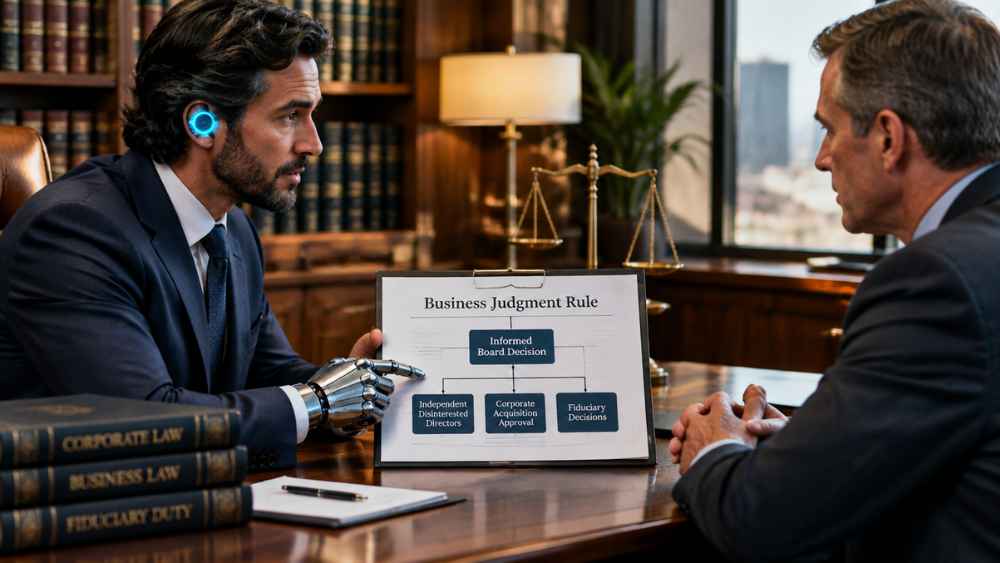
“The directors invoked the Business Judgment Rule after approving the acquisition through an informed process led by disinterested directors and outside advisers.”
What Is the Business Judgment Rule?
The Business Judgment RuleBoard of DirectorsA board of directors is the governing body of a corporation responsible for major oversight and decisions, including management supervision, strategic matters, significant transactions, and fiduciary governance.View definition is a judicial presumptionPresumptionA presumption is a legal rule that gives specified facts an evidentiary consequence, often shifting the burden of producing evidence without shifting the ultimate burden of persuasion.View definition protecting qualifying corporate board decisions from second-guessing.
Its exact formulation varies by state.
Therefore, lawyers should start with the governing corporate law. See Cornell LII’s Business Judgment Rule overview.
Standard Business Judgment Rule — Sample Contract Language
Suppose disinterested directors review forecasts, consult advisers, debate alternatives, and approve a risky expansion.
What Does the Rule Protect?
The rule generally protects business decisions made by directors who act on an informed, disinterested, and good-faith basis.
Courts usually avoid replacing board judgmentCivil LawsuitA civil lawsuit is a noncriminal court action in which a plaintiff seeks a legal remedy from a defendant. The process can include jurisdiction, pleadings, service, discovery, motions, settlement, trial, judgment, enforcement, and...View definition with their own business preferences.
Therefore, the doctrine protects decision-making discretion rather than perfect outcomes.
Why Does the Business Judgment Rule Exist?
Corporate directors must make decisions under uncertainty.
The rule encourages reasonable risk-taking without imposing liability whenever a decision later performs poorly.
Therefore, hindsight alone usually does not establish fiduciary breach.
Is the Rule a Presumption?
In many jurisdictions, including Delaware, the doctrine operates as a presumption favoring board decisions.
A plaintiffCivil CourtCivil court is a general term for a court handling noncriminal disputes involving people, businesses, organizations, or government entities. Civil cases can involve contracts, injuries, property, employment, civil rights, and other disputes and...View definition generally must plead and prove facts rebutting that presumption.
Therefore, the initial burden can be important in fiduciary litigationLegal DisputeA legal dispute is a disagreement or controversy involving claimed legal rights, duties, liabilities, property, or remedies. It can be resolved through negotiation, mediation, arbitration, administrative proceedings, litigation, or settlement depending on the...View definition .
What Is Delaware’s Board Authority?
Delaware law places management of the corporation’s business and affairs under the board’s direction.
That statutory allocation supports the board-centered governance model.
Therefore, judicial reviewAdministrative CourtAdministrative Court is a broad term for administrative tribunals that adjudicate disputes within agency systems. Federal administrative adjudication can involve ALJs, agency review, exhaustion requirements, and later judicial review under the Administrative Procedure...View definition begins from board authority. See 8 Del. C. § 141(a).
What Does “Informed” Mean?
Directors should gather and consider information reasonably available before making important decisions.
The required process depends on the transaction’s importance and circumstances.
Therefore, board minutesCorporate ResolutionA Corporate Resolution formally records an action approved by a corporation's board or stockholders. Resolutions commonly authorize financing, contracts, equity actions, officer appointments, bank accounts, transactions, and delegated signature authority, and they should...View definition , materials, experts, and deliberation can matter.
What Is Director Disinterest?
A disinterested director lacks a material personal financial interest in the challenged decision.
The analysis can also consider benefits not shared with stockholdersCorporation DefinitionA corporation is a legal entity created under state law that is separate from its owners, usually called shareholders. It can own property, enter contracts, incur debts, sue or be sued, and operate...View definition generally.
Therefore, personal benefit can undermine ordinary business-judgment review.
What Is Director Independence?
Independence asks whether a director can decide based on corporate interests rather than domination or material relationships.
Personal, financial, or professional ties can matter.
Therefore, independence is a fact-specific inquiry.
What Is Good Faith?
Good faithGood FaithGood Faith is a context-dependent legal concept involving honesty, fair dealing, and faithful performance. Contract law, the UCC, insurance, corporate fiduciary law, and bankruptcy use related but distinct good-faith standards.View definition generally requires honest exercise of corporate authority for proper purposes.
Intentional misconduct or knowing disregard of duty can defeat ordinary deference.
Therefore, good faith differs from simple business error.
Does a Bad Outcome Rebut the Rule?
No. A transaction can lose money while still receiving business-judgment protection.
Courts generally examine process, conflicts, and fiduciary conduct rather than results alone.
Therefore, failure does not automatically imply liability.
What Is Gross Negligence?
Delaware fiduciary law can use gross negligenceNegligence DefinitionNegligence is the failure to use the level of care that a reasonable person would use under similar circumstances. A negligence claim generally focuses on duty, breach, causation, and legally recognized harm.View definition when evaluating whether directors satisfied the duty of careBreach of DutyA breach of duty occurs when a person or entity fails to meet a legal duty owed to another person. In negligence cases, breach is usually one element alongside duty, causation, and damages,...View definition .
The standard is more demanding than ordinary negligence.
Therefore, minor process imperfections do not necessarily rebut the rule.
How Can a Plaintiff Rebut the Presumption?
A plaintiff can attack disinterest, independence, good faith, informed decision-making, or other applicable fiduciary requirements.
The precise test depends on jurisdiction and claim.
Therefore, allegations should focus on recognized doctrinal defects.
What Happens If the Rule Is Rebutted?
The court can apply a more demanding standard of reviewCourt of AppealsA court of appeals is a court that reviews decisions from lower courts. Federal courts of appeals usually examine the existing record for legal error rather than conducting a new trial or hearing...View definition when ordinary business-judgment deference does not apply.
For conflicted transactions, entire-fairness review can become relevant in Delaware.
Therefore, rebutting the presumption can shift both scrutiny and litigation risk.
What Is Entire Fairness?
Entire fairness is a demanding Delaware standard focusing on fair dealing and fair price.
It commonly appears in conflicted fiduciary transactions.
Therefore, it differs sharply from deferential business-judgment review.
What Is Enhanced Scrutiny?
Delaware courts use enhanced scrutiny in some takeoverAcquisitionAn acquisition is a transaction in which a buyer obtains ownership or control of a business, its equity, or selected assets through a negotiated M&A structure.View definition , defensive-measure, and change-of-control contexts.
The exact test depends on the transaction.
Therefore, the business judgment rule is not the only fiduciary standard.
Does the Rule Protect Interested Transactions?
Not automatically. Interested transactions can require special statutory or fiduciary analysis.
Approval by disinterested directors or stockholders can change the standard or available relief.
Therefore, conflict procedures should be designed before board approval.
What Does Delaware Section 144 Do?
Current Delaware Section 144 provides statutory protections for specified interested-director, officer, and controlling-stockholder transactions.
Its 2025 amendments created detailed approval and fairness pathways.
Therefore, current Delaware conflict analysis should use the amended statuteStatutory LawStatutory law is written law enacted by a legislative body through the formal lawmaking process. Federal and state statutes can create rights, duties, prohibitions, causes of action, procedures, penalties, and remedies, and courts...View definition . See 8 Del. C. § 144.
What Is a Disinterested Committee?
A disinterested committee can review, negotiate, reject, or approve a transaction without participation by interested decision-makers.
Current Delaware statutesPrimary AuthorityPrimary Authority is law issued by an institution with official power to create or state legal rules. Constitutions, statutes, regulations, court decisions, and court rules can be primary authority, while binding effect depends...View definition impose detailed requirements for some transactions.
Therefore, committee composition and mandate matter.
What Is Stockholder Ratification?
StockholderShareholderA shareholder is a person or entity that owns stock in a corporation. Rights can include voting, distributions, information access, and litigation rights depending on the shares and governing law.View definition approval can affect fiduciary review when the vote satisfies applicable disclosure, coercion, and disinterest requirements.
The effect depends on the transaction and law.
Therefore, not every shareholder vote restores business-judgment review.
What Is a Controlling Stockholder?
A controlling stockholder can possess majority voting power or equivalent managerial power under applicable Delaware law.
Current Section 144 includes statutory tests for controlling status.
Therefore, controllerData SubjectA Data Subject is an identified or identifiable natural person to whom personal data relates under the GDPR. Data subjects can be customers, employees, applicants, users, children, or other individuals, and they receive...View definition transactions require specialized analysis.
Can Officers Receive Similar Protection?
Business-judgment concepts can inform review of officer decisions, but fiduciary doctrine and statutory protections differ.
Officer duties should be analyzed separately.
Therefore, director standards should not be copied automatically.
What Is Duty of Care?
The duty of care concerns the process directors use to become informed and deliberate.
Corporate charters can limit monetary liability for some duty-of-care claims where statutes permit.
Therefore, fiduciary breach and personal damagesLegal RemedyA legal remedy is the relief a court or other authorized tribunal can provide after a legal right has been violated. Remedies can include damages, injunctions, restitution, specific performance, rescission, declarations, and other...View definition exposure can differ.
What Is Duty of Loyalty?
The duty of loyaltyFiduciary DutyA fiduciary duty is a legal duty that requires a trusted person or entity to protect another party’s interests. It often includes duties of loyalty, care, good faith, and proper handling of conflicts....View definition requires directors to act without improper self-interest or divided loyalty.
Conflicts, bad faith, and corporate-opportunity issues can implicate loyalty.
Therefore, loyalty concerns can overcome ordinary deference.
What Is an Exculpation Clause?
An exculpation clause can limit monetary liability for specified fiduciary breaches when corporate law permits it.
It does not erase the underlying fiduciary duty.
Therefore, liability protection and standard of conduct are distinct.
Does the Rule Apply to Failure of Oversight?
Oversight claims usually focus on board monitoring systems or conscious disregard of known problems.
They do not fit neatly within ordinary review of a single affirmative business decision.
Therefore, oversight claims require specialized fiduciary analysis.
Does the Rule Apply to No-Action Decisions?
Sometimes. A board’s decision not to pursue a corporate opportunity or claim can receive deference when properly informed and disinterested.
However, conflicts can change the analysis.
Therefore, omissions and refusals can still involve business judgment.
How Does the Rule Affect Derivative Litigation?
Boards generally control corporate claims because directors manage corporate affairs.
Derivative plaintiffs must often address demand or demand futilityShareholder Derivative SuitA Shareholder Derivative Suit is litigation brought by a shareholder to enforce a claim belonging to the corporation. Federal Rule 23.1 imposes special pleading requirements, while state corporate law governs substantive issues such...View definition before litigating on the corporation’s behalf.
Therefore, business judgment and derivative procedure often intersect.
What Is a Litigation Demand?
A litigation demand asks the board to cause the corporation to pursue specified claims.
A board can investigate and decide whether corporate litigationCommercial LitigationCommercial litigation is court-based dispute resolution involving business contracts, transactions, ownership, financing, competition, and other commercial relationships.View definition is in the company’s interests.
Therefore, that decision can receive judicial deference when proper standards are met.
Can a Board Use Experts?
Yes. Directors can rely on lawyers, accountants, bankers, and other experts when reliance is reasonable.
State statutes often protect good-faith reliance on qualified information.
Therefore, expert advice can strengthen decision process.
Why Do Board Minutes Matter?
Minutes can document materials reviewed, conflicts disclosed, questions asked, and approvals given.
They do not need to be transcripts.
Therefore, accurate minutes can support evidence of informed process.
Does the Rule Apply to LLCs?
LLC fiduciary rules depend heavily on the governing state statute and operating agreementLimited Liability CompanyA limited liability company, or LLC, is a business entity created under state law whose owners are called members. It generally separates the company’s legal obligations from the members’ personal assets while allowing...View definition .
Delaware LLC agreements can modify many fiduciary dutiesGeneral PartnershipA General Partnership is a business relationship in which two or more persons carry on a business as co-owners. It can arise without formal entity filing, while state law governs authority, fiduciary duties,...View definition .
Therefore, corporate business-judgment doctrine should not be imported automatically.
Does the Rule Apply to Nonprofits?
Nonprofit directors can receive similar judicial deference under applicable nonprofit and fiduciary law.
The governing statutes and purposes differ from for-profit corporations.
Therefore, entity type matters.
Can the Rule Be Waived?
The business judgment rule is a judicial standard rather than a simple contractual clause.
Parties cannot generally contract around mandatory corporate-law limits.
Therefore, governance documents should be analyzed with state law.
Business Judgment Rule Example
Suppose disinterested directors review forecasts, consult advisers, debate alternatives, and approve a risky expansion.
The project later loses money.
Therefore, poor results alone would not ordinarily defeat business-judgment protection.
Why Does the Business Judgment Rule Matter?
The rule preserves board authority while leaving room to challenge conflicts, bad faith, and deficient process.
It also shapes pleadingPleadingA pleading is a formal court document stating a party’s claims, defenses, or responses in a civil case. Federal Rules 7 and 8 identify permitted pleadings and govern claims, admissions, denials, affirmative defenses,...View definition burdens and standards of review.
Therefore, directors should focus on informed, independent, well-documented decision-making.