
Civil Court
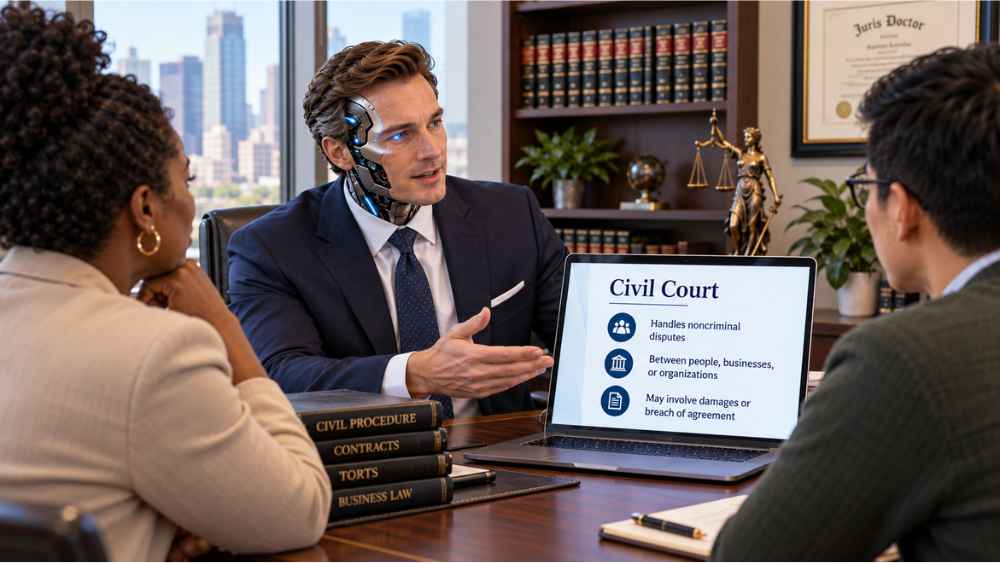
“The customer filed a civil court case seeking damages after the contractor allegedly breached the agreement and failed to correct defective work.”
What Is Civil Court?
Civil court is a general term for a court handling noncriminal disputes between people, businesses, organizations, or government entities.
Civil casesCivil DivisionA Civil Division is a court unit handling noncriminal disputes, with jurisdiction and procedures that vary by court system and locality.View definition can involve contracts, injuries, property, employment, family matters, civil rights, and many other legal issues.
The exact court name and jurisdictionLegal DisputeA legal dispute is a disagreement or controversy involving claimed legal rights, duties, liabilities, property, or remedies. It can be resolved through negotiation, mediation, arbitration, administrative proceedings, litigation, or settlement depending on the...View definition depend on the federal or state courtState CourtA state court is a court established under a state constitution and state law. State courts hear the vast majority of U.S. civil and criminal cases, and their structures, names, procedural rules, and...View definition system involved.
Standard Civil Court — Sample Contract Language
The case can involve service, discoveryCivil LawsuitA civil lawsuit is a noncriminal court action in which a plaintiff seeks a legal remedy from a defendant. The process can include jurisdiction, pleadings, service, discovery, motions, settlement, trial, judgment, enforcement, and...View definition , motions, settlement, trialLawsuitA lawsuit is a legal dispute brought before a court for a decision or remedy. Civil lawsuits can involve pleadings, service, discovery, motions, settlement, trial, judgment, and possible appeal.View definition , and judgment.
What Does a Civil Court Do?
A civil court resolves legal disputes and can award authorized remedies.
For example, a court can award damagesLegal RemedyA legal remedy is the relief a court or other authorized tribunal can provide after a legal right has been violated. Remedies can include damages, injunctions, restitution, specific performance, rescission, declarations, and other...View definition after finding a breach of contractBreach of ContractA breach of contract occurs when a party fails to perform an obligation required by an enforceable agreement. Examples include nonpayment, missed deadlines, defective performance, refusal to perform, or violation of another contract...View definition .
It can also issue injunctions or declarations when legal requirements are met.
Is Civil Court Different From Criminal Court?
Yes. Civil cases generally involve private rights and remedies.
Criminal cases involve prosecutions brought by the government for alleged crimes.
Therefore, civil and criminal cases use different procedures, burdens, and remedies.
Who Are the Parties in a Civil Case?
The person or entity bringing a civil claim is usually called the plaintiff.
The person or entity defending against the claim is usually called the defendant.
However, other proceedings can use terms such as petitionerPlaintiffA Plaintiff is the party who initiates a civil lawsuit and asks a court for legal relief. The plaintiff generally files the complaint, establishes standing and jurisdiction, serves the defendant, proves the elements...View definition and respondentDefendantA Defendant is the person or entity against whom a civil claim or criminal charge is brought. Civil defendants respond to complaints, preserve defenses, challenge jurisdiction, use discovery, assert counterclaims, seek dismissal or...View definition .
What Types of Cases Go to Civil Court?
Civil courts hear many kinds of disputes.
- Contract disputes.
- Personal injury claims.
- Property disputes.
- Employment cases.
- Consumer claims.
- Civil rights cases.
- Business disputes.
- Landlord-tenant matters.
- Family-law proceedings.
- Probate-related matters.
However, specialized courts can handle some categories.
Are Civil Cases Heard in State or Federal Court?
Both state and federal courts hear civil cases.
Most civil cases are filed in state courts.
Federal courts hear civil cases only when a federal jurisdictional basis exists.
See the U.S. Courts comparison of federal and state courts.
What Is Civil Jurisdiction?
Jurisdiction is the court’s legal authorityLegal AuthorityLegal authority is a source supporting a proposition of law and can be primary or secondary, binding or persuasive depending on jurisdiction and hierarchy.View definition to hear and decide a case.
A civil court needs subject-matter jurisdiction and appropriate authority over the parties.
Therefore, filing in the wrong court can lead to dismissal or transfer.
What Is Subject-Matter Jurisdiction?
Subject-matter jurisdiction concerns the types of cases a court may hear.
For example, a small claims courtSmall Claims CourtSmall claims court is a state court process for resolving lower-value civil disputes through simplified procedures. Claim limits, attorney rules, appeal rights, and available remedies vary by state and sometimes by the type...View definition can have monetary and subject limits.
Federal courts also have limited subject-matter jurisdiction.
What Is Personal Jurisdiction?
Personal jurisdictionMotion to DismissA motion to dismiss asks a court to end all or part of a case because of a legal or procedural defect. In federal civil cases, Rule 12 lists grounds including jurisdiction, venue,...View definition concerns the court’s authority over a defendant.
It can depend on residence, contacts with the forum, consent, or other legal bases.
Therefore, jurisdiction is separate from whether the claim is legally valid.
What Is Venue?
Venue concerns the proper geographic location for a case within a court system.
For example, venue can depend on where defendants reside or events occurred.
Therefore, venue and jurisdiction answerCivil LitigationCivil Litigation is the court process for resolving noncriminal disputes through pleadings, motions, discovery, settlement, trial, judgment, and possible appeal. Federal civil litigation follows the Federal Rules of Civil Procedure, while state systems...View definition different questions.
How Does a Civil Lawsuit Start?
A civil lawsuit usually starts when the plaintiff files a complaint or petition.
The filing identifies the parties, claims, factual allegations, and requested relief.
Next, the defendant generally must receive legally sufficient service.
What Is a Civil Complaint?
A complaint is a pleadingPleadingA pleading is a formal court document stating a party’s claims, defenses, or responses in a civil case. Federal Rules 7 and 8 identify permitted pleadings and govern claims, admissions, denials, affirmative defenses,...View definition that states the plaintiff’s claims.
It identifies the legal basis for relief and the facts supporting the case.
Therefore, the complaint frames the dispute at the beginning.
What Is Service of Process?
Service of processAffidavit of ServiceAn affidavit of service is a sworn statement documenting how and when legal papers were served and can provide proof of notice for jurisdiction, deadlines, and court procedure.View definition formally delivers required court papers to a defendant.
Proper service gives notice and supports the court’s authority to proceed.
However, service rules vary by court and case type.
What Is an Answer?
An answer is a defendant’s responsive pleadingAnswer to ComplaintAn Answer to Complaint is the defendant’s formal pleading responding to a civil complaint. It typically admits or denies allegations, states insufficient knowledge where appropriate, asserts defenses, and can include counterclaims, jury demands,...View definition to a civil complaintComplaintA Complaint is the pleading that ordinarily begins a civil lawsuit and states the plaintiff’s claims for relief. Federal complaints generally identify jurisdiction, factual allegations, legal claims, and requested relief while complying with...View definition .
It can admit or deny allegations and raise defenses.
Therefore, the answer helps define disputed issues.
What Is a Motion to Dismiss?
A motion to dismiss asks the court to end claims for a legal or procedural reason.
For example, a defendant can argue that the complaint does not state a legally sufficient claim.
However, dismissal rules differ across court systems.
What Is Discovery?
Discovery is the pretrial process for obtaining relevant information and evidence.
It can include document requests, interrogatoriesDiscovery DefinitionDiscovery is the pretrial process for exchanging information and evidence in a lawsuit. Common discovery tools include document requests, interrogatories, requests for admission, depositions, subpoenas, and expert disclosures.View definition , depositions, admissions, and subpoenas.
Therefore, discovery helps parties prepare for motions, settlement, and trial.
What Is a Deposition?
A deposition is sworn testimonySworn TestimonySworn testimony is evidence given by a witness under oath or affirmation in a formal legal proceeding.View definition taken through questions and answers before trial.
Lawyers can use depositions to learn facts, preserve testimony, and evaluate witnesses.
Therefore, depositions can be important in complex civil cases.
What Is Summary Judgment?
Summary judgment can resolve a civil claim without trial when no genuine material factual dispute requires a fact-finder.
The governing standard depends on the court system.
Therefore, evidence collected during discovery can become central.
Can Civil Cases Settle?
Yes. Parties can settle a civil case before or during litigation.
A settlement can include payment, releases, confidentialityEmployment ContractAn employment contract is an agreement defining terms of an employer-employee relationship. It can cover duties, compensation, benefits, equity, confidentiality, intellectual property, restrictive covenants, termination, severance, and dispute procedures while remaining subject to...View definition , or other negotiated terms.
Therefore, many civil disputes end without trial.
What Is Mediation?
MediationAlternative Dispute ResolutionAlternative Dispute Resolution, or ADR, includes negotiation, mediation, arbitration, settlement conferences, and other processes used outside ordinary trial adjudication. Each method differs in neutrality, confidentiality, party control, binding effect, cost, and review.View definition is a structured negotiation assisted by a neutral mediatorMediationMediation is a structured negotiation process where a neutral mediator helps parties try to resolve a dispute. The mediator generally does not impose a decision, so a settlement usually occurs only when the...View definition .
The mediator generally does not impose a decision.
Therefore, settlement occurs only if the parties agree.
What Is Arbitration?
Arbitration is a private dispute process where an arbitratorArbitrationArbitration is a private dispute process where a neutral arbitrator decides a legal dispute and usually issues an award. Binding arbitration often provides more flexible procedures but much narrower judicial review than ordinary...View definition decides the dispute.
Some civil disputes must be arbitrated because of a valid agreement.
Therefore, not every civil dispute reaches a courthouse.
What Happens at a Civil Trial?
A civil trial presents evidence to a judgeJudgeA Judge is a judicial officer who presides over legal proceedings, applies law, manages procedure, rules on motions and evidence, and issues orders or judgments. Trial, appellate, Article III, magistrate, bankruptcy, and state...View definition or juryJuryA Jury is a group of citizens selected to perform a legal factfinding or charging function. Petit juries decide facts and return verdicts in trials, while grand juries determine whether probable cause supports...View definition .
The plaintiff and defendant can call witnesses and offerOffer and AcceptanceOffer and Acceptance describes how parties manifest mutual assent to a contract. A valid offer gives another party power to accept, while acceptance must objectively communicate assent through an authorized method, subject to...View definition admissible exhibits.
Then the fact-finder applies the governing burden of proofBurden of ProductionThe burden of production requires a party to produce enough evidence on an issue for the issue to proceed to the factfinder rather than be resolved as a matter of law.View definition .
What Is the Burden of Proof in Civil Court?
The usual civil standard is preponderance of the evidenceBurden of ProofThe burden of proof is the legal responsibility to prove a fact or claim to the required level of certainty. It includes questions about who must produce evidence and how strongly the evidence...View definition .
This generally asks whether a fact is more likely true than not.
However, some civil issues use a higher clear-and-convincing standard.
Can Civil Cases Have a Jury?
Yes, in many civil cases where a jury right exists and is properly invoked.
Other civil cases are decided by a judge.
Therefore, the claim and procedural rules determine the fact-finder.
What Is a Bench Trial?
A bench trialTrial CourtA Trial Court is a court where parties present evidence, establish facts, and obtain an initial judgment or verdict. Federal district courts are the primary federal trial courts, while state systems use varied...View definition is a trial decided by a judge rather than a jury.
The judge determines facts and applies the law.
Therefore, benchBenchThe bench is the judge's raised courtroom desk and is also a common legal term for a judge, group of judges, or the judiciary.View definition trials differ from jury trials mainly in who decides factual disputes.
What Remedies Can Civil Court Award?
Civil remedies can include damages, injunctions, declarations, restitution, or specific performance.
The available remedyCause of ActionA Cause of Action is a recognized set of legal elements supporting a right to judicial relief. Its elements can arise from statutes, constitutions, regulations, or case law, and the claimant generally must...View definition depends on the claim and governing lawBoilerplate ClauseA boilerplate clause is standardized contract language addressing recurring legal mechanics such as notice, assignment, governing law, waiver, severability, and integration.View definition .
Therefore, winning liability does not automatically produce every requested remedy.
What Is a Civil Judgment?
A civil judgment is the court’s formal decision resolving claims or awarding relief.
For example, a money judgmentJudgmentA Judgment is a court's formal determination of rights and obligations in a civil action. Federal Rules 54 and 58 govern important aspects of judgment and entry, while final judgments affect appeals, post-trial...View definition can require a defendant to pay damages.
Therefore, judgment creates enforceable legal consequences.
How Is a Civil Judgment Enforced?
Judgment enforcementWrit of ExecutionA Writ of Execution is court process used to enforce a money judgment against nonexempt property. Federal Rule 69 makes execution the ordinary federal enforcement method while generally incorporating state execution procedure, and...View definition procedures vary by jurisdiction.
Possible tools can include liens, garnishment, levies, or other authorized collection methods.
However, exemptions and procedural protections can apply.
Can a Civil Judgment Be Appealed?
Many final civil judgments can be appealed.
The appellate courtCourt of AppealsA court of appeals is a court that reviews decisions from lower courts. Federal courts of appeals usually examine the existing record for legal error rather than conducting a new trial or hearing...View definition reviews alleged legal errors under applicable standards.
Therefore, an appeal is not simply a new trial.
What Is Small Claims Court?
Small claims court is a simplified civil forum for disputes below specified monetary limits.
Rules and limits vary greatly by state.
Therefore, local courtMunicipal CourtA Municipal Court is a local court whose authority is defined by state law, city law, or both. Many municipal courts have limited jurisdiction over traffic, misdemeanors, ordinances, protective orders, or smaller civil...View definition information should be checked before filing.
Civil Court vs. State Court
Civil court describes the type of dispute.
State court describes the government court system hearing the case.
Therefore, a state court can hear both civil and criminal matters.
Civil Court vs. Federal Court
Federal courts can hear civil cases when federal jurisdiction exists.
State courts handle the vast majority of civil litigation.
Therefore, “civil court” is not synonymous with “state court.”
Civil Court Example
Suppose a customer sues a contractor for defective work.
The customer files a complaint seeking damages.
The case can involve service, discovery, motions, settlement, trial, and judgment.
Why Does Civil Court Matter?
Civil courts provide a formal process for resolving noncriminal legal disputes.
Therefore, they protect private rights through enforceable remedies.
The key questions are practical. Which court has jurisdiction? What claim exists? What evidence supports it? Which remedy is available?