
Jury
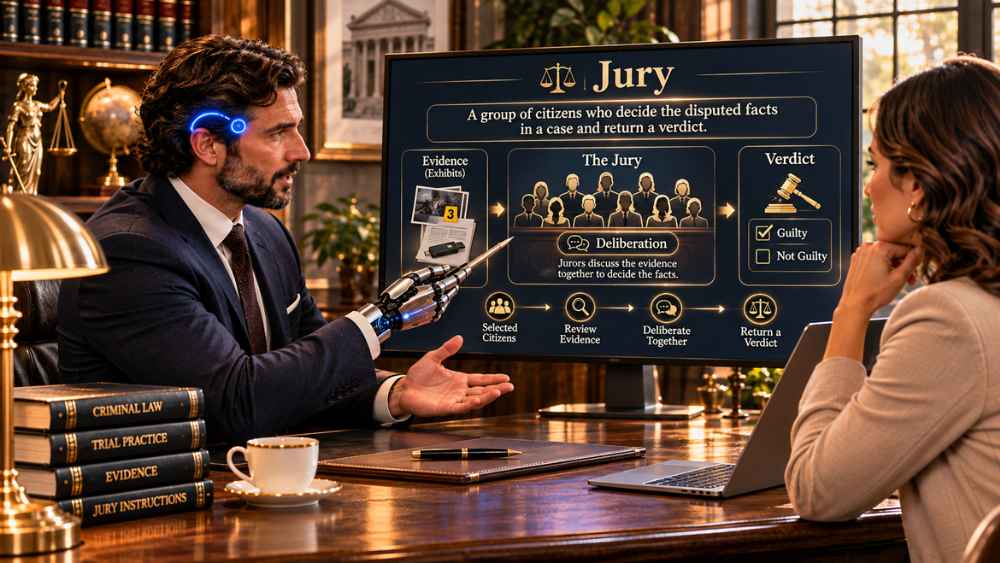
“The Jury heard testimony, reviewed admitted exhibits, followed the judge’s instructions, and returned a verdict on the disputed facts.”
What Is a Jury?
A Jury is a group of citizens selected to decide facts or perform another legally assigned function in court.
TrialLawsuitA lawsuit is a legal dispute brought before a court for a decision or remedy. Civil lawsuits can involve pleadings, service, discovery, motions, settlement, trial, judgment, and possible appeal.View definition juries and grand juries serve different purposes.
Therefore, jury roles depend on the proceeding. See U.S. Courts Jury Service.
Standard Jury — Sample Contract Language
Suppose a civil caseCivil CourtCivil court is a general term for a court handling noncriminal disputes involving people, businesses, organizations, or government entities. Civil cases can involve contracts, injuries, property, employment, civil rights, and other disputes and...View definition reaches trial after disputed negligenceBreach of DutyA breach of duty occurs when a person or entity fails to meet a legal duty owed to another person. In negligence cases, breach is usually one element alongside duty, causation, and damages,...View definition facts remain.
What Is a Petit Jury?
A petit jury, also called a trial jury, hears evidence and returns a verdict.
It can serve in civil or criminal trials.
Therefore, petit jurors are factfinders.
What Is a Grand Jury?
A federal grand juryGrand JuryA grand jury is a group of citizens that reviews prosecutor-presented evidence and determines whether probable cause exists to return a criminal indictment.View definition considers evidence presented by prosecutors and decides whether probable cause supports criminal charges.
It does not determine guilt at trial.
Therefore, grand juries and trial juries perform different functions.
What Does a Civil Jury Decide?
A civil jury determines disputed facts under instructions from the judgeJudgeA Judge is a judicial officer who presides over legal proceedings, applies law, manages procedure, rules on motions and evidence, and issues orders or judgments. Trial, appellate, Article III, magistrate, bankruptcy, and state...View definition .
The applicable burden is often preponderance of the evidenceBurden of ProofThe burden of proof is the legal responsibility to prove a fact or claim to the required level of certainty. It includes questions about who must produce evidence and how strongly the evidence...View definition .
Therefore, the jury applies law supplied by the court.
What Does a Criminal Jury Decide?
A criminal trial jury decides whether the prosecution proved guilt beyond a reasonable doubt.
The judge instructs jurors on legal elementsPrima FaciePrima Facie means that evidence is sufficient on its face to establish a claim, fact, or legal issue unless rebutted. The required showing depends on the cause of action, statute, or procedural doctrine.View definition .
Therefore, conviction requires the applicable constitutional and procedural standard.
How Are Jurors Selected?
Federal courts randomly select potential jurors from eligible citizens within the district.
Voir direVoir DireVoir Dire is the questioning of prospective jurors to assess qualifications, impartiality, and bias before trial. Judges and lawyers use it to support challenges for cause and peremptory challenges, subject to constitutional limits...View definition tests qualifications and impartiality.
Therefore, selection seeks a fair cross-section and unbiased panel.
What Is Jury Deliberation?
Jurors privately discuss admitted evidence and court instructions before reaching a verdict.
They generally cannot rely on outside information.
Therefore, deliberation is separate from public trial proceedings.
Can Jurors Ask Questions?
Some courts permit limited juror questions under controlled procedures.
Other courts restrict the practice.
Therefore, local rules and judicial practice matter.
What Is Jury Nullification?
Jury nullification describes a jury’s refusal to convict despite evidence satisfying the law as instructed.
Jurors do not receive a general legal right to ignore instructions.
Therefore, nullification is not ordinary doctrine for counsel to invoke.
Jury Example
Suppose a civil case reaches trial after disputed negligence facts remain.
The judge instructs the jury on negligence law.
Therefore, jurors decide what facts were proven and return a verdict.
Why Does a Jury Matter?
Juries place factual decision-making in the hands of citizens rather than judges alone.
They are central to many constitutional trial rights.
Therefore, jury selection and instructions receive close procedural protection.