
Trial Court
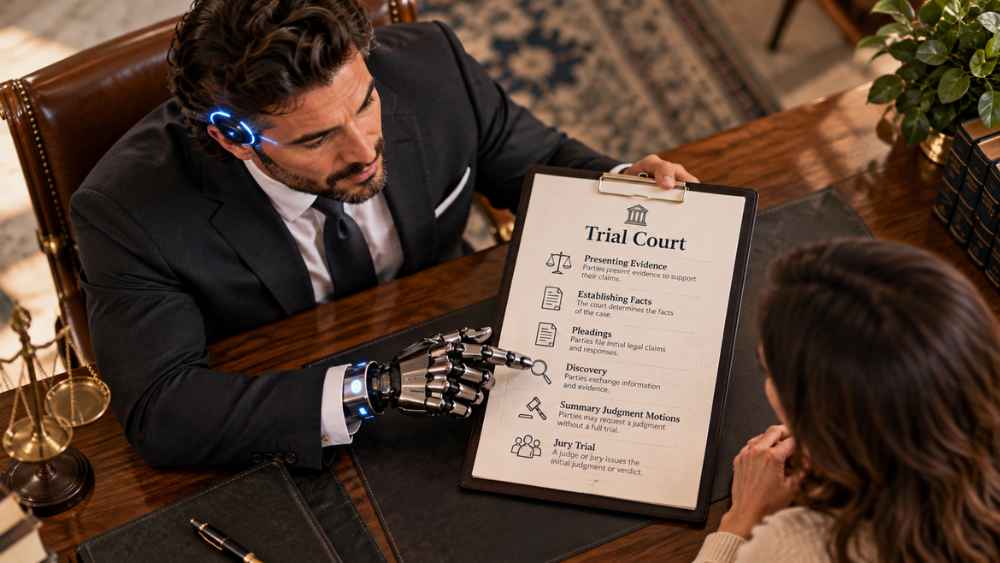
“The breach-of-contract case proceeded in the trial court through pleadings, discovery, summary-judgment motions, and a jury trial.”
What Is a Trial Court?
A TrialLawsuitA lawsuit is a legal dispute brought before a court for a decision or remedy. Civil lawsuits can involve pleadings, service, discovery, motions, settlement, trial, judgment, and possible appeal.View definition Court is a court where parties present evidence, establish facts, and obtain an initial judgmentCivil LawsuitA civil lawsuit is a noncriminal court action in which a plaintiff seeks a legal remedy from a defendant. The process can include jurisdiction, pleadings, service, discovery, motions, settlement, trial, judgment, enforcement, and...View definition or verdict.
Trial courts differ from appellate courts, which primarily review legal rulings.
Therefore, trial courts form the factual record of a case.
Standard Trial Court — Sample Contract Language
Suppose a business files a breach-of-contract action in state courtState CourtA state court is a court established under a state constitution and state law. State courts hear the vast majority of U.S. civil and criminal cases, and their structures, names, procedural rules, and...View definition .
What Does a Trial Court Do?
A trial court manages pleadings, discoveryCivil CourtCivil court is a general term for a court handling noncriminal disputes involving people, businesses, organizations, or government entities. Civil cases can involve contracts, injuries, property, employment, civil rights, and other disputes and...View definition , motions, hearings, trials, and judgments.
It applies law to facts developed in the record.
Therefore, most litigationLegal DisputeA legal dispute is a disagreement or controversy involving claimed legal rights, duties, liabilities, property, or remedies. It can be resolved through negotiation, mediation, arbitration, administrative proceedings, litigation, or settlement depending on the...View definition begins and develops there.
What Is a Court of First Instance?
Court of first instance is another term for a court that initially hears a dispute.
The phrase is common internationally and in comparative law.
Therefore, it generally corresponds to the trial-court concept.
Trial Court vs. Appellate Court
A trial court hears evidence and resolves factual disputes.
An appellate courtCourt of AppealsA court of appeals is a court that reviews decisions from lower courts. Federal courts of appeals usually examine the existing record for legal error rather than conducting a new trial or hearing...View definition reviews the record for legal error.
Therefore, appellate courts usually do not retry the case from the beginning.
What Are Federal Trial Courts?
U.S. district courts are the primary federal trial courts.
They hear most federal civil and criminal cases within constitutional and statutory limits.
See U.S. Courts information about district courts.
How Many Federal District Courts Are There?
The federal judiciaryFederal District CourtA Federal District Court is a United States trial court that hears federal civil and criminal cases within jurisdiction granted by Congress and the Constitution.View definition is organized into 94 judicial districts.
There is at least one federal district court in each state and the District of Columbia.
Therefore, federal trial jurisdiction is geographically divided.
What Special Federal Trial Courts Exist?
Congress has created specialized federal trial courts.
Examples include the U.S. Court of Federal ClaimsCourt of Federal ClaimsThe U.S. Court of Federal Claims is an Article I court with nationwide jurisdiction over specified claims against the United States, especially monetary claims under the Tucker Act and related statutes. Its docket...View definition and the U.S. Court of International Trade.
Therefore, not every federal trial begins in a district courtDistrict CourtA U.S. district court is the primary trial court in the federal court system. District courts hear qualifying federal civil and criminal cases, decide motions, conduct trials, and enter judgments that may later...View definition .
What Are State Trial Courts?
State trial courts hear most civil and criminal litigation in the United States.
Names and jurisdiction vary by state.
Therefore, a state trial courtCourt of Common PleasA Court of Common Pleas is a state trial court name used in several jurisdictions; its exact jurisdiction depends on state law and local court structure.View definition can be called superior, circuit, district, county, or another name.
What Is General Jurisdiction?
A general-jurisdiction trial court can hear a broad range of civil and criminal matters.
State systems commonly have at least one general-jurisdiction level.
Therefore, these courts often handle major lawsuits and felonies.
What Is Limited Jurisdiction?
A limited-jurisdiction court can hear only defined categories or lower-value disputes.
Examples can include small claims, traffic, misdemeanors, or municipal-code matters.
Therefore, authority depends on statuteStatutory LawStatutory law is written law enacted by a legislative body through the formal lawmaking process. Federal and state statutes can create rights, duties, prohibitions, causes of action, procedures, penalties, and remedies, and courts...View definition or constitution.
What Is Subject-Matter Jurisdiction?
Subject-matter jurisdiction is authority to hear a particular category of case.
Trial courts cannot exceed their jurisdictional grants.
Therefore, filing in the wrong court can require dismissal or transfer.
What Is Personal Jurisdiction?
Personal jurisdictionMotion to DismissA motion to dismiss asks a court to end all or part of a case because of a legal or procedural defect. In federal civil cases, Rule 12 lists grounds including jurisdiction, venue,...View definition is authority over a defendant or party.
It often depends on contacts, consent, service, or other legal rules.
Therefore, trial courts need proper authority over the parties.
What Is Venue in Trial Court?
Venue determines the proper geographic location within the court system.
A court can have jurisdiction but still be an improper venue.
Therefore, venue and jurisdiction should be analyzed separately.
How Does a Civil Case Begin?
A civil case commonly begins when the plaintiff files a complaint or petition.
The defendant then receives process and responds.
Therefore, pleadings define the initial dispute.
How Does a Criminal Case Begin?
Criminal cases can begin through complaint, information, indictmentGrand JuryA grand jury is a group of citizens that reviews prosecutor-presented evidence and determines whether probable cause exists to return a criminal indictment.View definition , or another authorized charging process.
Procedures vary by jurisdiction and offense.
Therefore, civil and criminal trial practice differ substantially.
What Is a Pleading?
A pleadingPleadingA pleading is a formal court document stating a party’s claims, defenses, or responses in a civil case. Federal Rules 7 and 8 identify permitted pleadings and govern claims, admissions, denials, affirmative defenses,...View definition is a formal document stating claims, defenses, or responses.
Complaints and answers are common pleadings.
Therefore, pleadings help frame trial-court issues.
What Is Discovery?
Discovery is the pretrial process for exchanging relevant information.
Tools can include interrogatoriesDiscovery DefinitionDiscovery is the pretrial process for exchanging information and evidence in a lawsuit. Common discovery tools include document requests, interrogatories, requests for admission, depositions, subpoenas, and expert disclosures.View definition , document requests, admissions, subpoenas, and depositions.
Therefore, discovery develops evidence before trial.
What Is a Pretrial Motion?
A pretrial motionMotionA Motion is a formal request asking a court to issue an order or grant specific relief. Federal Rule 7(b) generally requires motions to state their grounds with particularity and identify the relief...View definition asks the judgeJudgeA Judge is a judicial officer who presides over legal proceedings, applies law, manages procedure, rules on motions and evidence, and issues orders or judgments. Trial, appellate, Article III, magistrate, bankruptcy, and state...View definition for a ruling before trial.
Examples include motions to dismiss, compel discoveryMotion to CompelA motion to compel asks a court to order required discovery or disclosure when another party or person has not responded adequately. In federal civil cases, Rule 37 generally requires good-faith conference efforts...View definition , exclude evidence, or grant summary judgment.
Therefore, motions can narrow or end claims before trial.
What Is Summary Judgment?
Summary judgment resolves claims when no genuine dispute of material factSummary JudgmentSummary judgment is a court ruling entered without a full trial when no genuine dispute exists over any material fact and the moving party is entitled to judgment as a matter of law....View definition requires trial and law supports judgment.
The standard varies by procedural system.
Therefore, some cases end without a full trial.
What Is a Bench Trial?
A bench trialBench TrialA bench trial is a trial without a jury in which the judge decides disputed facts and applies the law. Strategy often focuses on precise proof, findings of fact, legal elements, and a...View definition is tried to a judge without a juryJuryA Jury is a group of citizens selected to perform a legal factfinding or charging function. Petit juries decide facts and return verdicts in trials, while grand juries determine whether probable cause supports...View definition .
The judge determines facts and law.
Therefore, findings of fact replace a jury verdictJury TrialA jury trial uses jurors to decide disputed facts and return a verdict while the judge resolves legal questions and instructs the jury on the law. Jury rights and procedures vary by case...View definition .
What Is a Jury Trial?
A jury trial uses jurors to decide disputed facts under the judge’s legal instructions.
Jury-trial rights depend on constitution, statute, and case type.
Therefore, not every trial includes a jury.
What Does the Trial Judge Do?
The judge manages procedure, rules on law and evidence, and maintains courtroomCourtroomA courtroom is the physical or virtual setting where judges conduct hearings and trials with court personnel, parties, witnesses, jurors, and an official record.View definition order.
In a bench trial, the judge also finds facts.
Therefore, the judge’s role differs from the jury’s role.
What Does a Jury Do?
A jury evaluates evidence and decides factual questions submitted by the court.
The judge instructs jurors on governing lawBoilerplate ClauseA boilerplate clause is standardized contract language addressing recurring legal mechanics such as notice, assignment, governing law, waiver, severability, and integration.View definition .
Therefore, verdicts combine factual findings with legal instructions.
What Is Voir Dire?
Voir direVoir DireVoir Dire is the questioning of prospective jurors to assess qualifications, impartiality, and bias before trial. Judges and lawyers use it to support challenges for cause and peremptory challenges, subject to constitutional limits...View definition is the jury-selection process.
Judges and attorneys can question potential jurors under local rules.
Therefore, voir dire seeks a fair and impartial jury.
What Is an Opening Statement?
An opening statement previews what a party expects the evidence to show.
It is generally not itself evidence.
Therefore, counsel should distinguish argument from proof.
What Is Direct Examination?
Direct examinationDirect ExaminationDirect Examination is questioning of a witness by the party that called the witness. It generally uses nonleading questions to establish personal knowledge, foundation, facts, exhibits, and expert opinions before cross-examination.View definition is questioning by the party who called the witness.
Evidence rules regulate the form of questions.
Therefore, direct testimony builds the party’s factual case.
What Is Cross-Examination?
Cross-examination is questioning by an opposing party.
It can test credibilityCross ExaminationCross Examination is questioning of a witness by an opposing party after direct examination. Federal Rule 611 generally permits leading questions and allows inquiry into the subject of direct testimony and credibility, while...View definition , memory, bias, and accuracy.
Therefore, cross-examination is a central trial tool.
What Is Evidence?
Evidence includes testimony, documents, objects, recordings, data, and other admissible proof.
Evidence rules determine what the factfinder can consider.
Therefore, admissibilityRelevanceRelevance asks whether evidence tends to make a consequential fact more or less probable. Federal Rules 401 and 402 establish the basic threshold, while Rule 403 permits exclusion when specified dangers substantially outweigh probative value.View definition can shape the trial record.
What Is an Objection?
An objectionObjectionAn Objection is a formal challenge to evidence, testimony, questions, argument, or procedure. Under Federal Rule of Evidence 103, timely and specific objections can prevent inadmissible evidence and preserve evidentiary issues for appeal.View definition asks the judge to exclude or limit improper evidence, testimony, or procedure.
The judge sustains or overrules it.
Therefore, objections can preserve issues for appeal.
What Is a Verdict?
A verdict is the jury’s decision on submitted issues.
It can address liability, guilt, damagesLegal RemedyA legal remedy is the relief a court or other authorized tribunal can provide after a legal right has been violated. Remedies can include damages, injunctions, restitution, specific performance, rescission, declarations, and other...View definition , or other findings.
Therefore, the verdict often precedes formal judgment.
What Is a Judgment?
A judgment is the court’s formal disposition of claims or charges.
It can follow trial, default, dismissal, settlement, or summary judgment.
Therefore, not every judgment follows a jury verdict.
What Is a Court Record?
The court recordCourt DocketA court docket is the official chronological record of filings, orders, hearings, and procedural events in a case. Docket entries and dates are essential for case tracking and deadline management.View definition includes filings, orders, transcripts, exhibits, and docket entries.
Appellate review generally depends on that record.
Therefore, trial-court preservation matters greatly.
What Is a Transcript?
A transcript is a written record of spoken courtroom proceedings.
Court reporters or authorized systems create it.
Therefore, transcripts can be essential on appeal.
What Is a Trial Exhibit?
A trial exhibit is a document, object, image, recording, or other item offered into evidence.
AuthenticationAdmissible EvidenceAdmissible Evidence is evidence a court permits the judge or jury to consider. In federal court, admissibility commonly depends on relevance, Rule 403 balancing, authentication, foundation, hearsay rules, privilege, witness competence, and other...View definition and evidentiary rules apply.
Therefore, trial teams prepare exhibits before use.
What Is a Final Judgment?
A final judgmentJudgmentA Judgment is a court's formal determination of rights and obligations in a civil action. Federal Rules 54 and 58 govern important aspects of judgment and entry, while final judgments affect appeals, post-trial...View definition generally resolves all claims as to all parties for appeal purposes.
Exceptions can permit interlocutory review.
Therefore, appeal timing depends on finality rules.
Can Trial Court Decisions Be Appealed?
Yes. Parties can appeal qualifying rulings to the appropriate appellate court.
Deadlines are usually strict.
Therefore, postjudgment review should begin promptly.
What Does an Appellate Court Review?
Appellate courts review legal rulings based on the record created below.
Different standards apply to legal, factual, and discretionary decisions.
Therefore, trial-court preservation affects appeal.
What Is a Standard of Review?
A standard of review describes how much deference an appellate court gives the trial court.
Examples include de novo and abuse-of-discretion review.
Therefore, issue type affects appellate strategy.
Can a Trial Court Enforce Its Judgment?
Yes. Trial courts can use enforcement procedures authorized by law.
Money judgments can support execution, garnishmentWrit of ExecutionA Writ of Execution is court process used to enforce a money judgment against nonexempt property. Federal Rule 69 makes execution the ordinary federal enforcement method while generally incorporating state execution procedure, and...View definition , or liens.
Therefore, judgment and collection are separate stages.
Are Trial Court Records Public?
Many filings and hearings are public.
However, sealing, privacy, juvenile, and confidentialityEmployment ContractAn employment contract is an agreement defining terms of an employer-employee relationship. It can cover duties, compensation, benefits, equity, confidentiality, intellectual property, restrictive covenants, termination, severance, and dispute procedures while remaining subject to...View definition rules create exceptions.
Therefore, access depends on the record and jurisdiction.
Trial Court Example
Suppose a business files a breach-of-contract action in state court.
The trial court manages discovery, hears motions, and conducts a jury trial.
The losing party can then seek appellate review.
Why Does a Trial Court Matter?
Trial courts create the factual and procedural record that determines most litigation outcomes.
They also make the first judicial rulings on claims, defenses, evidence, and remedies.
The key questions are practical. Which trial court has jurisdiction? Is venue proper? What procedures govern the case?