
Perjury
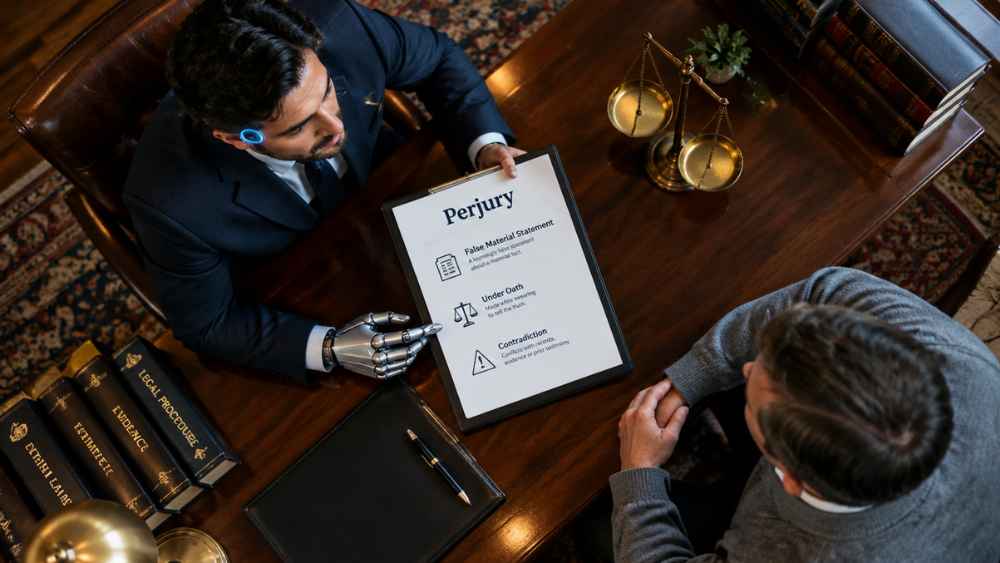
“Prosecutors alleged Perjury because the witness knowingly gave a material false answer under oath during the federal court proceeding.”
What Is Perjury?
PerjurySworn TestimonySworn testimony is evidence given by a witness under oath or affirmation in a formal legal proceeding.View definition is a crime involving a knowingly or willfully false material statement made under oath or penalty of perjury.
Federal statutesPrimary AuthorityPrimary Authority is law issued by an institution with official power to create or state legal rules. Constitutions, statutes, regulations, court decisions, and court rules can be primary authority, while binding effect depends...View definition define several forms of perjury and false declarations.
Therefore, not every inaccurate statement is perjury. See 18 U.S.C. § 1621.
Standard Perjury — Sample Contract Language
Suppose a witness knowingly lies under oath about a material transaction during a federal trialLawsuitA lawsuit is a legal dispute brought before a court for a decision or remedy. Civil lawsuits can involve pleadings, service, discovery, motions, settlement, trial, judgment, and possible appeal.View definition .
What Does Federal Perjury Require?
Section 1621 covers a person who willfully states or subscribes a material matter that the person does not believe true.
The statement must occur under an authorized oath or qualifying penalty-of-perjury declarationSummary JudgmentSummary judgment is a court ruling entered without a full trial when no genuine dispute exists over any material fact and the moving party is entitled to judgment as a matter of law....View definition .
Therefore, falsity alone is not enough.
What Does “Willfully” Mean?
Perjury generally requires a deliberate false statement rather than an innocent mistake.
Confusion, faulty memory, or misunderstanding can undermine the required mental state.
Therefore, prosecutors must prove more than factual inaccuracy.
What Is Materiality?
A false statement is material when it has the required legal significance to the proceeding or matter.
Federal perjury statutes expressly require materiality.
Therefore, trivial inaccuracies do not automatically create perjury.
Must Perjury Be Under Oath?
Traditional perjury involves testimony or statements under oath.
Federal law also covers qualifying unsworn written declarations made under penalty of perjury.
Therefore, a notaryNotary PublicA notary public is a state-commissioned official who verifies identity and performs authorized notarial acts such as acknowledgments, jurats, and oaths.View definition is not always required.
What Is a Declaration Under Penalty of Perjury?
Federal law allows many sworn statements to be replaced with a signed and dated unsworn declarationAffidavit DefinitionAn affidavit is a written statement of facts made under oath or affirmation before a person authorized to administer oaths. The signer, called the affiant, swears that the stated facts are true, subject...View definition using statutory language.
The declaration carries perjury consequences.
Therefore, unsworn declarations can have the same evidentiary force in qualifying settings. See 28 U.S.C. § 1746.
What Is 18 U.S.C. § 1623?
Section 1623 addresses knowingly false material declarations in proceedings before or ancillary to federal courts and grand juries.
It also covers certain false materials used in those proceedings.
Therefore, courtroomCourtroomA courtroom is the physical or virtual setting where judges conduct hearings and trials with court personnel, parties, witnesses, jurors, and an official record.View definition and grand-jury falsehoods can fall under a specialized statuteStatutory LawStatutory law is written law enacted by a legislative body through the formal lawmaking process. Federal and state statutes can create rights, duties, prohibitions, causes of action, procedures, penalties, and remedies, and courts...View definition . See 18 U.S.C. § 1623.
What Is the Federal Penalty for General Perjury?
Section 1621 authorizes a fine, imprisonment for up to five years, or both.
Other statutes can provide different penalties.
Therefore, the charging statute matters.
What Is the Penalty Under Section 1623?
Section 1623 generally authorizes a fine, imprisonment for up to five years, or both.
Special rules now apply to specified FISA court proceedings.
Therefore, federal penalties can depend on the proceeding.
Can a False Affidavit Be Perjury?
Yes, when the affidavitWitness DeclarationA witness declaration is a signed factual statement, often made under penalty of perjury under 28 U.S.C. § 1746 for use in legal proceedings.View definition or declaration satisfies the governing oath or penalty-of-perjury requirements.
The false matter must also meet the statute’s materiality and mental-state requirements.
Therefore, signed court declarations can carry criminal consequences.
Can Deposition Testimony Be Perjury?
Yes. DepositionsDiscovery DefinitionDiscovery is the pretrial process for exchanging information and evidence in a lawsuit. Common discovery tools include document requests, interrogatories, requests for admission, depositions, subpoenas, and expert disclosures.View definition usually occur under oath and can support perjury charges when statutory elements are met.
The false statement must be material and knowingly or willfully false.
Therefore, deposition testimonyDeposition DefinitionA deposition is sworn testimony given outside the courtroom before trial. Attorneys question a witness, called the deponent, while a court reporter records the answers for use in discovery, motions, or trial when...View definition carries the same truth obligation.
Can Trial Testimony Be Perjury?
Yes. A witness who deliberately gives material false testimony under oath can commit perjury.
The prosecution still must prove every criminal element beyond a reasonable doubtBurden of ProofThe burden of proof is the legal responsibility to prove a fact or claim to the required level of certainty. It includes questions about who must produce evidence and how strongly the evidence...View definition .
Therefore, contradictory testimony does not automatically prove the crime.
Can Grand Jury Testimony Be Perjury?
Yes. Section 1623 specifically covers material false declarations in federal grand-jury proceedings.
Grand-jury secrecy does not excuse false testimony.
Therefore, sworn grand-jury witnesses face perjury exposure.
Can a Written Verification Be Perjury?
Yes. Federal law can cover qualifying written verifications, certificates, and declarations under penalty of perjury.
State laws often have similar provisions.
Therefore, written filings should be reviewed carefully before signature.
Is a Mistake Perjury?
No, not by itself. A mistaken statement lacks the required knowing or willful falsity.
The same is true for genuine memory failure.
Therefore, intent is a central distinction.
Is an Opinion Perjury?
An opinion can be difficult to classify as false because perjury generally concerns factual assertions.
However, a claimed belief can itself be false when the speaker did not hold it.
Therefore, wording and context matter.
What If an Answer Is Literally True but Misleading?
Federal perjury law does not ordinarily punish an answerCivil LitigationCivil Litigation is the court process for resolving noncriminal disputes through pleadings, motions, discovery, settlement, trial, judgment, and possible appeal. Federal civil litigation follows the Federal Rules of Civil Procedure, while state systems...View definition merely because it is evasive if it is literally true.
Questioners bear responsibility for precise follow-up questions.
Therefore, ambiguityContract InterpretationContract interpretation is the legal process of determining what contractual language means and how the agreement applies to the parties' dispute.View definition can be critical.
What Is Recantation Under Section 1623?
Section 1623 provides a limited recantation defense in the same continuous court or grand-jury proceeding.
Strict timing conditions apply.
Therefore, later correction does not always erase perjury exposure.
When Can Section 1623 Recantation Apply?
The witness must admit the false statement before it substantially affects the proceeding.
Exposure of the falsity also cannot already be manifest.
Therefore, prompt voluntary correction matters.
What Is Subornation of Perjury?
Subornation of perjury means procuring another person to commit perjury.
Federal law criminalizes it separately.
Therefore, the person inducing false testimony can face liability even without testifying. See 18 U.S.C. § 1622.
Perjury vs. False Statements
Perjury generally requires an oath or qualifying penalty-of-perjury declaration.
Federal false-statement statutes can criminalize material lies in other government matters without an oath.
Therefore, the offenses overlap but are distinct.
Perjury vs. Obstruction of Justice
Obstruction focuses on corrupt interference with judicial, investigative, or official processes.
Perjury focuses on qualifying false statements.
Therefore, the same conduct can sometimes implicate more than one offense.
Perjury vs. Contempt
ContemptCourt OrderA court order is a legally operative directive or decision issued by a court. Orders can control procedure, resolve motions, require action, prohibit conduct, or provide final or interim relief.View definition punishes specified disobedience or interference with court authority.
Perjury punishes qualifying false testimony or declarations.
Therefore, lying and disobeying are separate legal concepts.
Can Inconsistent Statements Prove Perjury?
Section 1623 contains a special rule for irreconcilably contradictory material declarations.
The prosecution need not always identify which one was false under that provision.
Therefore, mutually exclusive sworn statements can create serious exposure.
Is a Particular Number of Witnesses Required?
Section 1623 expressly states that conviction does not require a particular number of witnesses or type of evidence.
Section 1621 has distinct historical corroboration doctrine.
Therefore, proof rules depend on the charging statute.
Who Decides Materiality?
Federal criminal procedure assigns legal issues according to constitutional and statutory doctrine.
Materiality remains an element that the prosecution must establish.
Therefore, charging and jury instructionsJury TrialA jury trial uses jurors to decide disputed facts and return a verdict while the judge resolves legal questions and instructs the jury on the law. Jury rights and procedures vary by case...View definition require careful treatment.
Can Perjury Occur Outside the United States?
Yes. Sections 1621 and 1623 can apply to covered statements made outside the United States.
The statutory requirements still must be met.
Therefore, location alone does not eliminate federal exposure.
Do States Have Their Own Perjury Laws?
Yes. Every state can define perjury and related false-swearing offenses under its own criminal code.
Elements and penalties vary.
Therefore, federal law should not be applied automatically to state proceedings.
What Evidence Can Prove Perjury?
Evidence can include transcripts, recordings, documents, communications, contradictory statements, and proof of the speaker’s knowledge.
Context can establish materiality and intent.
Therefore, perjury cases often depend on surrounding evidence rather than one sentence.
Perjury Example
Suppose a witness knowingly lies under oath about a material transaction during a federal trial.
The false answer is deliberate and material.
Therefore, the conduct can satisfy federal perjury requirements.
Why Does Perjury Matter?
Perjury laws protect the reliability of courts, grand juries, sworn statements, and official factfinding.
However, the crime requires materiality and a culpable mental state.
Therefore, honest mistakes and ambiguities should not be treated as automatic perjury.