
Exempt Employee
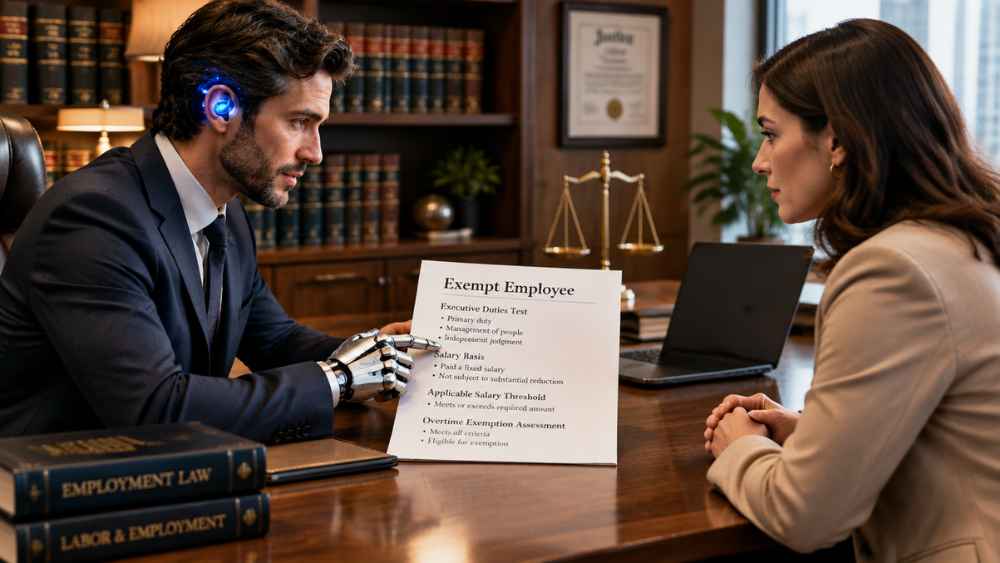
“The employer classified the manager as an Exempt Employee only after confirming the current salary threshold and the executive duties requirements.”
What Is an Exempt Employee?
An Exempt EmployeeFair Labor Standards Act (FLSA)The FLSA is the primary federal wage-and-hour law governing minimum wage, overtime, recordkeeping, child labor, and related protections for covered employees.View definition is an employee excluded from one or more Fair Labor Standards Act protections under a valid exemption.
The term most often refers to exemption from federal minimum-wage and overtime requirements.
Therefore, exempt status depends on law rather than job title. See U.S. Department of Labor Fact Sheet 17A.
Standard Exempt Employee — Sample Contract Language
Suppose a manager earns at least $684 weekly on a salary basis and genuinely manages a department.
What Does FLSA Exempt Mean?
The FLSAWage and Hour LawWage and hour law regulates minimum wage, overtime, compensable time, recordkeeping, youth employment, and related pay practices under the FLSA and state or local law.View definition contains exemptions for specific workers and work arrangements.
Section 13(a)(1) covers qualifying executive, administrative, professional, and outside-sales employees.
Therefore, employers must match each employee to a recognized exemption.
What Are the White-Collar Exemptions?
The major white-collar exemptions cover executive, administrative, professional, outside-sales, and specified computer employees.
Each exemption has its own duties requirements.
Therefore, one generic “salaried employee” test does not exist.
What Is the Current Federal Salary Threshold?
As of 2026, most executive, administrative, and professional exemptions require at least $684 per week.
That equals $35,568 on a 52-week annual basis.
Therefore, employers should use the restored 2019 threshold. See DOL salary-level guidance.
Why Is the 2026 Threshold $684?
A federal courtFederal CourtA federal court is a court within the U.S. federal judicial system. Federal courts have limited jurisdiction, so they hear only cases authorized by the Constitution or federal law, including many federal-question and...View definition vacated the Department of Labor’s 2024 overtime rule.
In May 2026, DOL restored the operative 2019 regulatory text through a technical amendment.
Therefore, the $684 threshold currently governs most EAP exemptions. See DOL’s May 14, 2026 announcement.
What Is the Salary-Basis Test?
The salary-basis test generally requires a predetermined amount that does not vary with work quality or quantity.
Permitted deductions exist under the regulationsPrimary AuthorityPrimary Authority is law issued by an institution with official power to create or state legal rules. Constitutions, statutes, regulations, court decisions, and court rules can be primary authority, while binding effect depends...View definition .
Therefore, a fixed salary can be necessary but not sufficient for exemption.
What Is the Duties Test?
The duties test examines the employee’s actual primary job functions.
Job descriptions and titles do not control by themselves.
Therefore, day-to-day work is central to classification.
What Is the Executive Exemption?
The executive exemption generally requires management as the primary duty.
The employee must direct at least two full-time employees or their equivalent and meet authority requirements.
Therefore, supervisory title alone is insufficient.
What Is the Administrative Exemption?
The administrative exemption generally covers qualifying office or nonmanual work related to management or business operations.
The primary duty must include discretion and independent judgmentCivil LawsuitA civil lawsuit is a noncriminal court action in which a plaintiff seeks a legal remedy from a defendant. The process can include jurisdiction, pleadings, service, discovery, motions, settlement, trial, judgment, enforcement, and...View definition on significant matters.
Therefore, routine clerical work usually does not qualify.
What Is the Learned Professional Exemption?
The learned professional exemption generally requires advanced knowledge in a field of science or learning.
The knowledge normally comes from prolonged specialized intellectual instruction.
Therefore, education and actual duties both matter.
What Is the Creative Professional Exemption?
The creative professional exemption covers qualifying work requiring invention, imagination, originality, or talent.
The field must involve recognized artistic or creative endeavor.
Therefore, routine production work is different.
What Is the Outside Sales Exemption?
Outside-sales employees must primarily make sales or obtain qualifying orders or contracts.
They must customarily and regularly work away from the employer’s place of business.
Therefore, the ordinary $684 salary thresholdOvertime PayOvertime Pay is premium compensation owed to covered nonexempt employees for qualifying excess hours. Under federal law, overtime generally begins after 40 hours worked in a workweek and must equal at least one...View definition does not apply to this exemption.
What Is the Computer Employee Exemption?
Specified skilled computer employees can qualify under Section 13(a)(1) or 13(a)(17).
Hourly computer employees can qualify at a rate of at least $27.63 per hour.
Therefore, job title alone does not make an IT worker exempt.
What Is the Highly Compensated Employee Exemption?
A highly compensated employee can use a streamlined duties test when compensation and other requirements are met.
The current federal total annual compensation threshold is $107,432.
Therefore, high pay alone still does not create exemption.
Does the Highly Compensated Threshold Include a Weekly Salary?
Yes. The employee must receive at least $684 per week on a salary or fee basis.
The remaining annual compensation can include specified commissions and nondiscretionary compensation.
Therefore, annual total and weekly salary both matter.
Do Doctors Need the Salary Threshold?
Qualifying doctors practicing medicine can fall within special professional rules without the ordinary salary threshold.
The regulations define the scope of that exception.
Therefore, medical-professional classification requires specialized review.
Do Lawyers Need the Salary Threshold?
Qualifying lawyers practicing law can fall within professional exemption rules without the ordinary salary threshold.
Licensure and actual practice matter.
Therefore, the general salary test does not apply to every professional.
Do Teachers Need the Salary Threshold?
Qualifying teachers can receive the professional exemption without the ordinary salary threshold.
Teaching must occur in an educational establishment under the regulations.
Therefore, educators have specialized exemption rules.
Are Blue-Collar Workers Exempt Under the White-Collar Rules?
No. The Part 541 white-collar exemptions do not cover manual laborers performing blue-collar work.
High pay does not change that rule.
Therefore, skilled trades can remain overtime-eligible despite strong earnings.
Are Police and Firefighters Exempt Under the White-Collar Rules?
First responders generally do not qualify for the executive, administrative, or professional exemptions based on frontline emergency duties.
Supervisory roles can require separate analysis.
Therefore, public-safety titles do not decide exemption.
Does Being Salaried Make an Employee Exempt?
No. A salaried employee can be nonexempt.
The employer must satisfy every element of the claimed exemption.
Therefore, salary and exemption should not be treated as synonyms.
Can an Hourly Employee Be Exempt?
Sometimes. Outside-sales employees have no salary requirement, and qualifying computer employees can use the statutory hourly rate.
Other exemptions can also use specialized pay rules.
Therefore, hourly status does not always mean nonexempt.
Can Bonuses Count Toward the Salary Level?
Employers can use qualifying nondiscretionary bonuses and incentive payments for a limited portion of the standard salary requirement.
Regulatory timing and catch-up rules apply.
Therefore, bonus treatment should follow current Part 541 rules.
What Happens After an Improper Salary Deduction?
Improper deductions can jeopardize salary-basis status when they show an actual practice inconsistent with salary payment.
A safe-harbor rule can protect employers in qualifying circumstances.
Therefore, payroll practices can affect exemption.
Can Exempt Employees Receive Extra Compensation?
Yes. Employers can provide commissions, bonuses, or additional pay without necessarily losing the exemption.
The salary-basis and duties requirements must still be satisfied.
Therefore, exemption does not prohibit incentive compensation.
Do Exempt Employees Receive Overtime Pay?
Employees validly exempt from the FLSA overtime requirement do not receive federal overtime solely because they exceed 40 hours.
State law or contracts can provide greater rights.
Therefore, federal exemption does not end every compensation question.
Do State Laws Use Higher Salary Thresholds?
Yes. Some states impose higher salary thresholds or stricter duties tests.
Employers must follow the rule that provides required employee protection.
Therefore, federal compliance can be only the starting point.
What Is Misclassification?
Misclassification occurs when an employer labels a worker exempt without satisfying the governing exemption.
Potential liability can include unpaid wagesWage TheftWage theft is a common term for unlawfully withholding wages or compensation a worker has earned. Claims can involve unpaid minimum wage, overtime, off-the-clock work, tips, deductions, misclassification, commissions, final wages, recordkeeping, and...View definition and other remedies.
Therefore, classification should reflect actual duties and pay.
How Are Exemptions Interpreted?
Courts apply the statutory and regulatory text to the employer’s claimed exemption.
The employer generally bears the burden of proving an FLSA exemption.
Therefore, classification records should be accurate and current.
Exempt Employee Example
Suppose a manager earns at least $684 weekly on a salary basis and genuinely manages a department.
The manager also supervises the required employees and has meaningful personnel authority.
Therefore, the executive exemption can apply if all regulatory requirements are satisfied.
Why Does Exempt Employee Status Matter?
Exempt status determines whether important FLSA protections apply to a worker.
A classification error can produce substantial wage liability.
Therefore, employers should review salary, duties, state law, and actual work together.