
Overtime Pay
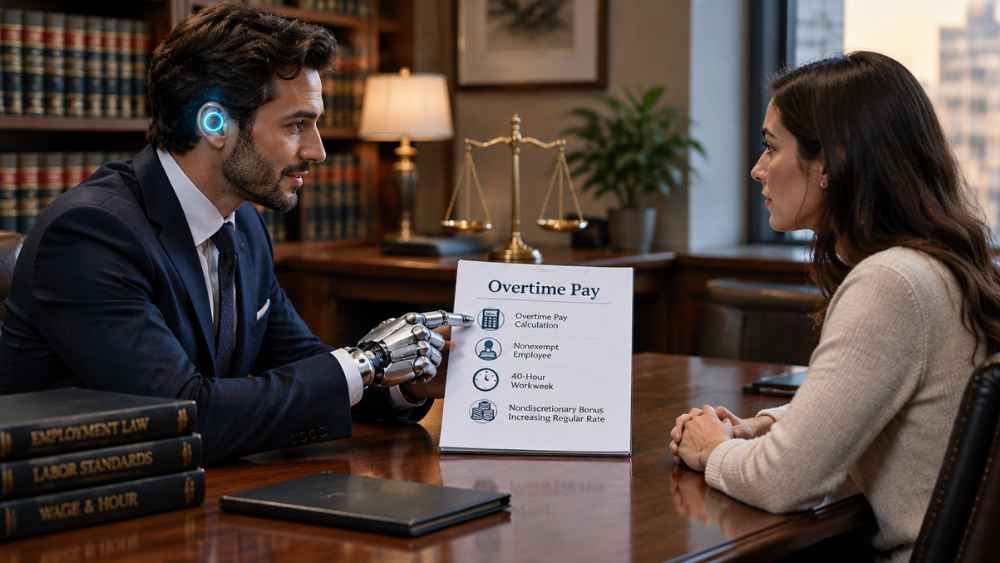
“The employer recalculated Overtime Pay after a nondiscretionary bonus increased the worker’s regular rate for several earlier workweeks.”
What Is Overtime Pay?
Overtime Pay is premium compensation owed to covered nonexempt employees for qualifying excess hours.
Under the FLSAWage and Hour LawWage and hour law regulates minimum wage, overtime, compensable time, recordkeeping, youth employment, and related pay practices under the FLSA and state or local law.View definition , overtime generally begins after 40 hours in a workweekNonexempt EmployeeA Nonexempt Employee remains entitled to applicable FLSA protections because no valid exemption removes them. Covered nonexempt employees generally receive minimum wage, overtime after 40 hours in a workweek, accurate timekeeping, and payment...View definition .
Therefore, covered workers receive at least one and one-half times the regular rate. See DOL Fact Sheet 23.
Standard Overtime Pay — Sample Contract Language
Suppose a nonexempt employeeFair Labor Standards Act (FLSA)The FLSA is the primary federal wage-and-hour law governing minimum wage, overtime, recordkeeping, child labor, and related protections for covered employees.View definition works 46 compensable hours during one workweek.
What Is the Federal Overtime Rate?
The federal rate is at least one and one-half times the employee’s regular rate for overtime hours.
The regular rate can exceed the stated hourly wage.
Therefore, overtime calculations require more than multiplying base pay by 1.5.
When Does Federal Overtime Begin?
Federal overtime generally begins after more than 40 hours worked in one workweek.
Paid leave usually does not count as hours worked under the FLSA.
Therefore, payroll systems should track actual compensable work hours.
What Is a Workweek?
A workweek is a fixed and regularly recurring period of 168 hours.
It consists of seven consecutive 24-hour periods.
Therefore, employers must identify the workweek before calculating overtime.
Can an Employer Change the Workweek?
Yes, when the change is intended to be permanent and not designed to evade overtime.
Employers cannot manipulate workweeks to defeat statutory rights.
Therefore, payroll structure must reflect a legitimate recurring period.
Can Hours Be Averaged Across Workweeks?
No. The FLSA generally requires overtime calculation separately for each workweek.
A short week cannot offset a long week.
Therefore, biweekly payroll does not create an 80-hour overtime threshold.
What Is the Regular Rate?
The regular rate includes remuneration for employment unless the FLSA excludes a payment.
It can include wages, commissions, and nondiscretionary bonuses.
Therefore, base hourly payMinimum WageMinimum wage is the legal floor for worker compensation. U.S. employers must consider the federal FLSA rate together with any higher state or local requirement, plus rules on tips, deductions, hours worked, and...View definition is not always the complete rate.
Do Nondiscretionary Bonuses Affect Overtime?
Yes. Nondiscretionary bonuses generally enter the regular-rate calculation.
The employer can need to allocate the bonus across the period it covers.
Therefore, later bonus payments can require overtime adjustments.
Do Discretionary Bonuses Affect Overtime?
Qualifying discretionary bonuses can be excluded from the regular rate.
The employer must retain genuine discretion over payment and amount under the statuteStatutory LawStatutory law is written law enacted by a legislative body through the formal lawmaking process. Federal and state statutes can create rights, duties, prohibitions, causes of action, procedures, penalties, and remedies, and courts...View definition .
Therefore, a bonus label alone does not decide treatment.
Do Commissions Affect Overtime?
Commissions generally enter the regular rate unless a specific exclusion or exemption applies.
Special rules govern allocation across workweeks.
Therefore, commissioned employees can still receive overtime.
Can Salaried Employees Receive Overtime?
Yes. A salaried employee can be nonexempt.
The employer must convert the salary into the applicable regular rate under governing rules.
Therefore, salary does not eliminate overtime eligibility.
Can Hourly Employees Be Exempt?
Some specialized exemptions can apply to hourly workers.
Qualifying computer employees provide one federal example.
Therefore, hourly status strongly suggests but does not universally prove overtime eligibility.
What Is the Current White-Collar Salary Threshold?
As of 2026, most executive, administrative, and professional exemptions use a $684 weekly salary threshold.
DOL restored the operative 2019 regulationRegulationA Regulation is a rule issued by a governmental authority, usually an administrative agency, under delegated legal authority. Federal regulations can arise through APA rulemaking, appear first in the Federal Register, and become...View definition after the 2024 rule was vacated.
Therefore, outdated $844 or $1,128 thresholds should not be used. See DOL’s May 2026 technical-amendment announcement.
Who Is Exempt From Federal Overtime?
The FLSA contains many exemptions for specified employees and industries.
Common examples include qualifying executive, administrative, professional, outside-sales, and computer employees.
Therefore, exemption must be established rather than assumed.
Does Weekend Work Automatically Earn Overtime?
No. Federal law does not require overtime merely because work occurs on a weekend.
The 40-hour workweek total usually controls.
Therefore, weekend premiums can arise from contracts or state law instead.
Does Holiday Work Automatically Earn Overtime?
No. The FLSA does not require a premium solely because work occurs on a holiday.
Collective bargaining agreements or employer policies can provide extra pay.
Therefore, holiday premiums and statutory overtime are different.
Does Daily Overtime Apply Under Federal Law?
Generally, no. Federal FLSA overtime uses the 40-hour workweek standard.
Some states require overtime after a daily hour threshold.
Therefore, state law can provide broader protection.
What Counts as Hours Worked?
Compensable hours include time the employer requires or permits the employee to work.
Work can occur at the workplace, home, or another location.
Therefore, off-the-clock tasks can create overtime. See DOL off-the-clock guidance.
Are Short Breaks Counted?
Short rest breaks of about 20 minutes or less generally count as work time.
Employers cannot deduct them from compensable hours under ordinary federal rules.
Therefore, break practices can affect overtime totals.
Are Meal Periods Counted?
Bona fide meal periods generally do not count when the employee is completely relieved from duty.
Working during the meal can make the time compensable.
Therefore, actual conduct matters more than automatic deductions.
Is Travel Time Counted?
Some travel time counts as compensable work.
Ordinary commuting generally does not, while workday travel often does.
Therefore, travel circumstances can change overtime totals.
Is Training Time Counted?
Required or job-related training often counts as compensable time.
Training can be excluded only when the applicable criteria are satisfied.
Therefore, employers should review attendance conditions carefully.
Is On-Call Time Counted?
On-call time can be compensable when restrictions prevent effective personal use.
Less restrictive arrangements can remain noncompensable.
Therefore, the practical burden of the restrictions matters.
Can an Employer Refuse to Pay Unauthorized Overtime?
No. An employer generally must pay for compensable overtime it suffered or permitted.
The employer can discipline a worker for violating scheduling rules.
Therefore, payment and discipline are separate issues.
Can an Employee Waive Overtime?
No. FLSA overtime rights generally cannot be waived through a private agreement.
An employee cannot validly volunteer unpaid overtimeWage TheftWage theft is a common term for unlawfully withholding wages or compensation a worker has earned. Claims can involve unpaid minimum wage, overtime, off-the-clock work, tips, deductions, misclassification, commissions, final wages, recordkeeping, and...View definition for a private employer in ordinary circumstances.
Therefore, informal agreements do not override the statute.
How Is Overtime Calculated for Multiple Rates?
Special rules apply when an employee performs work at two or more rates in the same workweek.
A weighted-average regular rate often applies unless law permits another method.
Therefore, multi-rate payroll needs careful calculation.
What Is Fluctuating Workweek Pay?
The fluctuating-workweek method can calculate overtime for some nonexempt salaried employees with variable hours.
Specific regulatory requirements must be satisfied.
Therefore, employers should not use the method casually.
What Is Compensatory Time?
Compensatory time substitutes paid time off for cash overtime in limited public-sector circumstances.
Private employers generally cannot use comp time to avoid FLSA overtime.
Therefore, public and private rules differ.
What Records Support Overtime Compliance?
Employers must maintain accurate records of hours worked, wages, and related payroll information.
Time records should reflect actual work rather than scheduled time alone.
Therefore, reliable records support both compliance and dispute resolutionLegal DisputeA legal dispute is a disagreement or controversy involving claimed legal rights, duties, liabilities, property, or remedies. It can be resolved through negotiation, mediation, arbitration, administrative proceedings, litigation, or settlement depending on the...View definition .
What Remedies Exist for Unpaid Overtime?
Employees can seek unpaid overtime under the FLSA and applicable state law.
Potential remedies can include back pay, liquidated damagesBreach of ContractA breach of contract occurs when a party fails to perform an obligation required by an enforceable agreement. Examples include nonpayment, missed deadlines, defective performance, refusal to perform, or violation of another contract...View definition , attorney feesMotion to CompelA motion to compel asks a court to order required discovery or disclosure when another party or person has not responded adequately. In federal civil cases, Rule 37 generally requires good-faith conference efforts...View definition , and other relief.
Therefore, misclassification and off-the-clock practices can create substantial exposure.
What Is the FLSA Limitations Period?
FLSA claims generally use a two-year limitations periodStatute of LimitationsA statute of limitations is a law that sets a deadline for starting a legal claim. The deadline varies by jurisdiction and claim type, and rules about accrual, discovery, tolling, or repose can...View definition .
Willful violations can extend the period to three years.
Therefore, willfulness can materially change potential back-pay exposure.
Can Retaliation Follow an Overtime Complaint?
The FLSA prohibits retaliationEqual Employment Opportunity Commission (EEOC)The Equal Employment Opportunity Commission (EEOC) is the federal agency that enforces major U.S. employment discrimination laws, investigates charges, promotes voluntary resolution, and may litigate violations.View definition against workers for protected wage-and-hour activity.
Protection can apply to complaints and participation in proceedings.
Therefore, employers should separate wage disputes from adverse employment action.
Do State Overtime Laws Matter?
Yes. State laws can require higher rates, daily overtime, stricter exemptions, or longer limitations periods.
Workers receive whichever applicable rules provide required protection.
Therefore, federal law is not always the final calculation.
Overtime Pay Example
Suppose a nonexempt employee works 46 compensable hours during one workweek.
The employee earns six overtime hours at the legally required premium rate.
Therefore, the employer must calculate the premium using the employee’s regular rate.
Why Does Overtime Pay Matter?
Overtime law protects covered workers from uncompensated excess hours and creates incentives for fair scheduling.
Accurate classification, timekeeping, and regular-rate calculations are essential.
Therefore, employers should review both federal and state rules before processing overtime.