
Nonexempt Employee
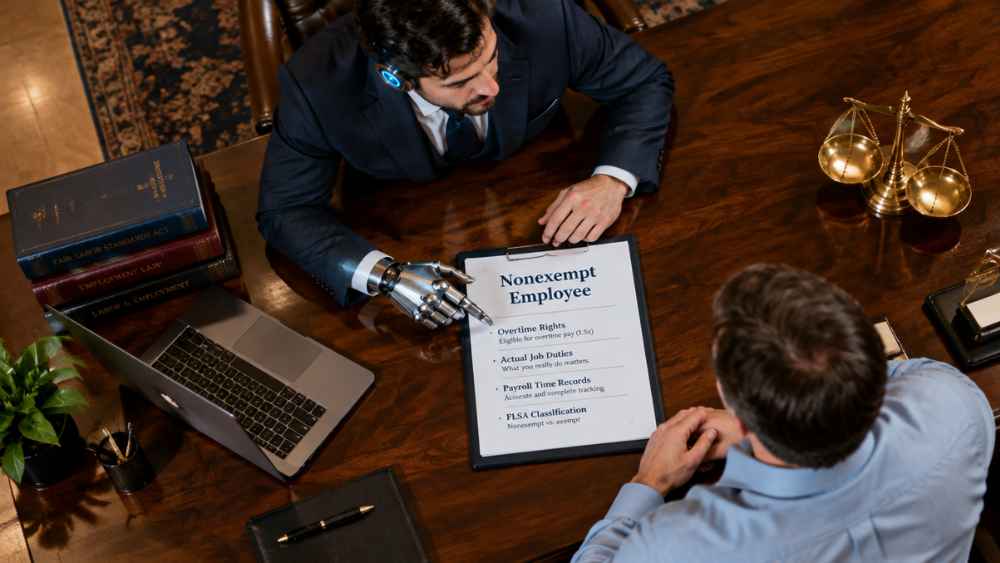
“The salaried coordinator remained a Nonexempt Employee because the actual duties did not satisfy any FLSA overtime exemption.”
What Is a Nonexempt Employee?
A Nonexempt EmployeeFair Labor Standards Act (FLSA)The FLSA is the primary federal wage-and-hour law governing minimum wage, overtime, recordkeeping, child labor, and related protections for covered employees.View definition is an employee entitled to the FLSAWage and Hour LawWage and hour law regulates minimum wage, overtime, compensable time, recordkeeping, youth employment, and related pay practices under the FLSA and state or local law.View definition protections that no valid exemption removes.
Covered nonexempt workers generally receive minimum wageMinimum WageMinimum wage is the legal floor for worker compensation. U.S. employers must consider the federal FLSA rate together with any higher state or local requirement, plus rules on tips, deductions, hours worked, and...View definition and overtime protections.
Therefore, nonexempt status carries timekeeping and pay obligations. See U.S. Department of Labor FLSA guidance.
Standard Nonexempt Employee — Sample Contract Language
Suppose a salaried coordinator earns $900 weekly but performs routine nonexempt work for 45 hours.
What Does Nonexempt Mean?
Nonexempt means the employee does not satisfy an applicable exemption from the relevant FLSA requirement.
The worker can be hourly or salaried.
Therefore, pay method alone does not determine status.
Do Nonexempt Employees Receive Minimum Wage?
Covered nonexempt employees generally must receive at least the applicable federal minimum wage.
State and local laws can require a higher rate.
Therefore, employers must check all applicable wage laws.
Do Nonexempt Employees Receive Overtime?
Covered nonexempt employees generally receive overtime after more than 40 hours in a workweek.
The federal premium is at least one and one-half times the regular rateOvertime PayOvertime Pay is premium compensation owed to covered nonexempt employees for qualifying excess hours. Under federal law, overtime generally begins after 40 hours worked in a workweek and must equal at least one...View definition .
Therefore, overtime eligibility is a core nonexempt protection. See DOL Fact Sheet 23.
Can a Salaried Worker Be Nonexempt?
Yes. Employers can pay a nonexempt worker a salary.
They must still calculate and pay legally required overtime.
Therefore, salary does not eliminate overtime rights.
Can a Highly Paid Worker Be Nonexempt?
Yes. High compensation does not automatically satisfy a statutory exemption.
Duties and other regulatory requirements still matter.
Therefore, income level alone cannot decide classification.
Can a Blue-Collar Worker Be Nonexempt?
Yes. Manual laborers generally remain outside the white-collar exemptions.
Examples include construction, maintenance, production, and skilled-trade workers.
Therefore, high hourly earnings can coexist with overtime eligibility.
How Is a Workweek Defined?
The FLSA uses a fixed and regularly recurring period of 168 hours.
That period consists of seven consecutive 24-hour periods.
Therefore, overtime is calculated by workweek rather than pay period.
Can Workweeks Be Averaged?
No. Employers generally cannot average hours across two or more workweeks to avoid overtime.
Each workweek stands on its own.
Therefore, 30 hours one week cannot offset 50 hours the next.
What Hours Must Be Counted?
Employers must count compensable time that they require or permit an employee to work.
The analysis includes work performed away from the normal workplace.
Therefore, off-the-clock work can create wage liability.
What Is Suffered or Permitted Work?
The FLSA treats work the employer suffers or permits as compensable.
An employer cannot accept work and simply refuse to count it.
Therefore, unauthorized work can still require payment.
What Is Off-the-Clock Work?
Off-the-clock work is compensable work omitted from recorded time.
Examples can include pre-shift tasks, post-shift tasks, or remote messages.
Therefore, employers need systems that capture all work time. See DOL off-the-clock guidance.
Are Meal Periods Compensable?
Bona fide meal periods generally need not count as hours worked when the employee is completely relieved from duty.
Working lunches can become compensable.
Therefore, meal labels do not control actual pay treatment.
Are Rest Breaks Compensable?
Short rest breaks of about 20 minutes or less generally count as compensable work time under federal rules.
Longer bona fide meal periods use different standards.
Therefore, break length and employee freedom matter.
Is Travel Time Compensable?
Some travel time counts as work, while ordinary home-to-work commuting generally does not.
Special assignments and workday travel can be compensable.
Therefore, travel purpose and timing matter.
Is Training Time Compensable?
Training can be noncompensable only when specific criteria are satisfied.
Required or job-related training often counts as work time.
Therefore, employers should not exclude training automatically.
Is Waiting Time Compensable?
Waiting time can count as work when the employee remains engaged to wait.
Employees who are waiting to be engaged can receive different treatment.
Therefore, the degree of freedom matters.
Is On-Call Time Compensable?
On-call time can count as work when restrictions prevent effective personal use of the time.
Less restrictive on-call arrangements can be noncompensable.
Therefore, practical constraints matter more than labels.
What Is the Regular Rate?
The regular rate is the hourly rate used to calculate federal overtime.
It can include more than an employee’s stated base wage.
Therefore, bonuses and other compensation can affect overtime.
Do Bonuses Affect the Regular Rate?
Many nondiscretionary bonuses must be included in the regular rate.
Truly discretionary bonuses can receive different treatment.
Therefore, bonus structure can change overtime calculations.
Can Employers Require Overtime?
Yes. The FLSA generally does not limit weekly hours for workers age 16 and older.
Employers can discipline unauthorized overtime while still paying for work performed.
Therefore, scheduling authority and wage obligations are separate.
Can Employees Waive Overtime?
No. Employees and employers generally cannot agree to waive statutory overtime rights.
A private agreement cannot convert compensable overtime into unpaid time.
Therefore, payroll obligations override contrary informal agreements.
Does Weekend Work Automatically Require Overtime?
No. The FLSA does not require extra pay solely for Saturday, Sunday, or holiday work.
Overtime generally depends on total workweek hours.
Therefore, calendar day alone does not create federal overtime.
What Records Must Employers Keep?
Employers must keep accurate records of hours worked and wages for covered nonexempt employees.
DOL regulationsPrimary AuthorityPrimary Authority is law issued by an institution with official power to create or state legal rules. Constitutions, statutes, regulations, court decisions, and court rules can be primary authority, while binding effect depends...View definition specify required information and retention periods.
Therefore, reliable timekeeping is a core compliance duty.
Can an Employer Round Time?
Federal law can permit neutral rounding practices under established standards.
A system cannot systematically undercount work time.
Therefore, actual practice matters more than written policy.
What Is Time Shaving?
Time shavingWage TheftWage theft is a common term for unlawfully withholding wages or compensation a worker has earned. Claims can involve unpaid minimum wage, overtime, off-the-clock work, tips, deductions, misclassification, commissions, final wages, recordkeeping, and...View definition is the improper reduction or deletion of recorded work time.
It can lead to minimum-wage and overtime violations.
Therefore, edits to time records need legitimate reasons and controls.
Can a Nonexempt Employee Work Remotely?
Yes. The FLSA applies to compensable work regardless of work location.
Employers must use reasonable processes for reporting remote work time.
Therefore, remote arrangements do not remove wage obligations.
What If the Employer Did Not Authorize the Work?
The employer generally must pay for compensable work it knew or should have known occurred.
The employer can separately enforce a no-unauthorized-overtime policy.
Therefore, discipline cannot replace payment.
Do State Laws Provide More Protection?
Yes. States can require daily overtime, meal rules, higher minimum wages, or different exemptions.
Employees receive applicable protections from each governing lawBoilerplate ClauseA boilerplate clause is standardized contract language addressing recurring legal mechanics such as notice, assignment, governing law, waiver, severability, and integration.View definition .
Therefore, federal law is often the minimum baseline.
What Is Nonexempt Misclassification?
Misclassification occurs when an overtime-eligible employee is incorrectly treated as exempt.
The error can produce unpaid overtime and other remedies.
Therefore, actual duties and current legal thresholds should be reviewed.
Nonexempt Employee Example
Suppose a salaried coordinator earns $900 weekly but performs routine nonexempt work for 45 hours.
The salary alone does not establish an exemption.
Therefore, the employer must calculate any overtime required by law.
Why Does Nonexempt Status Matter?
Nonexempt classification triggers important wage, overtime, timekeeping, and hours-worked rules.
Employers cannot avoid those protections through titles or salary labels.
Therefore, accurate classification is essential for lawful payroll.