
Bad Faith
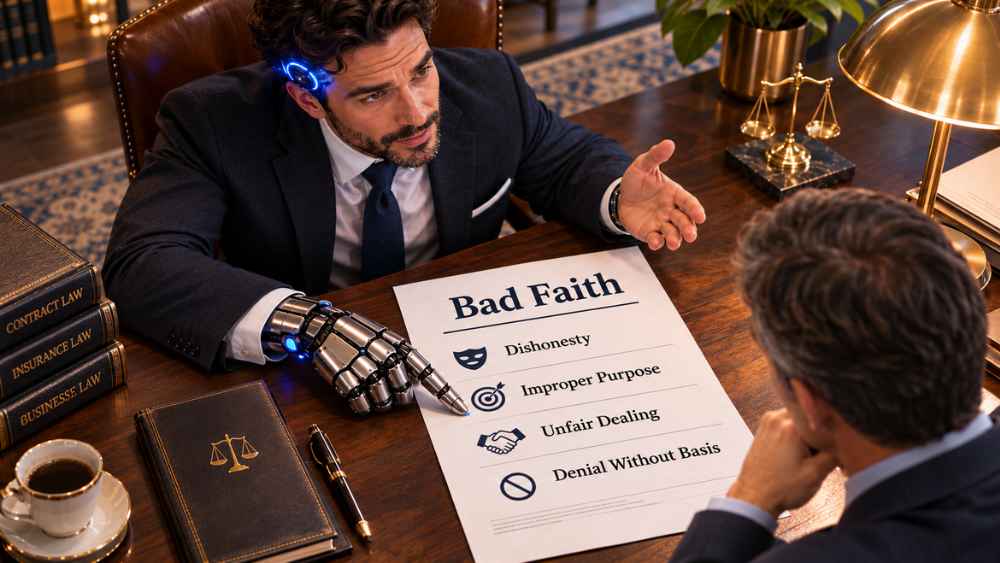
“The policyholder alleged Bad Faith after the insurer allegedly ignored key evidence, delayed investigation, and denied the claim without a reasonable basis.”
What Is Bad Faith?
Bad FaithGood FaithGood Faith is a context-dependent legal concept involving honesty, fair dealing, and faithful performance. Contract law, the UCC, insurance, corporate fiduciary law, and bankruptcy use related but distinct good-faith standards.View definition generally means dishonesty, improper purpose, unfair dealing, or conscious disregard of a legal dutyBreach of DutyA breach of duty occurs when a person or entity fails to meet a legal duty owed to another person. In negligence cases, breach is usually one element alongside duty, causation, and damages,...View definition .
Its legal consequences depend on context and jurisdictionLegal DisputeA legal dispute is a disagreement or controversy involving claimed legal rights, duties, liabilities, property, or remedies. It can be resolved through negotiation, mediation, arbitration, administrative proceedings, litigation, or settlement depending on the...View definition .
Therefore, bad faith is broader than one single cause of actionCause of ActionA Cause of Action is a recognized set of legal elements supporting a right to judicial relief. Its elements can arise from statutes, constitutions, regulations, or case law, and the claimant generally must...View definition . See Cornell LII on bad faith.
Standard Bad Faith — Sample Contract Language
Suppose a contracting party has approval discretion but rejects every compliant proposal to destroy the other party's expected benefit.
Bad Faith vs. Negligence
Negligence concerns failure to use required care.
Bad faith usually involves a more blameworthy state of mind or deliberate unfairness.
Therefore, careless error does not automatically establish bad faith.
What Is Contractual Bad Faith?
Contractual bad faith can arise when a party intentionally frustrates the other party’s expected contractual benefits.
The implied covenant of good faith and fair dealing supplies the doctrinal framework in many states.
Therefore, bad faith can exist even when no express term uses that phrase.
Can Bad Faith Override Contract Text?
The implied covenantCovenantA covenant is a binding promise in a contract or legal instrument requiring a party to take or refrain from specified action.View definition generally cannot contradict an express contract term.
It can constrain opportunistic use of discretion or technical rights.
Therefore, the claim must fit the agreement rather than rewrite it.
What Is Insurance Bad Faith?
Insurance bad faith concerns improper claim handling or failure to honor insurer duties under applicable law.
Standards and remedies vary significantly by state.
Therefore, insurance bad faith requires jurisdiction-specific research.
What Conduct Can Indicate Insurance Bad Faith?
Potential indicators include unreasonable investigation, unjustified delay, unsupported denial, or failure to consider settlement duties.
One adverse claim decision does not automatically prove bad faith.
Therefore, reasonableness and state law matter.
What Is Third-Party Bad Faith?
Third-party bad faith can involve an insurer’s handling of a liability claim against its insured.
Settlement opportunities and excess-judgment risk can be important.
Therefore, insurer duties can extend beyond paying first-party benefits.
What Is First-Party Bad Faith?
First-party bad faith concerns an insured’s own claim for policy benefits.
Examples include property, disability, or uninsured-motorist claims.
Therefore, claim type affects the legal framework.
Can Bad Faith Support Punitive Damages?
Sometimes. Punitive or exemplary damagesTrade Secret MisappropriationTrade Secret Misappropriation is wrongful acquisition, disclosure, or use of another person's qualifying trade secret. The DTSA provides federal civil remedies, while state trade-secret laws can also apply.View definition require statutory or common-law standards that vary by state.
Bad faith alone may not satisfy the required level of misconduct.
Therefore, damagesLegal RemedyA legal remedy is the relief a court or other authorized tribunal can provide after a legal right has been violated. Remedies can include damages, injunctions, restitution, specific performance, rescission, declarations, and other...View definition must be analyzed separately.
What Is Bad Faith in Litigation?
Courts can use bad-faith findings when imposing sanctions or exercising inherent powers.
The standard is often higher than ordinary litigation error.
Therefore, aggressive advocacy is not automatically sanctionable bad faith.
What Is Bad Faith in Bankruptcy?
Bankruptcy courts can consider bad faith in filing, plan confirmation, stay relief, or other matters.
Tests vary by statutory context.
Therefore, bankruptcy bad faith is issue-specific.
What Is Corporate Bad Faith?
Corporate fiduciary law can treat intentional misconduct or conscious disregard of duties as bad faith.
Delaware connects such conduct with the duty of loyaltyBusiness Judgment RuleThe Business Judgment Rule is a judicial presumption protecting qualifying corporate decisions from hindsight review. Its application varies by jurisdiction but commonly depends on informed decision-making, disinterest, independence, good faith, and compliance with...View definition .
Therefore, bad faith can affect fiduciary liability.
How Is Bad Faith Proven?
Evidence can include communications, inconsistent explanations, ignored facts, unreasonable procedures, concealment, and deliberate obstruction.
The required proof depends on the claim.
Therefore, contemporaneous records often matter.
Bad Faith Example
Suppose a contracting party has approval discretion but rejects every compliant proposal to destroy the other party’s expected benefit.
The conduct can support a bad-faith theory under applicable law.
Therefore, motive and contractual purpose can matter.
Why Does Bad Faith Matter?
Bad-faith doctrines police deliberate unfairness that ordinary breach or negligence rules may not fully address.
They can affect liability, remedies, sanctions, and insurance exposure.
Therefore, the precise legal context should always be identified.