
COPPA
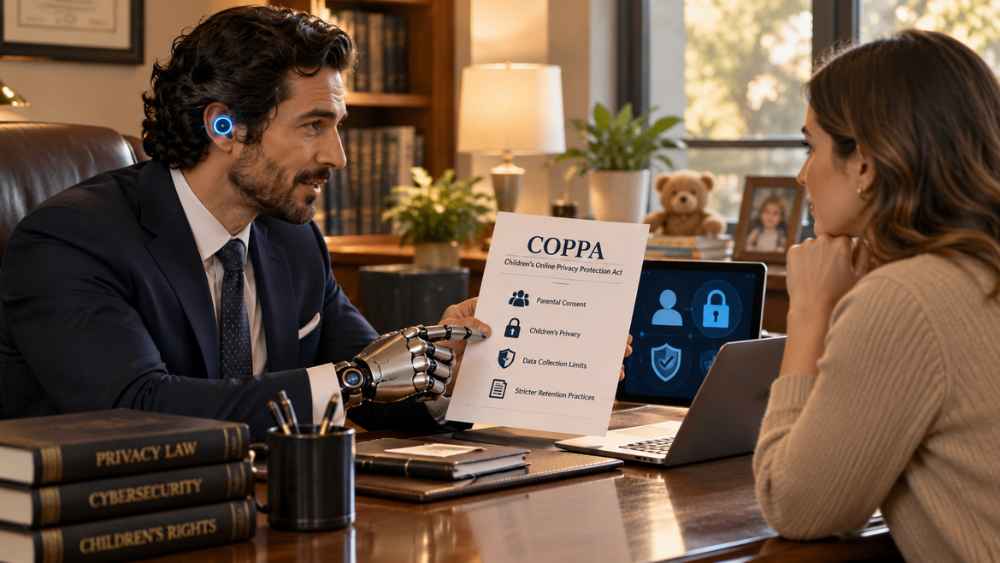
“The children’s game updated its COPPA program to obtain separate parental consent for targeted advertising disclosures and apply stricter retention controls.”
What Is COPPA?
The Children’s Online Privacy Protection Act, or COPPA, is a federal law protecting children’s online privacy.
It regulates covered websites and online services that collect personal informationPersonally Identifiable Information (PII)Personally Identifiable Information (PII) is information that can distinguish or trace an individual’s identity alone or with other linked or linkable information. Common examples include identifiers, contact details, biometrics, financial information, health information,...View definition from children under 13.
Therefore, operators should assess audience, data collection, parental notice, consent, security, and retention. See FTC COPPA guidance.
Standard COPPA — Sample Contract Language
Suppose a child-directed game collects device identifiers and location from users under 13.
Who Enforces COPPA?
The Federal Trade Commission enforces the COPPA Rule.
State attorneys general can also bring qualifying COPPA actions.
Therefore, covered operators can face both federal and state enforcement.
What Is the COPPA Rule?
The COPPA Rule appears in 16 C.F.R. Part 312.
It implements the Children’s Online Privacy Protection Act.
Therefore, compliance requires reviewing both the statuteStatutory LawStatutory law is written law enacted by a legislative body through the formal lawmaking process. Federal and state statutes can create rights, duties, prohibitions, causes of action, procedures, penalties, and remedies, and courts...View definition and current FTC rule.
What Changed in the 2025 COPPA Amendments?
The FTC amended the COPPA Rule in 2025 to strengthen children’s privacy protections.
The amended Rule became effective June 23, 2025.
Therefore, most regulated entities had to comply by April 22, 2026. See 90 Fed. Reg. 16918.
What Is the Current COPPA Compliance Date?
Most 2025 Rule amendments had a compliance date of April 22, 2026.
Certain Safe HarborMotion for SanctionsA motion for sanctions asks a court to penalize or correct litigation misconduct. The legal standard, safe-harbor rules, notice requirements, and available remedies depend on the authority invoked.View definition provisions used earlier compliance timing.
Therefore, businesses operating in late 2026 should follow the amended Rule.
Which Websites and Services Does COPPA Cover?
COPPA covers commercial websites and online services directed to children under 13 that collect covered personal information.
It also covers general-audience services with actual knowledge of qualifying child data collection.
Therefore, audience and knowledge both matter.
Does COPPA Apply to Apps?
Yes. The Rule can apply to mobile apps, games, connected devices, and other online services.
Technology format does not remove COPPA duties.
Therefore, product teams should assess all child-facing digital services.
What Is a Child Under COPPA?
COPPA defines a child as an individual under 13 years old.
The Rule focuses on online collection, use, and disclosure of personal information from that age group.
Therefore, age-screen design can be legally important.
What Is a Child-Directed Website or Service?
The FTC evaluates content, visuals, characters, activities, language, advertising, audience evidence, and intended users.
No single factor controls every case.
Therefore, child-directed status depends on the totality of circumstances.
What Is a Mixed Audience Service?
A mixed-audience service is a subset of child-directed services that does not primarily target children.
It can use a neutral age screen under the amended Rule.
Therefore, mixed-audience status differs from general-audience status.
Can Mixed-Audience Services Age Screen?
Yes. Qualifying mixed-audience services can determine whether visitors are children before collecting covered personal information.
The age screen must be neutral and should not encourage false age entries.
Therefore, product design affects compliance.
Can a Primarily Child-Directed Service Block Children?
A primarily child-directed service generally must treat visitors as children for COPPA purposes.
It cannot simply use age screening to avoid child users.
Therefore, the service should build COPPA protections into its core design.
What Is Actual Knowledge?
Actual knowledge can trigger COPPA for a general-audience service when it knows a particular user is under 13.
Knowledge can arise from information the operator receives or reviews.
Therefore, internal handling of age information matters.
What Is Personal Information Under COPPA?
COPPA defines personal information broadly.
The amended Rule includes traditional identifiers, persistent identifiers, images, voice, precise location, biometric identifiers, and specified government identifiers.
Therefore, product teams should inventory more than names and email addresses.
What Are Persistent Identifiers?
Persistent identifiers can recognize a user over time and across websites or online services.
Examples can include cookies, device identifiers, and IP-address-related identifiers.
Therefore, advertising and analytics technologies can trigger COPPA obligations.
Are Biometric Identifiers Covered?
Yes. The amended Rule expanded personal information to include qualifying biometric identifiers.
Examples can include data used for automated recognition of a person.
Therefore, face, iris, fingerprint, or voice-related systems need careful review.
Are Government-Issued Identifiers Covered?
Yes. The amended Rule expanded covered personal information to include specified government-issued identifiers.
These identifiers can create heightened privacy and security risk.
Therefore, operators should avoid unnecessary collection.
Does COPPA Cover Photos and Videos?
Yes. A photograph, video, or audio file containing a child’s image or voice can be personal information.
Public posting can also constitute disclosure.
Therefore, user-upload features require privacy controls.
Does COPPA Cover Geolocation?
Yes. Covered geolocation includes information sufficient to identify street name and city or town.
More precise location can create greater risk.
Therefore, child-location features should use data minimizationPrivacy by DesignPrivacy by Design embeds privacy protections into systems, products, and processes from the beginning through proactive controls, privacy-protective defaults, lifecycle security, and user-centered transparency.View definition .
What Is Verifiable Parental Consent?
Verifiable parental consent uses a method designed to verify that the consenting person is the child’s parent.
The appropriate method depends on how information will be used or disclosed.
Therefore, consent design should match processing risk.
When Is Parental Consent Required?
Covered operators generally must obtain verifiable parental consent before collecting, using, or disclosing children’s personal information.
The Rule contains limited exceptions.
Therefore, exceptions should be documented rather than assumed.
What Is Separate Consent for Third-Party Disclosures?
The amended Rule requires separate verifiable parental consent for certain disclosures to third parties.
This is especially important for targeted advertising and unrelated disclosure purposes.
Therefore, one bundled consent can be insufficient.
Does COPPA Limit Targeted Advertising?
Yes. The amended Rule strengthens parental control over third-party disclosures used for targeted advertising.
Separate opt-in parental consent can be required.
Therefore, contextual and behavioral advertising should be distinguished.
What Is Direct Notice to Parents?
Operators must provide parents with direct notice describing covered information practices before obtaining consent.
The notice should explain collection, use, disclosure, and parental rights.
Therefore, direct notice and public privacy policyPrivacy PolicyA Privacy Policy is a public statement explaining how an organization collects, uses, discloses, retains, protects, and otherwise handles personal information. Applicable privacy laws can require specific disclosures about purposes, rights, recipients, retention,...View definition serve different functions.
What Must the Online COPPA Privacy Policy Include?
Covered operators must post a clear online notice describing their children’s information practices.
The policy should identify operators, collection practices, uses, disclosures, and parental rights.
Therefore, generic privacy language can be inadequate.
What Rights Do Parents Have?
Parents can review information collected from their child and request deletion.
They can also refuse further collection or use.
Therefore, operators need practical parent-access workflows.
What Is Data Minimization Under COPPA?
COPPA prohibits conditioning participation on collection of more personal information than reasonably necessary.
The amended Rule reinforces purpose-based minimization.
Therefore, every child-data field should have a specific need.
What Are COPPA Retention Rules?
Operators may retain children’s personal information only as long as reasonably necessary for the specific collection purpose.
They must then delete it using reasonable measuresTrade SecretA trade secret is qualifying business information that has independent economic value because it is not generally known and is protected by reasonable secrecy measures. Federal and state law can provide remedies for...View definition .
Therefore, indefinite retention is inconsistent with the amended Rule.
What Security Program Duties Apply?
Covered operators must maintain reasonable procedures protecting confidentialityEmployment ContractAn employment contract is an agreement defining terms of an employer-employee relationship. It can cover duties, compensation, benefits, equity, confidentiality, intellectual property, restrictive covenants, termination, severance, and dispute procedures while remaining subject to...View definition , security, and integrity of children’s personal information.
The amended Rule strengthens security-program requirements.
Therefore, security governance should cover vendors, access, risk, and incident responseData Breach NotificationData Breach Notification is legally required notice after qualifying security incidents. GDPR Articles 33 and 34 use regulator and high-risk individual notice rules, while U.S. states apply their own definitions, triggers, timing, content,...View definition .
What Is a COPPA Safe Harbor?
FTC-approved Safe Harbor programs provide self-regulatory compliance frameworks meeting Rule requirements.
Membership does not eliminate the need to follow approved program rules.
Therefore, operators should verify current program status and obligations.
Can Schools Consent for Parents?
FTC guidance recognizes limited school authorization in the educational context under existing COPPA principles.
The 2025 amendments did not finalize the proposed school-specific Rule changes.
Therefore, schools and education technology providers should follow current FTC guidance carefully.
How Does COPPA Relate to FERPA?
COPPA regulates covered online collection from children under 13.
FERPAFERPAFERPA is the Family Educational Rights and Privacy Act, which protects education records at covered educational agencies and institutions. It gives parents and eligible students rights to inspect, seek amendment, control many disclosures,...View definition protects education records at federally funded educational agencies and institutions.
Therefore, an education technology service can face both frameworks.
Does COPPA Apply to Teens?
COPPA specifically protects children under 13.
Other federal, state, and platform rules can protect teenagers.
Therefore, COPPA compliance does not resolve all youth-privacy obligations.
What Are COPPA Civil Penalties?
COPPA violations can lead to FTC enforcement and significant civil penalties.
Penalty amounts can change through statutory inflation adjustments.
Therefore, operators should verify current penalty ceilings when assessing exposure.
Can COPPA Affect Advertising Vendors?
Yes. Third-party plugins and advertising networks can create data collection on a child-directed service.
The site operator can remain responsible for collection occurring through its service.
Therefore, vendor due diligenceVendor ComplianceVendor compliance manages legal, contractual, ethics, security, and regulatory risks created by suppliers and other third parties.View definition is essential.
What Records Should Operators Keep?
Operators should document audience analysis, consent methods, notices, vendor controls, retention, security, and parental requests.
Records can support compliance and enforcement response.
Therefore, privacy governance should be auditable.
COPPA Example
Suppose a child-directed game collects device identifiers and location from users under 13.
It also shares identifiers with an advertising partner for targeted ads.
Therefore, the operator must evaluate notice, separate parental consent, minimization, security, and retention.
Why Does COPPA Matter?
COPPA gives parents meaningful control over children’s online personal information.
The amended Rule now imposes stronger consent, retention, security, and third-party disclosure requirements.
Therefore, child-facing services should build privacy into product design from the start.