
Data Localization
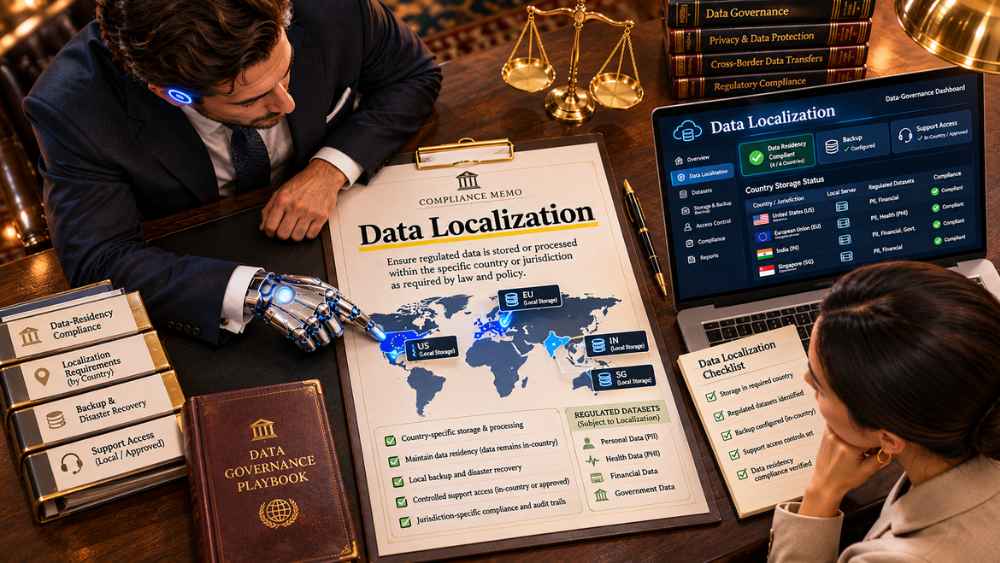
“The data-governance team mapped localization requirements to each regulated dataset and verified storage, backup, support-access, and subprocessor locations with the cloud provider.”
What Is Data Localization?
Data localization refers to legal or administrative requirements that specified data be stored or processed within a particular country or jurisdictionLegal DisputeA legal dispute is a disagreement or controversy involving claimed legal rights, duties, liabilities, property, or remedies. It can be resolved through negotiation, mediation, arbitration, administrative proceedings, litigation, or settlement depending on the...View definition . Requirements can range from keeping a local copy to restricting or prohibiting certain overseas storage or processing.
See the OECD overview of data localisation trends and challenges.
Standard Data Localization — Sample Contract Language
A financial-services company learns that a jurisdiction requires certain regulated records to remain locally stored. It separates the covered dataset, selects compliant hosting and backup regions, restricts remote access, and documents vendor commitments.
Why Is Data Localization Important?
Localization rules can reshape cloud architecture, vendor selection, backup design, remote support, disaster recovery, and global operating models. The requirements are highly jurisdiction- and sector-specific.
How Does Data Localization Work?
Organizations identify which data categories are covered, what location requirement applies, and whether the rule concerns storage, processing, copies, access, computing facilities, or transfer restrictionsOperating AgreementAn operating agreement is a contract that governs an LLC’s ownership, management, finances, and internal affairs. It can define voting rights, contributions, distributions, transfers, buyouts, management authority, and other rules while remaining subject...View definition . Technical architecture and contracts are then aligned to the legal requirement.
What Rules Govern Data Localization?
There is no single global definition or localization regime. OECD analysis describes measures ranging from local-storage requirements that still permit foreign processing to more restrictive local storage-and-processing mandates with tight limits on transfers.
How Is Data Localization Different From Related Concepts?
Data residency describes where data is located as a factual matter, while data localization usually refers to a legal or administrative requirement concerning location. Cross-border transfer rules may condition transfers without requiring the data to remain local.
What Should Practitioners Check?
Check primary law for the specific country and sector, then verify production storage, backups, replicas, administratorProbate CourtProbate court is a state court, or a division of a state court, that handles estates and related matters after death. It can validate wills, appoint personal representatives, supervise administration, resolve creditor and...View definition access, encryption-key location, subprocessors, and disaster-recovery regions. Contractual promises should match the provider’s real architecture.
Can AI Assist With Data Localization?
AI can help map data flows, compare contracts, summarize questionnaires, and identify inconsistencies across records. Legal triggers, jurisdiction-specific requirements, risk judgments, and final mitigationForce MajeureForce Majeure is a contract concept that can excuse or delay performance after extraordinary events covered by the agreement. Relief depends on clause wording, causation, notice, mitigation, exclusions, governing law, and the specific...View definition decisions require accountable human review.
Data Localization Example
A financial-services company learns that a jurisdiction requires certain regulated records to remain locally stored. It separates the covered dataset, selects compliant hosting and backup regions, restricts remote access, and documents vendor commitments.
Why Does Data Localization Matter?
Data localization is a family of location requirements rather than one universal rule. Compliance requires both precise legal interpretation and detailed technical mapping.