
Probate Court
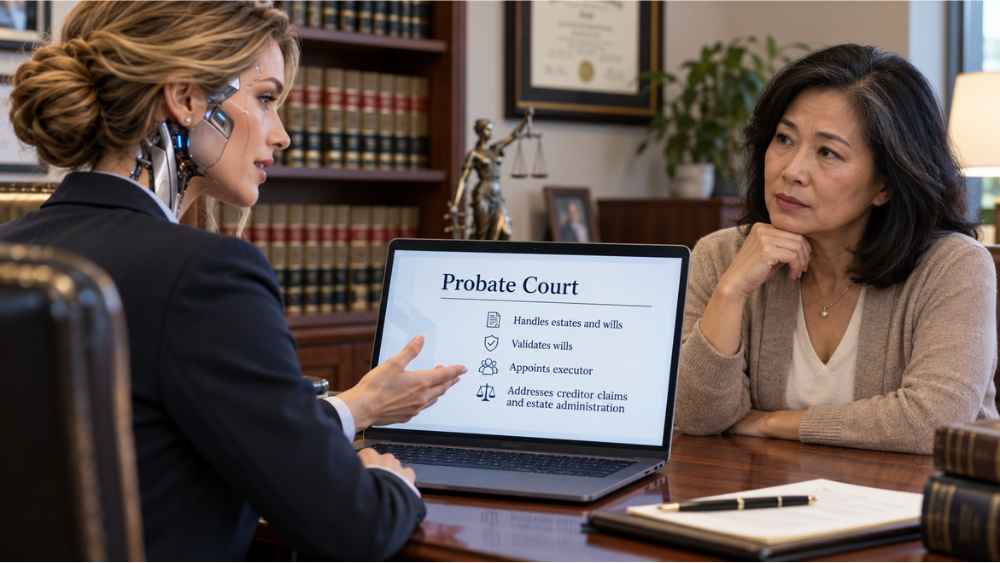
“The executor filed a petition in probate court to admit the will, obtain authority to administer the estate, and begin addressing creditor claims.”
What Is Probate Court?
Probate courtProbate JudgeA probate judge presides over wills, estates, guardianships, conservatorships, and other probate matters assigned by state law.View definition is a state courtState CourtA state court is a court established under a state constitution and state law. State courts hear the vast majority of U.S. civil and criminal cases, and their structures, names, procedural rules, and...View definition or state-court division. It handles estates and related matters after a person dies.
Its duties can include validating wills, appointing personal representatives, supervising estate administration, and resolving disputes among interested parties.
Court names and jurisdictionLegal DisputeA legal dispute is a disagreement or controversy involving claimed legal rights, duties, liabilities, property, or remedies. It can be resolved through negotiation, mediation, arbitration, administrative proceedings, litigation, or settlement depending on the...View definition vary by state. See Cornell LII’s probate overview.
Standard Probate Court — Sample Contract Language
Suppose a person dies with a valid will and individually owned property.
What Does Probate Court Do?
Probate court supervises the legal process for administering certain property and obligations after death.
For example, the court can determine whether a will is valid and appoint an executor.
Therefore, probate court often provides legal authorityLegal AuthorityLegal authority is a source supporting a proposition of law and can be primary or secondary, binding or persuasive depending on jurisdiction and hierarchy.View definition for estate administration.
What Is Probate?
Probate is the judicial process for validating a will and administering a decedent’s estate.
The process can include collecting assets, paying debts, resolving claims, and distributing property.
However, not every asset passes through probate.
Who Is the Decedent?
The decedent is the person who died.
Probate proceedings focus on the decedent’s estate and legal affairs.
Therefore, the decedent’s domicile can affect which state court has authority.
What Is a Probate Estate?
A probate estate generally includes property that passes through court-supervised estate administration.
It often includes assets owned in the decedent’s individual name without a controlling survivorship or beneficiaryLetter of CreditA Letter of Credit is a documentary undertaking by an issuer to pay a beneficiary when a complying presentation is made.View definition mechanism.
Therefore, probate assets differ from many nonprobate assets.
What Is a Will?
A will is a legal document directing how specified property should pass after death.
It can also nominate an executor and address other estate matters.
However, the will must satisfy applicable state-law requirements.
What Does It Mean to Admit a Will to Probate?
Admitting a will to probate means the court accepts the document as the decedent’s valid will for estate administration.
The court can examine execution requirements, capacity, and objections.
Therefore, admissionDirect EvidenceDirect Evidence proves a fact without requiring an additional inference about that fact. Examples can include eyewitness testimony, admissions, recordings, photographs, contracts, and other evidence that directly addresses the disputed issue.View definition to probate gives the personal representative authority to proceed under the will.
What Happens If There Is No Will?
A person who dies without a valid will dies intestate.
State intestacy law then determines who inherits probate property.
Therefore, family relationships and state statutesPrimary AuthorityPrimary Authority is law issued by an institution with official power to create or state legal rules. Constitutions, statutes, regulations, court decisions, and court rules can be primary authority, while binding effect depends...View definition become central.
What Is Intestate Succession?
Intestate succession is the statutory system for distributing probate property when no valid will controls.
Spouses, descendants, parents, or other relatives can inherit depending on state law.
Therefore, intestacy rules vary from state to state.
Who Is a Personal Representative?
A personal representative administers the estate under court authority.
The term can include an executor named in a will or an administrator appointed by the court.
See Cornell LII’s personal representative overview.
What Is an Executor?
An executor is a personal representative nominated in a will.
The court usually must appoint the executor before formal authority begins.
Therefore, nomination in a will does not always create immediate authority.
What Is an Administrator?
An administrator is a personal representative appointed when no qualifying executor serves.
This often occurs in an intestate estate.
Therefore, the court can appoint someone to manage the estate even without a will.
What Are Letters Testamentary?
Letters testamentary are court-issued documents showing an executor’s authority in many jurisdictions.
Banks and other institutions can request them before releasing estate assets.
However, terminology differs among states.
What Are Letters of Administration?
Letters of administration can document an administrator’s court-appointed authority.
They serve a similar practical purpose to letters testamentary.
Therefore, the correct document depends on the estate and jurisdiction.
What Is a Probate Petition?
A probate petition asks the court to open an estate proceeding or grant specified relief.
For example, a petition can seek appointment of a personal representative.
Therefore, probate usually begins with a formal filing.
Who Are Heirs?
Heirs are people entitled to inherit under intestacy law.
They are not always the same people named in a will.
Therefore, probate papers often identify both heirs and will beneficiaries.
Who Are Beneficiaries?
Beneficiaries are people or entities entitled to receive property under a will, trust, or other arrangement.
In probate, will beneficiaries can receive estate distributions after required obligations are addressed.
Therefore, beneficiaries have an interest in proper estate administration.
What Are Estate Creditors?
Estate creditors are people or entities asserting claims against the decedent or estate.
The personal representative may need to give notice and evaluate creditor claims.
Therefore, valid debts can reduce property available for beneficiaries.
How Are Creditor Claims Handled?
Probate law usually provides deadlines and procedures for creditor claims.
The personal representative can allow or dispute claims.
Therefore, creditors should follow state-specific filing and notice rules.
What Is an Estate Inventory?
An estate inventory identifies probate assets and often provides values.
It can include real estate, bank accounts, investments, vehicles, and personal property.
Therefore, inventory requirements help the court and interested parties understand the estate.
What Is Estate Accounting?
An estate accounting reports receipts, expenses, distributions, and other financial activity.
Some estates require court approval of an accounting.
Therefore, accurate records are important for personal representatives.
What Is a Probate Bond?
A probate bond can protect the estate from certain losses caused by a personal representative.
The court or state law can require a bond.
However, a valid will can sometimes waive the requirement.
What Is a Will Contest?
A will contest challenges the validity of a purported will.
Common allegations can involve lack of capacity, undue influence, fraud, or improper execution.
Therefore, a contested probate can become formal litigation.
What Is Testamentary Capacity?
Testamentary capacityLegal CapacityLegal capacity is the legally recognized ability to make a decision or perform an effective legal act. The required level depends on the transaction, timing, jurisdiction, and governing legal standard.View definition concerns whether a person had the legal mental capacity to make a valid will.
The required standard comes from state law.
Therefore, medical evidence and witness testimonyDirect ExaminationDirect Examination is questioning of a witness by the party that called the witness. It generally uses nonleading questions to establish personal knowledge, foundation, facts, exhibits, and expert opinions before cross-examination.View definition can become important in a contest.
What Is Undue Influence?
Undue influence can invalidate a will when improper pressure overcomes the testator’s free intent.
The legal elementsPrima FaciePrima Facie means that evidence is sufficient on its face to establish a claim, fact, or legal issue unless rebutted. The required showing depends on the cause of action, statute, or procedural doctrine.View definition vary by state.
Therefore, suspicious circumstances alone may not establish the claim.
What Is a Holographic Will?
A holographic will is a handwritten will recognized under the laws of some states.
Requirements vary significantly.
Therefore, a handwritten document is not automatically valid everywhere.
What Is a Small Estate Procedure?
Many states offerOffer and AcceptanceOffer and Acceptance describes how parties manifest mutual assent to a contract. A valid offer gives another party power to accept, while acceptance must objectively communicate assent through an authorized method, subject to...View definition simplified procedures for estates below specified thresholds or meeting other requirements.
These procedures can reduce court involvement.
Therefore, a full probate case may not be necessary for every estate.
What Property Avoids Probate?
Some property passes outside probate through another legal mechanism.
Examples can include jointly owned survivorship property and accounts with valid beneficiary designations.
Assets held in a properly funded trust can also avoid ordinary probate administration.
Do Life Insurance Proceeds Go Through Probate?
Life insurance proceeds usually pass directly to a valid named beneficiary.
However, proceeds can enter probate if the estate is the beneficiary or no beneficiary survives.
Therefore, beneficiary designations matter.
Do Retirement Accounts Go Through Probate?
Retirement accounts often pass to named beneficiaries outside probate.
However, the account can become part of the probate estate in some circumstances.
Therefore, plan documents and beneficiary designations should be reviewed.
Does Jointly Owned Property Go Through Probate?
Property with a valid survivorship feature can pass automatically to the surviving owner.
Other forms of co-ownership can require probate.
Therefore, the title form matters.
What Is Ancillary Probate?
Ancillary probate is an additional probate proceeding in another state where the decedent owned property.
It commonly involves real estate located outside the primary probate state.
Therefore, multistate ownership can increase estate-administration complexity.
What Is a Probate Hearing?
A probate hearing allows the court to consider petitions, objections, accountings, or other estate issues.
Some matters are uncontested and brief.
However, disputed matters can require testimony and evidentiary hearings.
Can Probate Court Handle Guardianships?
In some states, probate courts or probate divisions also handle guardianships and conservatorships.
Other states assign those matters to different courts.
Therefore, local courtMunicipal CourtA Municipal Court is a local court whose authority is defined by state law, city law, or both. Many municipal courts have limited jurisdiction over traffic, misdemeanors, ordinances, protective orders, or smaller civil...View definition structure should be checked.
Can Probate Court Handle Trust Disputes?
Some probate courts hear trust administration and trust litigation.
For example, beneficiaries can dispute trustee conduct or trust interpretation.
However, jurisdiction varies by state.
Can Probate Court Remove an Executor?
Yes, when state law permits removal and the required grounds are proven.
Examples can include serious misconduct, incapacity, or failure to perform required duties.
Therefore, personal representatives remain accountable to legal standards.
Can Probate Court Interpret a Will?
Yes. Courts can resolve disputes over the meaning of will provisions.
For example, beneficiaries can disagree about which property a clause describes.
Therefore, probate can involve both validity and interpretation.
How Long Does Probate Take?
Timing depends on state procedures, estate complexity, creditor periods, taxes, and disputes.
Simple estates can move faster than contested or complex estates.
Therefore, there is no single nationwide probate timeline.
How Much Does Probate Cost?
Costs can include filing feesClerk of CourtA Clerk of Court manages a court’s major nonjudicial functions, including dockets, records, filings, notices, fees, jury administration, and operational systems. The clerk supports judicial work but does not decide the merits of...View definition , publication, appraisal, bond, attorney feesMotion to CompelA motion to compel asks a court to order required discovery or disclosure when another party or person has not responded adequately. In federal civil cases, Rule 37 generally requires good-faith conference efforts...View definition , and personal-representative expenses.
Some states regulate or calculate certain fees by statuteStatutory LawStatutory law is written law enacted by a legislative body through the formal lawmaking process. Federal and state statutes can create rights, duties, prohibitions, causes of action, procedures, penalties, and remedies, and courts...View definition .
Therefore, total cost depends on the estate and jurisdiction.
Can Probate Court Orders Be Appealed?
Many final probate orders can be appealed under state appellate rules.
However, appealability and deadlines vary by order type and state.
Therefore, parties should identify deadlines promptly.
Probate Court vs. Family Court
Probate court focuses on estates and related matters.
Family courtFamily CourtFamily Court is a court or specialized division that handles specified family-law matters such as custody, support, divorce, parentage, domestic violence, adoption, or juvenile issues. Its structure, jurisdiction, procedures, privacy rules, and appeal...View definition focuses on divorce, custody, support, and similar family disputes.
However, some states combine these functions within one court system.
Probate Court vs. Civil Court
Probate is generally a civil legal process.
However, many states assign probate matters to a specialized court or division.
Therefore, the phrase “civil court” does not identify the correct probate venue by itself.
Probate Court Example
Suppose a person dies with a valid will and individually owned property.
The nominated executor petitions the probate court for appointment.
The estate then addresses assets, creditor claims, taxes, and distributions under court-supervised procedures.
Why Does Probate Court Matter?
Probate court provides legal authority for administering estates and resolving disputes after death.
However, state law controls procedure, jurisdiction, and many substantive rights.
The key questions are practical. Is probate required? Which court has jurisdiction? Who should serve? Which assets belong to the estate?