
Digital Evidence
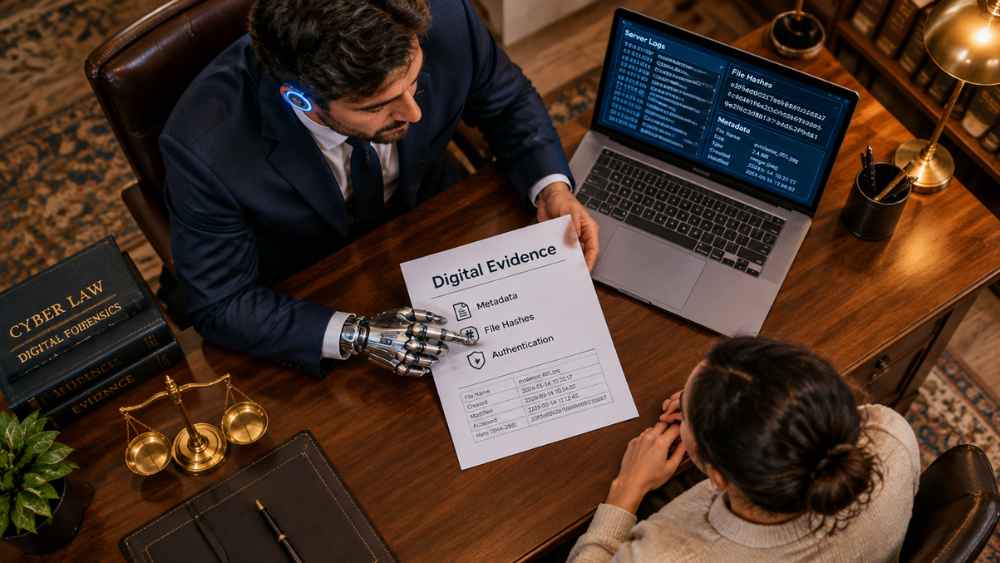
“Counsel authenticated the Digital Evidence using native files, metadata, server logs, witness testimony, and matching forensic hash values.”
What Is Digital Evidence?
Digital EvidenceDirect EvidenceDirect Evidence proves a fact without requiring an additional inference about that fact. Examples can include eyewitness testimony, admissions, recordings, photographs, contracts, and other evidence that directly addresses the disputed issue.View definition is information stored, transmitted, or generated electronically and offered to prove a fact.
Examples include email, texts, photographs, video, metadataRequest for ProductionA Request for Production is a civil discovery request for documents, electronically stored information, tangible things, or inspection access. In federal court, Rule 34 governs requests to parties and sets requirements for particularity,...View definition , logs, cloud data, and device records.
Therefore, digital evidence can appear in nearly every type of modern case.
Standard Digital Evidence — Sample Contract Language
Suppose a fraud case turns on a series of payment instructions sent by email.
Is Digital Evidence Automatically Admissible?
No. Digital evidence must satisfy the same basic admissibilityRelevanceRelevance asks whether evidence tends to make a consequential fact more or less probable. Federal Rules 401 and 402 establish the basic threshold, while Rule 403 permits exclusion when specified dangers substantially outweigh probative value.View definition rules as other evidence.
Relevance, authenticationAdmissible EvidenceAdmissible Evidence is evidence a court permits the judge or jury to consider. In federal court, admissibility commonly depends on relevance, Rule 403 balancing, authentication, foundation, hearsay rules, privilege, witness competence, and other...View definition , hearsay, privilege, Rule 403, and original-writing rules can apply.
Therefore, technical reliability alone does not guarantee admission.
What Is Authentication?
Authentication requires evidence sufficient to support a finding that the item is what the proponent claims.
Federal Rule of Evidence 901AuthenticationAuthentication is the evidentiary process of showing that an item is what its proponent claims it is. Federal Rules 901 and 902 permit authentication through witness knowledge, distinctive characteristics, system evidence, certifications, digital...View definition provides the general standard.
Therefore, the proponent needs a foundationDirect ExaminationDirect Examination is questioning of a witness by the party that called the witness. It generally uses nonleading questions to establish personal knowledge, foundation, facts, exhibits, and expert opinions before cross-examination.View definition linking the evidence to its claimed source. See Federal Rule of Evidence 901.
How Can Digital Evidence Be Authenticated?
Authentication can come from witness testimony, distinctive characteristics, metadata, system evidence, hashes, records, or other methods.
No single method fits every item.
Therefore, foundation should match the technology involved.
What Is Self-Authentication?
Federal Rule of Evidence 902 allows specified evidence to be authenticated without live foundational testimony.
Digital records can qualify under Rules 902(13) and 902(14) with proper certification.
Therefore, certification can streamline technical foundation. See Federal Rule of Evidence 902.
What Is Rule 902(13)?
Rule 902(13) covers qualifying records generated by an electronic process or system.
A certification must satisfy the Rule’s requirements.
Therefore, system-generated logs can sometimes avoid live authentication testimony.
What Is Rule 902(14)?
Rule 902(14) covers qualifying data copied from an electronic device, storage medium, or file through digital identification.
Hash values are a common identification method.
Therefore, forensic copies can often use certification.
What Is a Hash Value?
A hash valueChain of CustodyChain of Custody is the documented history showing who collected, handled, transferred, stored, tested, and preserved evidence. It supports authentication and integrity, especially for fungible, biological, forensic, and digital evidence, while serious gaps...View definition is a digital fingerprint produced by applying a mathematical function to data.
Matching hashes can support evidence that two digital copies are identical.
Therefore, hashes are useful for integrity and chain-of-custody documentation.
What Is Metadata?
Metadata is data describing another digital record.
It can show creation dates, modification times, authors, device information, geolocation, paths, or system events.
Therefore, metadata can provide both substantive evidence and authentication support.
Can Email Be Digital Evidence?
Yes. Email can prove communications, notice, intent, timing, business activity, or other facts.
Authentication and hearsay rules still apply.
Therefore, sender address alone may not always establish authorship.
Can Text Messages Be Evidence?
Yes. Text messages can be admitted when properly authenticated and otherwise admissible.
Context, phone records, content, witnesses, and device data can support attribution.
Therefore, screenshots alone can require additional foundation.
Can Social Media Posts Be Evidence?
Yes. Posts, messages, profiles, and media can provide relevant evidence.
The proponent must connect the content to the claimed person or account.
Therefore, account name alone may not be enough.
Can Screenshots Be Evidence?
Yes. A screenshot can accurately capture a digital display at a point in time.
However, screenshots can omit metadata, context, or later edits.
Therefore, stronger preservation methods can improve reliability.
Can Photographs Be Digital Evidence?
Yes. Digital photographs can show scenes, injuries, property, documents, or other facts.
Witness testimony or technical evidence can authenticate them.
Therefore, file metadata can supplement visual foundation.
Can Video Be Digital Evidence?
Yes. Surveillance, body-camera, phone, meeting, and social-media video can be evidence.
Authenticity, completeness, timestamps, and editing can become disputed.
Therefore, original files should be preserved when possible.
Can Audio Recordings Be Digital Evidence?
Yes. Audio can prove words, identity, timing, or events.
Recording laws and hearsay rules can create separate issues.
Therefore, lawful acquisitionMergerA merger is a corporate transaction combining entities under statute so that one survives or a new entity results, with assets and liabilities transferring according to law.View definition and authentication both matter.
What Are System Logs?
System logs record events generated by software, devices, networks, or applications.
They can show logins, access, errors, transactions, or configuration changes.
Therefore, system architecture and time settings can affect interpretation.
What Is Cloud Evidence?
Cloud evidence is information stored or processed through remote hosted systems.
Examples include SaaS logs, cloud documents, backups, and collaboration content.
Therefore, collection can require provider records and account-specific exports.
What Is Mobile Device Evidence?
Mobile evidence can include texts, app data, call records, photos, location information, and device logs.
Collection methods should preserve relevant data without unnecessary alteration.
Therefore, forensic expertise can be important.
What Is Computer Forensics?
Computer forensics uses structured methods to identify, preserve, collect, examine, and report digital information.
Forensic tools can create validated copies and detailed acquisition records.
Therefore, repeatable methods support evidentiary reliability.
What Is a Forensic Image?
A forensic image is a bit-level copy of digital storage created for examination.
Investigators can calculate hashes before and after copying.
Therefore, examination can proceed without altering the original media.
What Is Chain of Custody?
Chain of custody documents who collected, possessed, transferred, stored, or examined evidence.
Digital evidence also benefits from hashes and access logs.
Therefore, chain records help show integrity over time.
Does Every Chain-of-Custody Gap Exclude Evidence?
No. Courts generally consider whether the foundation sufficiently supports authenticity.
Some gaps affect weight rather than admissibility.
Therefore, the significance of a gap depends on the circumstances.
What Is the Best Evidence Rule?
Federal Rules 1001 through 1004 govern proof of writings, recordings, and photographs.
Electronic information receives specialized treatment under Rule 1001Best Evidence RuleThe Best Evidence Rule generally requires an original writing, recording, or photograph when a party seeks to prove its content. Federal Evidence Rules 1001–1008 define originals and duplicates, permit reliable copies, and provide...View definition .
Therefore, digital outputs can qualify as originals in appropriate circumstances. See Federal Rule of Evidence 1001.
What Is an Original Electronic Record?
For electronically stored information, an original can include a printout or other output that accurately reflects the information.
The precise rule depends on the item and purpose.
Therefore, “original” does not always mean the physical storage device.
What Is a Duplicate?
Rule 1001 defines duplicates made by methods that accurately reproduce the original.
Rule 1003 generally permits duplicates unless authenticity or fairness concerns arise.
Therefore, a faithful digital copy can often be used.
Can Digital Evidence Be Hearsay?
Yes. Human statements contained in digital records can satisfy the hearsay definitionHearsay DefinitionHearsay is an out-of-court statement offered to prove the truth of what the statement asserts. Federal evidence rules generally restrict hearsay, but many exclusions and exceptions can allow particular statements into evidence.View definition .
Exceptions or exclusions can still permit admission.
Therefore, authentication and hearsay are separate questions.
Are Machine-Generated Records Hearsay?
Purely machine-generated data may not be a human statement under hearsay doctrine.
However, embedded human inputs can raise hearsay issues.
Therefore, the source of each data element should be identified.
Can Business Records Include Digital Evidence?
Yes. Electronic business recordsDocumentary EvidenceDocumentary evidence includes paper and electronic records offered in court. Its admissibility commonly depends on relevance, authentication, hearsay rules, and the Federal Rules governing writings, recordings, and photographs.View definition can qualify under the business-records exception when requirements are met.
A custodian or certification can establish foundation.
Therefore, ordinary system records can be admissible without every creator testifying.
What Is Rule 403?
Rule 403 allows exclusion when specified dangers substantially outweigh probative value.
Confusing technical presentations or highly prejudicial digital content can trigger review.
Therefore, relevant digital evidence can still be limited.
What Is Digital Evidence Preservation?
Preservation keeps relevant digital information from being lost, overwritten, altered, or deleted.
Legal holds often suspend routine deletion when litigationLegal DisputeA legal dispute is a disagreement or controversy involving claimed legal rights, duties, liabilities, property, or remedies. It can be resolved through negotiation, mediation, arbitration, administrative proceedings, litigation, or settlement depending on the...View definition is reasonably anticipated.
Therefore, preservation should begin before collection.
How Does Rule 37(e) Apply?
Rule 37(e)Legal HoldA Legal Hold is a process for preserving information that may be relevant to pending or reasonably anticipated litigation. It can suspend routine deletion, identify custodians and systems, preserve ESI and physical evidence,...View definition addresses lost ESI when a party failed to take reasonable preservation steps.
The available measures depend on prejudiceLachesLaches is an equitable defense based on unreasonable delay that materially prejudices another party. It differs from a statute of limitations and is subject to important limits when federal statutes establish specific filing...View definition and intent.
Therefore, ESI preservation has specific federal consequences. See Federal Rule of Civil Procedure 37.
What Is Spoliation?
Spoliation concerns loss, destruction, or alteration of evidence subject to a preservation duty.
Digital spoliation can involve auto-delete, account deletion, overwriting, or device replacement.
Therefore, retention settings can become litigation evidence themselves.
What Is Native Format?
Native format preserves a file in the application format in which it ordinarily exists.
Native files can retain metadata that PDFs or screenshots omit.
Therefore, production format can affect evidentiary value.
What Is a Load File?
A load file provides structured metadata and document relationships for review platforms.
Litigation productions often use load files for large data sets.
Therefore, technical production specifications can matter greatly.
What Is Deepfake Evidence?
A deepfake is synthetic or manipulated media created to imitate real people or events.
Authenticity challenges can require provenance, metadata, expert analysis, and source comparison.
Therefore, modern evidence practice increasingly requires media verificationVerified ComplaintA verified complaint is a complaint accompanied by a sworn verification or declaration under penalty of perjury confirming specified factual allegations.View definition .
What Is Digital Provenance?
Digital provenance describes the origin and history of a digital item.
It can include creation source, metadata, signatures, logs, hashes, and custody information.
Therefore, provenance helps courts assess authenticity and integrity.
Digital Evidence Example
Suppose a fraud case turns on a series of payment instructions sent by email.
The proponent preserves native messages, headers, server logs, and forensic hashes.
Therefore, several independent sources can support authenticity and timing.
Why Does Digital Evidence Matter?
Digital evidence captures communications, transactions, activity, location, and system events that traditional evidence may miss.
However, authenticity, hearsay, integrity, preservation, and technical context still require careful proof.
Therefore, legal and forensic analysis should work together.