
E-Filing
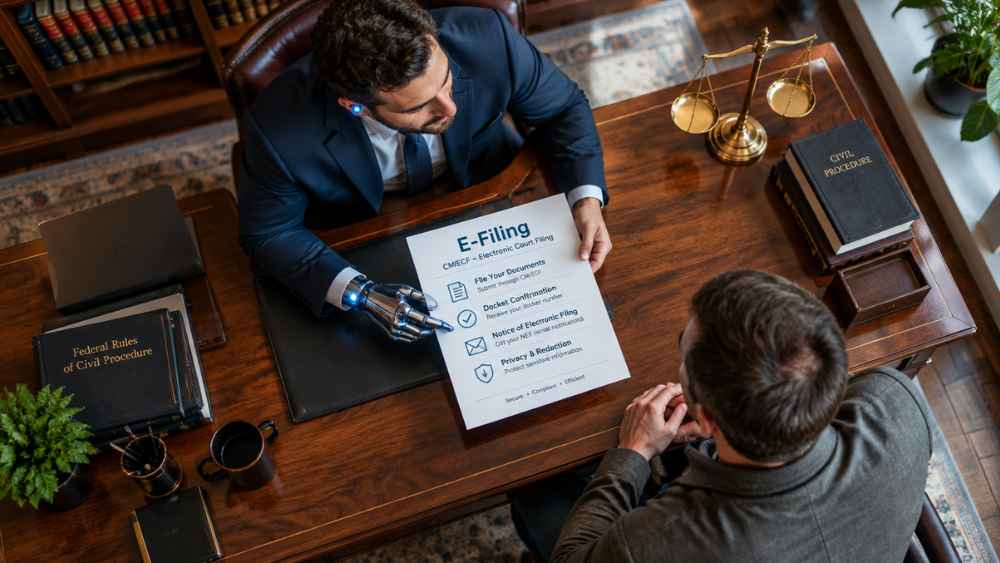
“Counsel completed E-Filing through CM/ECF, verified the docket entry, saved the Notice of Electronic Filing, and confirmed required privacy redactions.”
What Is E-Filing?
E-Filing is the electronic submission of court documents through an authorized filing system.
Federal courts use the Case Management/Electronic Case Files system, or CM/ECF.
Therefore, electronic filingClerk of CourtA Clerk of Court manages a court’s major nonjudicial functions, including dockets, records, filings, notices, fees, jury administration, and operational systems. The clerk supports judicial work but does not decide the merits of...View definition is part of modern court procedure. See U.S. Courts CM/ECF guidance.
Standard E-Filing — Sample Contract Language
Suppose counsel uploads a motionMotionA Motion is a formal request asking a court to issue an order or grant specific relief. Federal Rule 7(b) generally requires motions to state their grounds with particularity and identify the relief...View definition in PDF through the authorized CM/ECF event.
What Is CM/ECF?
CM/ECF is the federal Judiciary’s electronic case-management and filing system.
It accepts pleadings, motions, petitions, and other case documents online.
Therefore, it combines docket management with electronic filing.
What Is PACER’s Role?
PACERCourt ClerkA Court Clerk is a nonjudicial officer who manages filings, dockets, records, notices, fees, jury administration, technology, and other court operations. Clerks can provide neutral procedural information but cannot decide cases, interpret court...View definition provides account access and public electronic access to federal courtFederal CourtA federal court is a court within the U.S. federal judicial system. Federal courts have limited jurisdiction, so they hear only cases authorized by the Constitution or federal law, including many federal-question and...View definition court recordsClerk of CourtA Clerk of Court manages a court’s major nonjudicial functions, including dockets, records, filings, notices, fees, jury administration, and operational systems. The clerk supports judicial work but does not decide the merits of...View definition .
Filing privileges remain court-specific.
Therefore, a PACER account alone does not automatically authorize filing everywhere.
Is E-Filing Available 24 Hours?
Federal CM/ECF generally permits registered filing at all hours.
Maintenance outages and local rules can affect availability.
Therefore, filers should not wait until the last minutes before a deadline.
What File Format Is Used?
Federal CM/ECF accepts court filings in PDF format.
Individual courts can impose file-size and technical requirements.
Therefore, local technical rules should be checked. See PACER filing guidance.
Who Can E-File?
Attorneys commonly receive e-filing privileges after admissionDirect EvidenceDirect Evidence proves a fact without requiring an additional inference about that fact. Examples can include eyewitness testimony, admissions, recordings, photographs, contracts, and other evidence that directly addresses the disputed issue.View definition and registration.
Some courts permit authorized pro seSmall Claims CourtSmall claims court is a state court process for resolving lower-value civil disputes through simplified procedures. Claim limits, attorney rules, appeal rights, and available remedies vary by state and sometimes by the type...View definition or bankruptcy users to file electronically.
Therefore, filer eligibility depends on the court.
Does E-Filing Replace Court Rules?
No. Electronic filing is only a filing method.
The document still must satisfy substantive, procedural, formatting, and signature rules.
Therefore, successful upload does not cure legal defects.
What Does Rule 5 Say About E-Filing?
Federal Rule 5 authorizes electronic filing under applicable court procedures.
Registered electronic filing can also accomplish service in many circumstances.
Therefore, e-filing and e-service often operate together. See Federal Rule of Civil Procedure 5.
Does E-Filing Serve the Summons?
No. Initial service of processAffidavit of ServiceAn affidavit of service is a sworn statement documenting how and when legal papers were served and can provide proof of notice for jurisdiction, deadlines, and court procedure.View definition generally follows Rule 4SummonsA summons is a court-issued document notifying a defendant that a lawsuit has been filed and requiring a response. In federal civil cases, Rule 4 governs summons contents, issuance, service, waiver, proof of...View definition rather than ordinary electronic filing.
Electronic serviceCertificate of ServiceA certificate of service records when and how a legal filing was served on required parties and helps establish compliance with procedural notice rules.View definition applies mainly to later papers.
Therefore, docket filing and initial service should be separated.
What Is a Notice of Electronic Filing?
CM/ECF generates a Notice of Electronic Filing when a document is docketed.
Registered recipients can receive electronic notice.
Therefore, the notice is an important filing record.
When Is an E-Filing Complete?
Completion depends on the court system’s docketing confirmation and local procedures.
A failed upload is not a completed filing.
Therefore, filers should save confirmation records.
What If CM/ECF Is Unavailable?
Courts publish procedures for outages and emergency filing situations.
Relief depends on local rules and circumstances.
Therefore, filers should document technical problems promptly.
Can a Filing Be Corrected After Submission?
Once docketed, a filing becomes part of the court recordTrial CourtA Trial Court is a court where parties present evidence, establish facts, and obtain an initial judgment or verdict. Federal district courts are the primary federal trial courts, while state systems use varied...View definition .
Correction often requires a new filing or clerk assistance.
Therefore, final review before submission matters.
What Are Electronic Signatures?
Courts commonly permit approved electronic signatureDigital SignatureA digital signature is a cryptographic form of electronic signature used to authenticate a signer and verify the integrity of an electronic record.View definition conventions such as typed attorney signatures.
Local rules govern the accepted form.
Therefore, signature requirements should be confirmed for each court.
What Are Privacy Redactions?
Federal court
Rule 5.2 governs privacy protection in federal civil casesCivil DivisionA Civil Division is a court unit handling noncriminal disputes, with jurisdiction and procedures that vary by court system and locality.View definition .
Therefore, e-filing requires deliberate privacy review. See Federal Rule of Civil Procedure 5.2.
Can Sealed Documents Be E-Filed?
Many courts provide special electronic procedures for sealed or restricted filings.
A motion to seal can also be required.
Therefore, confidentialityEmployment ContractAn employment contract is an agreement defining terms of an employer-employee relationship. It can cover duties, compensation, benefits, equity, confidentiality, intellectual property, restrictive covenants, termination, severance, and dispute procedures while remaining subject to...View definition status should be determined before upload.
Does Each Court Use the Same E-Filing Rules?
No. Federal courts use CM/ECF but supplement national rules with local procedures.
State courts use their own systems and requirements.
Therefore, filing instructions are court-specific.
What Is NextGen CM/ECF?
NextGen CM/ECF integrates court filing with upgraded individual PACER accounts.
Federal courts have migrated on different schedules.
Therefore, account linking and privileges can vary by court.
E-Filing Example
Suppose counsel uploads a motion in PDF through the authorized CM/ECF event.
The system dockets the document and generates electronic notice.
Therefore, counsel should save the confirmation and verify the docket entryCourt DocketA court docket is the official chronological record of filings, orders, hearings, and procedural events in a case. Docket entries and dates are essential for case tracking and deadline management.View definition .
Why Does E-Filing Matter?
E-filing speeds submission, service, access, and docket management.
It also creates technical, privacy, and deadline risks when used incorrectly.
Therefore, procedural and technical compliance must work together.