
Tax Court
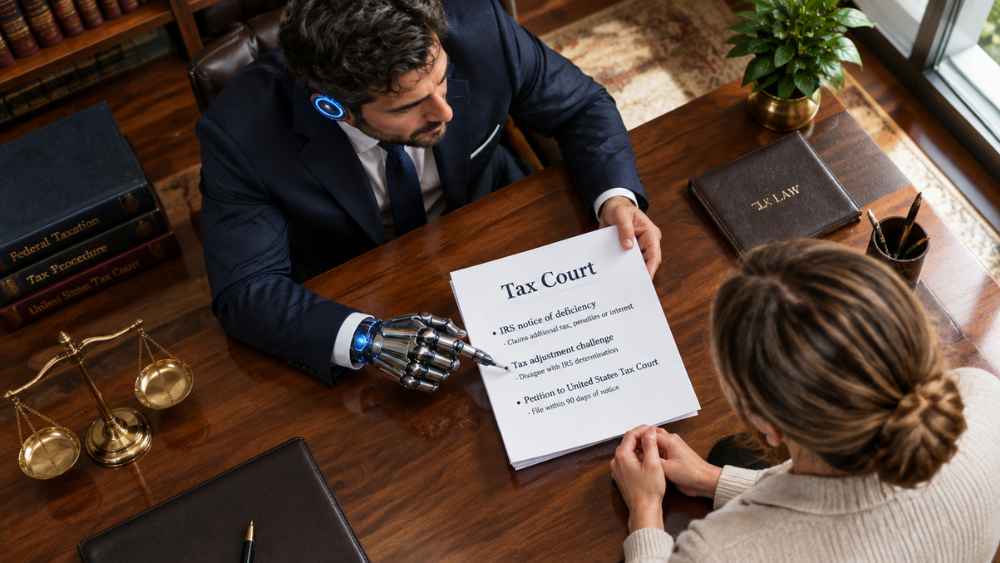
“The taxpayer petitioned the Tax Court after receiving a notice of deficiency and challenged the IRS adjustment before paying the disputed amount.”
What Is the U.S. Tax Court?
The United States Tax Court is an independent federal trial courtFederal District CourtA Federal District Court is a United States trial court that hears federal civil and criminal cases within jurisdiction granted by Congress and the Constitution.View definition for specified disputes between taxpayers and the IRS.
It is a court of record and is not part of the IRS.
Therefore, it provides an independent tax forum. See U.S. Tax Court information.
Standard Tax Court — Sample Contract Language
Suppose the IRS issues a notice of deficiency and the taxpayer disputes the adjustment.
What Types of Cases Does Tax Court Hear?
Its jurisdictionLegal DisputeA legal dispute is a disagreement or controversy involving claimed legal rights, duties, liabilities, property, or remedies. It can be resolved through negotiation, mediation, arbitration, administrative proceedings, litigation, or settlement depending on the...View definition includes deficiency cases and other matters Congress assigns by statuteStatutory LawStatutory law is written law enacted by a legislative body through the formal lawmaking process. Federal and state statutes can create rights, duties, prohibitions, causes of action, procedures, penalties, and remedies, and courts...View definition .
Examples include collection review, innocent-spouse relief, worker classificationIndependent ContractorAn independent contractor is a self-employed person or business providing services without employee status under the applicable legal test. Classification depends on actual facts, and tax, wage, labor, and state laws can use...View definition , interest abatement, and whistleblower matters.
Therefore, jurisdiction depends on a statutory basis.
What Is a Deficiency Case?
A deficiency case challenges an IRS determination that additional tax is due.
A taxpayer generally petitions after receiving a valid notice of deficiency.
Therefore, filing deadlines tied to the notice are critical.
Do Taxpayers Usually Pay First?
One major feature of Tax Court is that a taxpayer can often litigate a deficiency before paying the disputed amount.
Other tax forums often require payment first for refund litigation.
Therefore, forum choice can affect cash flow.
What Is a Collection Due Process Case?
A collection due processEx ParteEx Parte refers to a one-sided request, proceeding, or communication. Courts permit ex parte relief only in authorized circumstances, while professional-conduct rules generally bar private communications with judges unless law or court order...View definition case reviews specified IRS lien or levyWrit of ExecutionA Writ of Execution is court process used to enforce a money judgment against nonexempt property. Federal Rule 69 makes execution the ordinary federal enforcement method while generally incorporating state execution procedure, and...View definition determinations.
The taxpayer petitions after the required administrative process.
Therefore, Tax Court jurisdiction depends on the determination and timely filing.
What Is Innocent-Spouse Jurisdiction?
Tax Court can review qualifying requests for relief from joint and several liabilityLiability DefinitionLiability means legal responsibility for an act, omission, debt, loss, or other obligation. Liability can arise from negligence, contracts, statutes, strict-liability rules, or responsibility for another person’s conduct.View definition under Internal Revenue Code Section 6015.
Different procedural routes can create jurisdiction.
Therefore, taxpayers should check notice and timing rules carefully.
What Is a Small Tax Case?
Eligible disputes involving $50,000 or less can use simplified small-tax-case procedures.
Small-tax-case decisions generally do not permit appealCourt of AppealsA court of appeals is a court that reviews decisions from lower courts. Federal courts of appeals usually examine the existing record for legal error rather than conducting a new trial or hearing...View definition .
Therefore, the election trades simplified procedure for finality. See U.S. Tax Court case procedures.
Who Are the Parties?
The taxpayer who starts the case is generally the petitionerPlaintiffA Plaintiff is the party who initiates a civil lawsuit and asks a court for legal relief. The plaintiff generally files the complaint, establishes standing and jurisdiction, serves the defendant, proves the elements...View definition .
The Commissioner of Internal Revenue is generally the respondentDefendantA Defendant is the person or entity against whom a civil claim or criminal charge is brought. Civil defendants respond to complaints, preserve defenses, challenge jurisdiction, use discovery, assert counterclaims, seek dismissal or...View definition .
Therefore, Tax Court uses different labels from ordinary civil litigationCivil LitigationCivil Litigation is the court process for resolving noncriminal disputes through pleadings, motions, discovery, settlement, trial, judgment, and possible appeal. Federal civil litigation follows the Federal Rules of Civil Procedure, while state systems...View definition .
How Is a Case Started?
A taxpayer files a petition invoking a statutory basis for Tax Court jurisdiction.
The petition must satisfy form and timing requirements.
Therefore, a late petition can defeat review.
Can Tax Court Hear Refund Cases?
Tax Court can determine overpayments in cases properly within its jurisdiction.
It is not a general refund court for every paid tax claim.
Therefore, district courts and the Court of Federal ClaimsCourt of Federal ClaimsThe U.S. Court of Federal Claims is an Article I court with nationwide jurisdiction over specified claims against the United States, especially monetary claims under the Tucker Act and related statutes. Its docket...View definition remain important refund forums.
Does Tax Court Conduct Trials?
Yes. Tax Court is a federal trial court and conducts trials in locations around the country.
Cases can also resolve through settlement or stipulated decision.
Therefore, Tax Court litigation can resemble other civil trials.
Are Tax Court Decisions Appealable?
Parties can generally appeal regular Tax Court decisions to the appropriate U.S. court of appeals.
Small-tax-case decisions generally are not appealable.
Therefore, procedure choice affects appellate rights.
Can a Taxpayer Represent Themselves?
Yes. Many Tax Court petitioners appear without counsel.
The court provides guidance for self-represented taxpayers.
Therefore, representation by a lawyer is not mandatory.
Tax Court vs. District Court
Tax Court often permits prepayment litigation of deficiencies.
District-court tax refund suits generally require full payment of the assessed tax first.
Therefore, forum choice depends on jurisdiction and procedural postureCase BriefA case brief is a structured summary of a judicial opinion covering material facts, procedure, issue, rule, holding, reasoning, and disposition.View definition .
Tax Court vs. Court of Federal Claims
Both can hear certain federal tax disputes but under different jurisdictional paths.
The Court of Federal Claims commonly hears refund suits after payment.
Therefore, the forums are not interchangeable.
Tax Court Example
Suppose the IRS issues a notice of deficiency and the taxpayer disputes the adjustment.
The taxpayer timely petitions Tax Court before paying the disputed deficiency.
Therefore, the court can review the tax determination if jurisdictional requirements are met.
Why Does Tax Court Matter?
Tax Court gives taxpayers an independent national judicial forum for disputes Congress assigns to it.
Its prepayment role is especially important in deficiency cases.
Therefore, statutory notice and filing deadlines deserve immediate attention.