
Work Product Doctrine
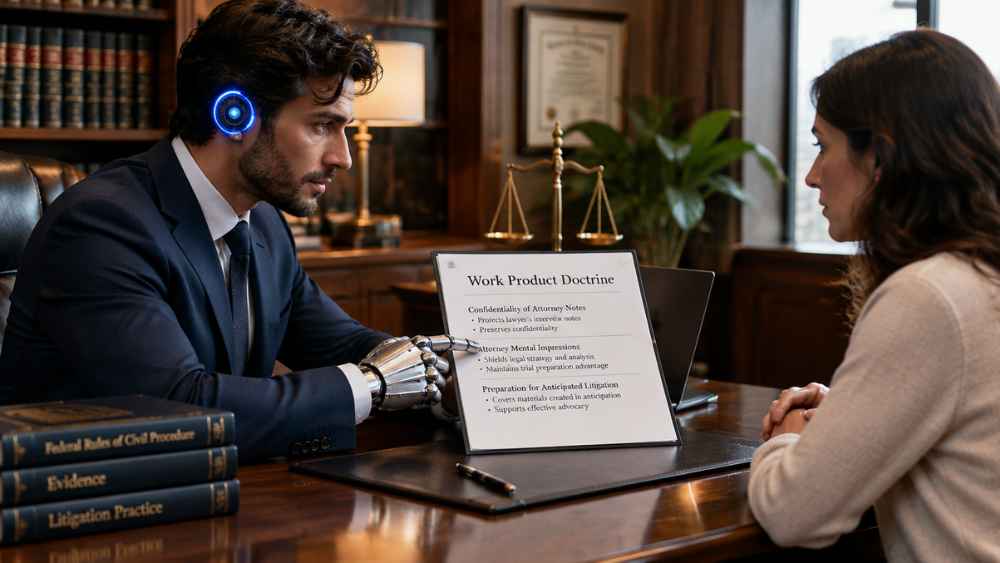
“Counsel asserted the Work Product Doctrine over interview notes prepared after a credible litigation threat because the notes reflected trial preparation and legal impressions.”
What Is the Work Product Doctrine?
The Work Product Doctrine protects qualifying litigation-preparation materials from ordinary discoveryCivil CourtCivil court is a general term for a court handling noncriminal disputes involving people, businesses, organizations, or government entities. Civil cases can involve contracts, injuries, property, employment, civil rights, and other disputes and...View definition .
Federal Rule of Civil Procedure 26(b)(3) codifies the core federal protection.
Therefore, the doctrine preserves private trial preparationPretrial ConferenceA pretrial conference is a court-supervised case-management meeting used to set deadlines, narrow issues, coordinate discovery, improve trial preparation, and facilitate settlement before trial.View definition . See Federal Rule of Civil Procedure 26(b)(3).
Standard Work Product Doctrine — Sample Contract Language
Suppose counsel interviews witnesses after receiving a credible litigationLegal DisputeA legal dispute is a disagreement or controversy involving claimed legal rights, duties, liabilities, property, or remedies. It can be resolved through negotiation, mediation, arbitration, administrative proceedings, litigation, or settlement depending on the...View definition threat.
Where Did the Doctrine Come From?
The Supreme CourtSupreme CourtThe Supreme Court of the United States is the nation’s highest federal court. It reviews selected cases involving the Constitution and federal law, resolves important federal legal questions, and sits at the top...View definition recognized the doctrine in Hickman v. Taylor.
The Court protected an attorney’s private preparation from routine opponent discovery.
Therefore, modern Rule 26 reflects a longstanding adversarial-system principle. See Hickman v. Taylor.
What Materials Can Receive Protection?
Rule 26 protects documents and tangible things prepared in anticipationPrior ArtPrior art is legally available information used to evaluate whether patent claims are novel and nonobvious, including qualifying patents, publications, public uses, sales, and other disclosures.View definition of litigation or for trialLawsuitA lawsuit is a legal dispute brought before a court for a decision or remedy. Civil lawsuits can involve pleadings, service, discovery, motions, settlement, trial, judgment, and possible appeal.View definition .
The material can come from a party or the party’s representative.
Therefore, protection extends beyond documents personally written by counsel.
Who Can Create Work Product?
Lawyers can create work product, but they are not the only qualifying creators.
Consultants, insurers, investigators, agents, and other representatives can create protected material.
Therefore, creator identity matters less than litigation purpose.
What Does “In Anticipation of Litigation” Mean?
Courts ask whether litigation meaningfully caused the material to be prepared.
The exact formulation differs among federal circuits.
Therefore, ordinary business recordsDocumentary EvidenceDocumentary evidence includes paper and electronic records offered in court. Its admissibility commonly depends on relevance, authentication, hearsay rules, and the Federal Rules governing writings, recordings, and photographs.View definition do not become work product merely because litigation is possible.
What Is Ordinary Work Product?
Ordinary work product usually means factual litigation-preparation material.
Examples include witness summaries, investigation records, and factual compilations.
Therefore, ordinary work product receives qualified rather than absolute protection.
What Is Opinion Work Product?
Opinion work product reveals mental impressions, conclusions, opinions, or legal theories about litigation.
Rule 26(b)(3)(B) requires courts to protect those mental processes.
Therefore, opinion work product receives especially strong protection.
Can Ordinary Work Product Be Discovered?
Yes, but only after the requesting party satisfies additional requirements.
The party must show substantial need and inability to obtain a substantial equivalent without undue hardshipAmericans with Disabilities Act (ADA)The Americans with Disabilities Act (ADA) is a federal civil-rights law prohibiting disability discrimination in employment, state and local government services, public accommodations, transportation, and telecommunications. Different ADA titles impose different duties and...View definition .
Therefore, relevanceRelevanceRelevance asks whether evidence tends to make a consequential fact more or less probable. Federal Rules 401 and 402 establish the basic threshold, while Rule 403 permits exclusion when specified dangers substantially outweigh probative value.View definition alone does not overcome the protection.
What Is Substantial Need?
Substantial need means the requested material is genuinely important to preparing the requesting party’s case.
The standard requires more than convenience.
Therefore, courts examine the practical importance of the information.
What Is Undue Hardship?
Undue hardship exists when obtaining equivalent information by other means would be exceptionally difficult or burdensome.
Unavailable witnesses or lost evidence can strengthen the showing.
Therefore, alternative sources matter.
Can Opinion Work Product Be Ordered Produced?
Courts protect opinion work product more strongly than ordinary factual work product.
Supreme Court
Therefore, substantial need alone usually cannot justify disclosure of core legal thought. See Upjohn Co. v. United States.
Does the Doctrine Protect Facts Themselves?
No. The doctrine protects qualifying materials, not underlying historical facts.
An opposing party can still seek the same facts through depositionsDiscovery DefinitionDiscovery is the pretrial process for exchanging information and evidence in a lawsuit. Common discovery tools include document requests, interrogatories, requests for admission, depositions, subpoenas, and expert disclosures.View definition or other discovery.
Therefore, protection does not create ownership of facts.
Does It Protect Witness Statements?
Witness statements prepared for litigation can qualify as work product.
However, Rule 26 gives a person access to that person’s own prior statementWitness StatementA witness statement is a written or recorded account of relevant facts provided by a person with knowledge of an event or dispute.View definition .
Therefore, special rules apply to prior statements.
What Is a Party’s Own Prior Statement?
A party or other person can request that person’s own previous statement about the action or subject matter.
Rule 26(b)(3)(C) permits access without the substantial-need showing.
Therefore, work-product protection does not block this narrow request.
Does the Doctrine Protect Emails?
Yes, when the email otherwise satisfies work-product requirements.
Email format does not change the litigation-preparation analysis.
Therefore, legal teams should assess purpose rather than medium.
Does It Protect Attorney Notes?
Attorney notes about interviews, strategy, and evidence often contain opinion work product.
Purely factual portions can receive qualified protection.
Therefore, notes frequently receive strong discovery protection.
Does It Protect Investigation Files?
Yes, when the investigation occurred because of anticipated litigation.
Routine compliance or business investigations can fall outside the doctrine.
Therefore, dual-purpose investigations require close analysis.
What Is a Dual-Purpose Document?
A dual-purpose document serves both business and litigation functions.
Federal circuits use different tests for determining work-product status.
Therefore, contemporaneous records of purpose can become important.
Work Product vs. Attorney-Client Privilege
Attorney-client privilegeAttorney Client PrivilegeAttorney client privilege generally protects confidential communications between lawyers and clients made for the purpose of seeking or providing legal advice.View definition protects qualifying confidential legal communications.
Work product protects litigation preparation even when no privileged communication exists.
Therefore, the doctrines overlap but have different elements.
Can Work Product Protect Nonlawyer Material?
Yes. Rule 26 expressly covers work by a party or representative.
Representatives can include consultants, insurers, sureties, indemnitors, and agents.
Therefore, attorney authorship is not mandatory.
Does the Doctrine Apply Before a Lawsuit Is Filed?
Yes. Litigation need not already be pending.
The material must still arise from a sufficiently concrete anticipation of litigation.
Therefore, pre-suit preparation can qualify.
Does It Apply After Litigation Ends?
Work-product protection can survive the specific litigation that created it.
Courts can consider later related or unrelated litigation differently.
Therefore, case closure does not automatically erase the doctrine.
Can Sharing Work Product Waive Protection?
Yes, in some circumstances.
Disclosure that substantially increases an adversary’s access can support waiver.
Therefore, work-product waiver differs from ordinary confidentialityEmployment ContractAn employment contract is an agreement defining terms of an employer-employee relationship. It can cover duties, compensation, benefits, equity, confidentiality, intellectual property, restrictive covenants, termination, severance, and dispute procedures while remaining subject to...View definition analysis.
Does Sharing With a Common-Interest Party Always Waive It?
Not necessarily. Sharing with aligned parties can preserve protection in many circumstances.
The exact rule depends on jurisdiction and relationship.
Therefore, parties should document the shared litigation interestPrejudgment InterestPrejudgment Interest compensates a prevailing party for the time value of money lost before judgment and is governed by claim-specific and jurisdiction-specific rules.View definition .
What Is a Work Product Log?
Parties often identify withheld work product on a privilege logRequest for ProductionA Request for Production is a civil discovery request for documents, electronically stored information, tangible things, or inspection access. In federal court, Rule 34 governs requests to parties and sets requirements for particularity,...View definition .
Rule 26(b)(5) requires enough information to assess the claim without revealing protected substance.
Therefore, vague labels can create discovery disputes.
Can Courts Review Work Product In Camera?
Yes. A judgeJudgeA Judge is a judicial officer who presides over legal proceedings, applies law, manages procedure, rules on motions and evidence, and issues orders or judgments. Trial, appellate, Article III, magistrate, bankruptcy, and state...View definition can review disputed material privately when needed to evaluate protection.
The court can separate protected mental impressions from discoverable portions.
Therefore, partial production can sometimes resolve the dispute.
How Does Work Product Apply to Experts?
Rule 26 protects draft expert reports and many attorney-expert communications.
Specific exceptions permit discovery of compensation and certain facts or assumptions.
Therefore, expert discovery has specialized work-product rules.
Are Draft Expert Reports Protected?
Yes. Rule 26(b)(4)(B) protects drafts of expert reports and disclosures.
The protection applies regardless of the draft’s form.
Therefore, electronic drafts receive the same basic protection.
Are Attorney-Expert Communications Protected?
Rule 26(b)(4)(C) protects many communications between counsel and retained testifying experts.
Compensation, supplied facts, and supplied assumptions fall within stated exceptions.
Therefore, attorney-expert protection is strong but not unlimited.
Does Work Product Apply in Criminal Cases?
Yes, but criminal procedure uses separate rules and doctrine.
Federal Rule of Criminal Procedure 16 protects specified attorney and government work product.
Therefore, civil Rule 26 should not be applied mechanically to criminal discovery.
Can Work Product Be Used at Trial?
Work-product status mainly concerns discovery rather than ultimate trial admissibility.
Use of protected material can create waiver or evidentiary issues.
Therefore, trial strategy should consider both protection and disclosure consequences.
Work Product Doctrine Example
Suppose counsel interviews witnesses after receiving a credible litigation threat.
Counsel records factual summaries and legal impressions for trial preparation.
Therefore, the notes can receive work-product protection.
Why Does the Work Product Doctrine Matter?
The doctrine lets lawyers and parties investigate, analyze, and prepare litigation without routine adversary access.
However, factual materials can become discoverable after the required showing.
Therefore, courts balance preparation privacy against genuine discovery need.