
FERPA
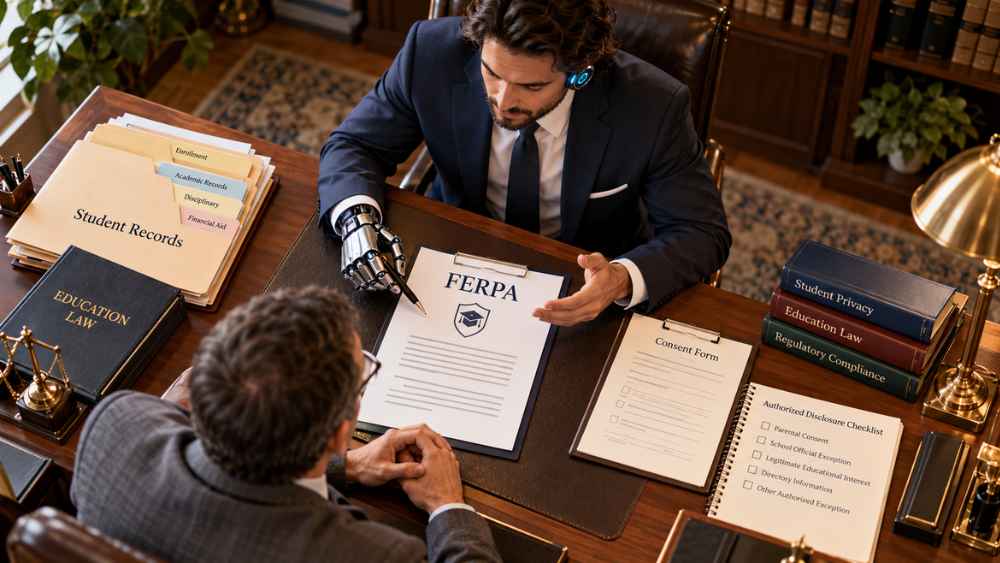
“The university applied FERPA before releasing student records, confirming whether consent or a recognized disclosure exception authorized the request.”
What Is FERPA?
The Family Educational Rights and Privacy Act, or FERPA, protects privacy rightsPrivacy PolicyA Privacy Policy is a public statement explaining how an organization collects, uses, discloses, retains, protects, and otherwise handles personal information. Applicable privacy laws can require specific disclosures about purposes, rights, recipients, retention,...View definition in student education records.
It applies to educational agencies and institutions receiving funds under programs administered by the U.S. Department of Education.
Therefore, schools must manage access, disclosure, amendment, and notice rights carefully. See U.S. Department of Education FERPA regulations.
Standard FERPA — Sample Contract Language
Suppose a university receives a parent request for an adult student’s grades.
Who Enforces FERPA?
The U.S. Department of Education’s Student Privacy Policy Office administers FERPA compliance.
Parents and eligible students can file qualifying complaints with SPPO.
Therefore, FERPA enforcement differs from an ordinary private damagesLegal RemedyA legal remedy is the relief a court or other authorized tribunal can provide after a legal right has been violated. Remedies can include damages, injunctions, restitution, specific performance, rescission, declarations, and other...View definition lawsuitLawsuitA lawsuit is a legal dispute brought before a court for a decision or remedy. Civil lawsuits can involve pleadings, service, discovery, motions, settlement, trial, judgment, and possible appeal.View definition .
What Are Education Records?
Education records directly relate to a student, and a covered school or its agent maintains them.
The definition includes many formats and systems.
Therefore, FERPA is not limited to paper files or transcripts.
What Records Are Generally Excluded?
FERPA contains exclusions for specified records, including certain sole-possession, law-enforcement-unit, employment, treatment, and alumni records.
The precise requirements matter.
Therefore, not every record mentioning a student is an education record.
Who Holds FERPA Rights?
Parents generally hold FERPA rights for students who have not become eligible students.
The rights transfer when the student turns 18 or attends a postsecondary institution at any age.
Therefore, age and educational level matter.
What Is an Eligible Student?
An eligible student is a student who is at least 18 or attends a postsecondary institution at any age.
FERPA rights transfer from the parent to that student.
Therefore, postsecondary schools generally communicate directly with the student. See Department of Education eligible-student guidance.
What Is the Right to Inspect and Review?
Parents and eligible students can inspect and review applicable education records.
Schools must provide access within a reasonable time.
Therefore, record-access procedures should be clear and workable.
What Is the 45-Day FERPA Rule?
A covered educational agency or institution must generally provide access within 45 days after receiving a request.
State law can require a shorter period.
Therefore, schools should track requests promptly. See Department of Education access guidance.
Does FERPA Require Copies?
FERPA generally provides a right to inspect and review rather than an automatic right to copies.
Copies or other arrangements can be required when circumstances effectively prevent meaningful inspection.
Therefore, access format depends on practical circumstances.
Can Schools Charge for Access?
Schools generally cannot charge for searching or retrieving education records.
They can sometimes charge reasonable copy costs.
Therefore, fees cannot effectively prevent exercise of access rights.
What Is the Right to Seek Amendment?
Parents and eligible students can request amendment of records they believe are inaccurate, misleading, or privacy-violating.
FERPA provides procedures for challenging certain record content.
Therefore, schools need amendment and hearing processes.
What Is the General Consent Rule?
FERPA generally requires prior written consentCorporate ResolutionA Corporate Resolution formally records an action approved by a corporation's board or stockholders. Resolutions commonly authorize financing, contracts, equity actions, officer appointments, bank accounts, transactions, and delegated signature authority, and they should...View definition before disclosing personally identifiable information from education records.
However, numerous regulatory exceptions apply.
Therefore, schools should identify a lawful disclosure basis before releasing records.
What Must FERPA Consent Include?
Valid consent must be signed and dated.
It must specify records, disclosure purpose, and the party or class receiving the records.
Therefore, oral consent is generally insufficient. See Department of Education consent guidance.
What Is Personally Identifiable Information Under FERPA?
FERPA PIIPersonal DataPersonal data is information relating to an identified or identifiable person, including direct identifiers and information that can identify or link to an individual in context.View definition includes direct identifiersPersonally Identifiable Information (PII)Personally Identifiable Information (PII) is information that can distinguish or trace an individual’s identity alone or with other linked or linkable information. Common examples include identifiers, contact details, biometrics, financial information, health information,...View definition and information that can identify a student alone or in combination.
Context and linkability can matter.
Therefore, removing a name does not always de-identify an education record.
What Is the School Official Exception?
FERPA can allow disclosure without consent to school officials with legitimate educational interests.
Qualified contractors and service providers can sometimes fit the exception.
Therefore, outsourcing does not eliminate school responsibility.
When Can a Contractor Be a School Official?
A contractor can qualify when it performs an institutional function the school would otherwise use employees to perform.
The school must maintain required control over use and maintenance of education records.
Therefore, contracts and actual practice both matter.
What Is Legitimate Educational Interest?
A school official generally has legitimate educational interest when access is needed to fulfill professional responsibilities.
Schools define criteria in their annual FERPA notice.
Therefore, employee status alone does not authorize unlimited record access.
What Is Directory Information?
Directory information is information that would not generally be harmful or invasive if disclosed.
Schools can designate categories such as name, activities, or dates of attendance.
Therefore, designation and notice requirements matter.
Can Directory Information Be Disclosed Without Consent?
Yes, when the school has properly designated directory information and completed FERPA notice procedures.
Parents or eligible students must receive an opportunity to restrict disclosure.
Therefore, schools should honor valid opt-out requests. See Department of Education directory-information guidance.
What Is the Health or Safety Emergency Exception?
FERPA permits disclosure to appropriate parties during an actual, impending, or imminent health or safety emergency.
The disclosure must relate to the emergency.
Therefore, the exception is not a blanket releaseWaiver DefinitionA waiver is the intentional relinquishment of a known legal right, claim, privilege, or protection. A waiver can be express or implied, although enforceability depends on the right involved, the evidence of intent,...View definition rule. See Department of Education emergency guidance.
What Is the Studies Exception?
FERPA can permit disclosure for qualifying studies conducted for or on behalf of educational agencies or institutions.
A written agreement and use restrictions apply.
Therefore, research partnerships require structured privacy controls.
What Is the Audit or Evaluation Exception?
FERPA can allow disclosures to authorized representatives for qualifying audits or evaluations of supported education programs.
Written agreements and data protections can apply.
Therefore, government data sharing should identify the exact regulatory exception.
Can Schools Respond to Subpoenas?
FERPA permits certain disclosures pursuant to judicial orders or lawfully issued subpoenas.
Notice to the parent or eligible student can be required unless an exception applies.
Therefore, subpoenaDiscovery DefinitionDiscovery is the pretrial process for exchanging information and evidence in a lawsuit. Common discovery tools include document requests, interrogatories, requests for admission, depositions, subpoenas, and expert disclosures.View definition response should include FERPA review.
What Are Record-of-Disclosure Duties?
Schools generally must record many requests for and disclosures of PII from education records.
FERPA lists exceptions where recording is unnecessary.
Therefore, disclosure logging should be part of records governance.
What Is Redisclosure?
Recipients of FERPA-protected PII can face restrictions on redisclosing or using the information for unrelated purposes.
Exceptions depend on the regulatory basis.
Therefore, downstream data use should be controlled.
What Is Annual FERPA Notice?
Covered schools must annually notify parents or eligible students of core FERPA rights.
The notice includes inspection, amendment, consent, and complaintCivil LawsuitA civil lawsuit is a noncriminal court action in which a plaintiff seeks a legal remedy from a defendant. The process can include jurisdiction, pleadings, service, discovery, motions, settlement, trial, judgment, enforcement, and...View definition rights.
Therefore, annual communication is a recurring compliance duty. See 34 C.F.R. § 99.7.
Can Parents Access College Records?
Once rights transfer to an eligible student, parents generally need the student’s consent.
FERPA contains exceptions, including a tax-dependent provision in qualifying circumstances.
Therefore, family payment of tuition alone does not automatically create access rights.
How Does FERPA Apply to EdTech Vendors?
Schools can use education technology vendors under FERPA when a lawful disclosure basis applies.
School-official vendors must meet control, use, and redisclosure conditions.
Therefore, vendor contracts should reflect FERPA requirements.
Does FERPA Require Specific Cybersecurity Controls?
FERPA does not operate like a detailed cybersecurity framework.
However, schools remain responsible for lawful maintenance and disclosure of education records.
Therefore, reasonable security controls support FERPA compliance and privacy obligations.
How Does FERPA Relate to COPPA?
FERPA protects education records at covered educational institutions.
COPPACOPPACOPPA is the federal Children’s Online Privacy Protection Act and Rule governing covered online services that collect personal information from children under 13. The amended Rule now strengthens parental consent, third-party disclosure, data...View definition governs covered online collection from children under 13.
Therefore, school technology can implicate both laws.
How Does FERPA Relate to HIPAA?
Many student health records maintained by covered schools fall under FERPA rather than the HIPAA Privacy RuleHIPAAHIPAA is the Health Insurance Portability and Accountability Act of 1996. Its Privacy, Security, and Breach Notification Rules protect certain health information handled by covered entities and business associates and give individuals important...View definition .
The precise result depends on the institution and record.
Therefore, student-health privacy requires classification before applying either framework.
Can Students File a FERPA Complaint?
Eligible students can file qualifying FERPA complaints with SPPO.
Parents can file while they hold the relevant FERPA rights.
Therefore, complainantPlaintiffA Plaintiff is the party who initiates a civil lawsuit and asks a court for legal relief. The plaintiff generally files the complaint, establishes standing and jurisdiction, serves the defendant, proves the elements...View definition status depends on who holds the rights.
What Is the FERPA Complaint Deadline?
A FERPA complaint is generally timely when submitted within 180 days of the violation or reasonable knowledge of it.
SPPO can extend the period for good causeGood CauseGood Cause is a legally sufficient reason for a court to grant relief, modify a schedule, excuse conduct, or issue another order. The required showing depends on the governing rule and often considers...View definition .
Therefore, complaints should be filed promptly. See SPPO complaint guidance.
Does FERPA Create a General Private Damages Claim?
FERPA enforcement primarily operates through the Department of Education’s statutory framework.
Supreme CourtSupreme CourtThe Supreme Court of the United States is the nation’s highest federal court. It reviews selected cases involving the Constitution and federal law, resolves important federal legal questions, and sits at the top...View definition Court precedentCase LawCase law is law developed through judicial decisions. Court opinions interpret statutes, constitutions, regulations, contracts, and prior decisions, and some rulings become binding precedent for lower courts.View definition limits attempts to enforce FERPA’s nondisclosure provisions through 42 U.S.C. § 1983.
Therefore, state privacy or contract theories can require separate analysis.
What Records Should Schools Keep?
Schools should maintain annual notices, consent forms, disclosure logs, access requests, amendment records, contracts, and applicable data-sharing agreements.
Records support both operations and investigations.
Therefore, FERPA compliance should be documented.
FERPA Example
Suppose a university receives a parent request for an adult student’s grades.
The student now holds the FERPA rights.
Therefore, the university generally needs consent or a valid FERPA exception before disclosure.
Why Does FERPA Matter?
FERPA gives parents and eligible students meaningful control over education records.
It also allows specified disclosures that support education, safety, research, and administration.
Therefore, schools must balance access, privacy, and authorized data sharing.