
Service of Process
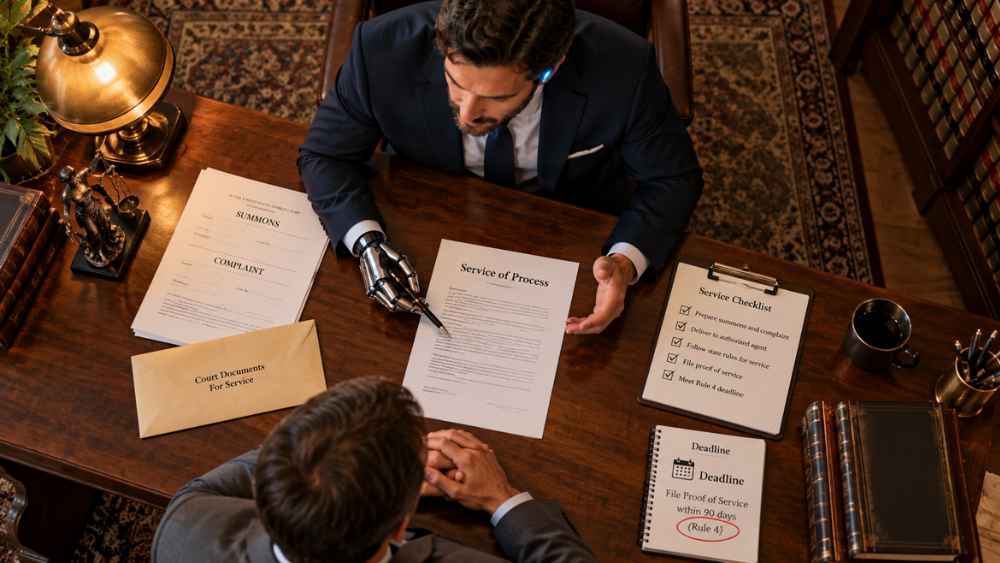
“The plaintiff completed Service of Process by delivering the summons and complaint to the corporation’s authorized registered agent within the Rule 4 deadline.”
What Is Service of Process?
Service of ProcessAffidavit of ServiceAn affidavit of service is a sworn statement documenting how and when legal papers were served and can provide proof of notice for jurisdiction, deadlines, and court procedure.View definition is the formal delivery of court papers using legally authorized procedures.
It provides notice and helps establish the court’s authority over a defendantCivil CourtCivil court is a general term for a court handling noncriminal disputes involving people, businesses, organizations, or government entities. Civil cases can involve contracts, injuries, property, employment, civil rights, and other disputes and...View definition .
Therefore, proper service is fundamental to civil procedure. See Federal Rule of Civil Procedure 4.
Standard Service of Process — Sample Contract Language
Suppose a plaintiff files a federal complaintComplaintA Complaint is the pleading that ordinarily begins a civil lawsuit and states the plaintiff’s claims for relief. Federal complaints generally identify jurisdiction, factual allegations, legal claims, and requested relief while complying with...View definition against a corporation.
What Papers Are Served at the Start of a Federal Case?
The plaintiff generally serves the federal summonsSummonsA summons is a court-issued document notifying a defendant that a lawsuit has been filed and requiring a response. In federal civil cases, Rule 4 governs summons contents, issuance, service, waiver, proof of...View definition with a copy of the complaintCivil LawsuitA civil lawsuit is a noncriminal court action in which a plaintiff seeks a legal remedy from a defendant. The process can include jurisdiction, pleadings, service, discovery, motions, settlement, trial, judgment, enforcement, and...View definition .
The summons identifies the court, parties, response time, and default consequences.
Therefore, serving only the complaint is usually insufficient.
Who Issues the Summons?
After filing the complaint, the plaintiff can present a properly completed summons to the clerk.
The clerk signs, seals, and issues it.
Therefore, the summons is formal court process rather than a private notice.
Who Is Responsible for Service?
The plaintiff is responsible for having the summons and complaint served within the Rule 4 time limit.
The plaintiff does not always need to serve personally.
Therefore, planning service is part of case commencement.
Who Can Serve Process?
Any nonparty who is at least 18 can generally serve a federal summons and complaint.
The court can also appoint a marshal or another person in specified circumstances.
Therefore, the plaintiff should use a legally qualified server.
Can a Party Personally Serve the Defendant?
A party generally should not personally serve federal process when Rule 4(c)(2) requires service by a nonparty.
Professional process servers are common.
Therefore, parties should keep formal service separate from personal confrontation.
What Is Personal Service?
Personal service means delivering the summons and complaint directly to the defendant.
It is a common method for individuals.
Therefore, proof should document who received the papers and when.
How Can an Individual Be Served in Federal Court?
Rule 4(e) allows methods permitted by the state where the federal courtFederal CourtA federal court is a court within the U.S. federal judicial system. Federal courts have limited jurisdiction, so they hear only cases authorized by the Constitution or federal law, including many federal-question and...View definition sits or where service occurs.
It also permits specified federal delivery methods.
Therefore, federal and state service law can overlap.
Can Process Be Left at a Dwelling?
Rule 4(e)(2)(B) permits leaving process at the individual’s dwelling or usual abode with a suitable resident.
That resident must meet the Rule’s age and discretion standard.
Therefore, the server should document the address and recipient facts.
Can an Agent Accept Service?
Yes. A server can deliver process to an agent whom appointment or law authorizes to receive it.
Therefore, the plaintiff should verify that authority.
Therefore, ordinary employees are not automatically service agents.
How Is a Corporation Served?
Rule 4(h) permits service using qualifying state-law methods or delivery to specified corporate representatives.
OfficersCorporation DefinitionA corporation is a legal entity created under state law that is separate from its owners, usually called shareholders. It can own property, enter contracts, incur debts, sue or be sued, and operate...View definition , managing agents, general agents, and authorized service agents can qualify.
Therefore, entity structure matters.
How Is an LLC Served?
An LLC is generally served under rules applicable to corporations, partnerships, or associations.
State law can identify registered agents and alternative methods.
Therefore, business-entity records can help locate the proper recipient.
What Is a Registered Agent?
A registered agentArticles of IncorporationArticles of incorporation are the formation document filed with a state to create a corporation. They typically provide basic information such as the corporation’s name, registered agent, share structure, and incorporator, although requirements...View definition is a person or entity designated to receive legal process for a business.
State filings usually identify the agent.
Therefore, registered-agent service can simplify entity service.
How Is the United States Served?
Rule 4(i) requires service on specified federal government recipients.
Rule 4(i) can require multiple deliveries or mailings.
Therefore, serving only the named agency can be insufficient.
How Are State or Local Governments Served?
Rule 4(j) governs service on state and local governments.
Service can use the chief executive officer or methods prescribed by state law.
Therefore, public-entity service differs from private service.
How Are Foreign Defendants Served?
Rule 4(f) governs individuals in foreign countries.
International agreements, including the Hague Service Convention, can control.
Therefore, foreign service can require substantial lead time.
What Is Waiver of Service?
Rule 4(d) allows many defendants to waive formal service after receiving a proper written request.
Waiver does not waive objections to personal jurisdictionMotion to DismissA motion to dismiss asks a court to end all or part of a case because of a legal or procedural defect. In federal civil cases, Rule 12 lists grounds including jurisdiction, venue,...View definition or venueLegal DisputeA legal dispute is a disagreement or controversy involving claimed legal rights, duties, liabilities, property, or remedies. It can be resolved through negotiation, mediation, arbitration, administrative proceedings, litigation, or settlement depending on the...View definition .
Therefore, waiver can reduce service cost without conceding the merits.
How Much Time Does a Defendant Get to Return a Waiver?
A domestic defendant generally receives at least 30 days to return a waiver request.
A defendant outside any U.S. judicial districtDistrict CourtA U.S. district court is the primary trial court in the federal court system. District courts hear qualifying federal civil and criminal cases, decide motions, conduct trials, and enter judgments that may later...View definition generally receives at least 60 days.
Therefore, plaintiffs should plan waiver timing before filing deadlines expire.
What Happens If a Domestic Defendant Refuses Waiver Without Good Cause?
Rule 4(d) can require the defendant to pay later service expenses and related motionMotionA Motion is a formal request asking a court to issue an order or grant specific relief. Federal Rule 7(b) generally requires motions to state their grounds with particularity and identify the relief...View definition costs.
The rule encourages cooperation with service.
Therefore, ignoring a proper waiver request can increase costs.
How Does Waiver Affect the Answer Deadline?
A defendant who timely waives service generally receives more time to answerCivil LitigationCivil Litigation is the court process for resolving noncriminal disputes through pleadings, motions, discovery, settlement, trial, judgment, and possible appeal. Federal civil litigation follows the Federal Rules of Civil Procedure, while state systems...View definition than after ordinary service.
Rule 12 commonly provides 60 days from the waiver request date, or 90 days outside the United States.
Therefore, waiver changes response timing.
What Is the Federal Service Deadline?
Rule 4(m) generally gives the plaintiff 90 days after filing to complete service.
The court must extend time when good causeGood CauseGood Cause is a legally sufficient reason for a court to grant relief, modify a schedule, excuse conduct, or issue another order. The required showing depends on the governing rule and often considers...View definition is shown.
Therefore, plaintiffs should not wait until the deadline approaches.
Does Rule 4(m) Apply Abroad?
The 90-day rule does not apply the same way to foreign service under Rule 4(f) or 4(j)(1).
Courts still expect reasonable diligence.
Therefore, international service should begin promptly.
What Is Proof of Service?
The server generally files an affidavitWitness DeclarationA witness declaration is a signed factual statement, often made under penalty of perjury under 28 U.S.C. § 1746 for use in legal proceedings.View definition proving service unless the defendant waived service.
Failure to prove service does not itself invalidate otherwise valid service.
Therefore, filing proof remains important for the record.
What Is an Affidavit of Service?
An affidavit of service states when, where, how, and on whom process was served.
It provides evidence supporting valid service.
Therefore, accurate detail can prevent later disputes.
What Is Substituted Service?
Substituted service uses a legally authorized alternative to direct hand delivery.
State law can permit residence delivery, mail, publication, or other methods under specified conditions.
Therefore, alternative service requires legal authorityLegal AuthorityLegal authority is a source supporting a proposition of law and can be primary or secondary, binding or persuasive depending on jurisdiction and hierarchy.View definition .
What Is Service by Publication?
Service by publication gives notice through a newspaper or other authorized public method.
It is usually a last resort when diligent efforts fail.
Therefore, courts can require proof that better methods were unavailable.
What Is Alternative Service?
Courts can authorize alternative methods when rules or statutesPrimary AuthorityPrimary Authority is law issued by an institution with official power to create or state legal rules. Constitutions, statutes, regulations, court decisions, and court rules can be primary authority, while binding effect depends...View definition permit.
A court can allow email or social-media service in limited circumstances.
Therefore, technology does not automatically make electronic serviceCertificate of ServiceA certificate of service records when and how a legal filing was served on required parties and helps establish compliance with procedural notice rules.View definition valid.
Service of Process vs. Service Under Rule 5
Rule 4 governs initial summons-and-complaint service.
Rule 5 generally governs later pleadings and papers after a party appears.
Therefore, later service is often easier than original process.
What Is Insufficient Process?
Rule 12(b)(4) challenges defects in the summons or process itself.
Examples can involve a legally defective summons.
Therefore, document validity and delivery method are separate issues.
What Is Insufficient Service of Process?
Rule 12(b)(5) challenges the manner or effectiveness of service.
Examples can involve the wrong recipient or unauthorized method.
Therefore, plaintiffs should preserve evidence of proper service.
Can Improper Service Void a Default Judgment?
A judgment can be vulnerable when the court lacked personal jurisdiction because service was defective.
Rule 60(b)(4) can address void judgments.
Therefore, valid service is especially important before seeking default.
Can a Defendant Waive a Service Objection?
Yes. Rule 12 requires certain defenses to be raised promptly or they can be waived.
Insufficient service is one waivable defense.
Therefore, defendants should review service immediately.
Does Actual Notice Cure Defective Service?
Actual knowledge of the lawsuitLawsuitA lawsuit is a legal dispute brought before a court for a decision or remedy. Civil lawsuits can involve pleadings, service, discovery, motions, settlement, trial, judgment, and possible appeal.View definition does not always cure legally defective service.
The required procedure still matters.
Therefore, courts distinguish actual noticeConstructive NoticeConstructive notice is legally imputed knowledge arising from a recognized notice method, such as public recording or other circumstances that the law treats as sufficient notice.View definition from legally valid service.
Can Service Be Extended?
Yes. Rule 4(m) requires an extension for good cause and permits courts additional discretion.
Local precedentMajority OpinionA majority opinion states the reasoning and result supported by more than half of the judges participating in an appellate decision and can provide binding precedent.View definition influences discretionary extensions.
Therefore, plaintiffs should move promptly when service problems arise.
Service of Process Example
Suppose a plaintiff files a federal complaint against a corporation.
A process server delivers the summons and complaint to the corporation’s authorized registered agent.
Therefore, the plaintiff can file proof showing timely entity service.
Why Does Service of Process Matter?
Service gives defendants formal noticeLegal NoticeLegal notice is a formal communication of a legal fact, claim, obligation, deadline, proceeding, or intended action given through a recognized method.View definition and supports personal jurisdiction.
Defective service can delay cases, trigger dismissal, or undermine default judgments.
Therefore, service rules should be followed precisely from the start.