
Court Clerk
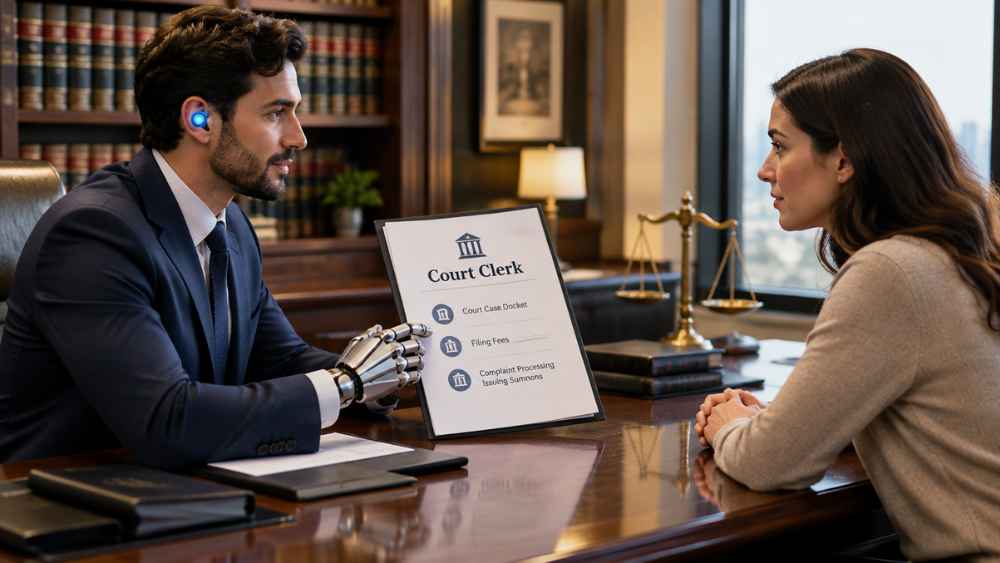
“The Court Clerk opened the case docket, processed the filing fee, recorded the complaint, and issued the summons without deciding the dispute.”
What Is a Court Clerk?
A Court ClerkClerk of CourtA Clerk of Court manages a court’s major nonjudicial functions, including dockets, records, filings, notices, fees, jury administration, and operational systems. The clerk supports judicial work but does not decide the merits of...View definition is a nonjudicial court officer who manages records, filings, case flow, and administrative operations.
Clerk duties vary by court system.
Therefore, the clerk supports judicial work without deciding cases. See U.S. Courts’ legal glossary.
Standard Court Clerk — Sample Contract Language
The clerk’s office opens the docket, collects the fee, processes the complaintCivil LawsuitA civil lawsuit is a noncriminal court action in which a plaintiff seeks a legal remedy from a defendant. The process can include jurisdiction, pleadings, service, discovery, motions, settlement, trial, judgment, enforcement, and...View definition , and issues the summonsSummonsA summons is a court-issued document notifying a defendant that a lawsuit has been filed and requiring a response. In federal civil cases, Rule 4 governs summons contents, issuance, service, waiver, proof of...View definition when appropriate.
What Is a Clerk of Court?
Clerk of Court is the title commonly used for the chief administrative officer of a court.
Deputy clerks and other staff perform delegated clerk-office functions.
Therefore, “court clerk” can refer to the chief clerk or clerk’s office personnel.
Who Appoints a Federal District Court Clerk?
Each federal district courtFederal District CourtA Federal District Court is a United States trial court that hears federal civil and criminal cases within jurisdiction granted by Congress and the Constitution.View definition may appoint its clerk.
The clerk remains subject to removalState CourtA state court is a court established under a state constitution and state law. State courts hear the vast majority of U.S. civil and criminal cases, and their structures, names, procedural rules, and...View definition by the court.
Therefore, the clerk serves the judiciaryBenchThe bench is the judge's raised courtroom desk and is also a common legal term for a judge, group of judges, or the judiciary.View definition rather than the executive branch. See 28 U.S.C. § 751.
Who Appoints a Federal Appellate Clerk?
Each federal court of appealsCourt of AppealsA court of appeals is a court that reviews decisions from lower courts. Federal courts of appeals usually examine the existing record for legal error rather than conducting a new trial or hearing...View definition may appoint a clerk.
The appellate clerk can appoint deputies and staff with court approval.
Therefore, appellate courts maintain their own clerk operations. See 28 U.S.C. § 711.
What Does a Court Clerk Do?
Clerk offices manage nonjudicial functions needed to keep cases moving.
Core tasks include records, filings, notices, jury administration, fees, and public access.
Therefore, the clerk’s office is central to court administration. See U.S. Courts Judicial Administration.
Does the Clerk Maintain Court Records?
Yes. The clerk serves as an official custodian of court records in many systems.
The office maintains dockets, orders, judgments, filings, and case-related information.
Therefore, record access often begins with the clerk.
What Is a Court Docket?
A docket is the chronological record of filings, orders, hearings, and events in a case.
Clerk offices maintain and update docket information.
Therefore, the docket is a key procedural historyCase SummaryA case summary concisely explains a judicial decision's material facts, procedural history, issue, holding, reasoning, and result.View definition .
Does the Clerk Accept Filings?
Yes. Clerks receive pleadings, motions, notices, exhibits, and other papers through authorized filing systems.
Electronic filing is common in modern courts.
Therefore, filers must comply with procedural and technical requirements.
Can a Clerk Reject a Filing?
Clerk authority to reject or return filings depends on court rulesPrimary AuthorityPrimary Authority is law issued by an institution with official power to create or state legal rules. Constitutions, statutes, regulations, court decisions, and court rules can be primary authority, while binding effect depends...View definition and local procedures.
Some defects require correction, while judges decide substantive legal sufficiency.
Therefore, administrative screening is not a merits ruling.
Does the Clerk Issue Summonses?
Clerk offices can issue summonses or other court process when procedural rules authorize it.
The party usually remains responsible for proper service.
Therefore, issuance and service are separate steps.
Does the Clerk Send Court Notices?
Yes. Clerk offices send or electronically transmit many official notices, entries, and scheduling communications.
Electronic docket systems often automate delivery.
Therefore, parties should keep contact information current.
Does the Clerk Collect Filing Fees?
Yes. Courts collect filing fees and other authorized payments through the clerk’s office.
Federal clerks also handle fines, costs, and other monies under judiciary procedures.
Therefore, fee payment is an administrative courtAdministrative CourtAdministrative Court is a broad term for administrative tribunals that adjudicate disputes within agency systems. Federal administrative adjudication can involve ALJs, agency review, exhaustion requirements, and later judicial review under the Administrative Procedure...View definition function.
Does the Clerk Manage Jury Administration?
Yes. Federal clerk offices help administer jury selectionVoir DireVoir Dire is the questioning of prospective jurors to assess qualifications, impartiality, and bias before trial. Judges and lawyers use it to support challenges for cause and peremptory challenges, subject to constitutional limits...View definition , summonses, records, and logistics.
Judges decide legal issues involving jurors.
Therefore, administrative juryJuryA Jury is a group of citizens selected to perform a legal factfinding or charging function. Petit juries decide facts and return verdicts in trials, while grand juries determine whether probable cause supports...View definition management differs from judicial rulings.
Does the Clerk Assign Cases to Judges?
Clerk offices administer case-assignment systems under court rules.
Many courts use random assignmentAssignmentAssignment transfers a contractual right or other legal interest from an assignor to an assignee. Most rights can be assigned, but contract restrictions, personal rights, material changes to the obligor’s burden, notice, defenses,...View definition methods.
Therefore, parties generally cannot select their judgeJudgeA Judge is a judicial officer who presides over legal proceedings, applies law, manages procedure, rules on motions and evidence, and issues orders or judgments. Trial, appellate, Article III, magistrate, bankruptcy, and state...View definition .
Does the Clerk Enter Judgments?
Clerks formally record judgments and orders as the rules require.
Some procedural rules also authorize clerk action in narrow circumstances.
Therefore, entering a judgment differs from judicially deciding the case.
Can a Clerk Enter Default?
Federal Rule 55(a) directs the clerk to enter default after a qualifying failure to plead or defend is shown.
Default judgmentAnswer to ComplaintAn Answer to Complaint is the defendant’s formal pleading responding to a civil complaint. It typically admits or denies allegations, states insufficient knowledge where appropriate, asserts defenses, and can include counterclaims, jury demands,...View definition can require judicial action.
Therefore, clerk authority can be ministerial but legally significant.
Can a Clerk Enter a Default Judgment?
Rule 55(b)(1) permits clerk-entered default judgment only in narrow sum-certain cases meeting specific conditions.
Other default judgments require the court.
Therefore, clerk judgment authority is limited.
What Is a Deputy Clerk?
A deputy clerk performs clerk functions delegated by the clerk and court.
Deputies can process filings, maintain records, assist courtrooms, or support case administration.
Therefore, many public interactions occur with deputy clerks.
What Is a Courtroom Deputy?
A courtroomCourtroomA courtroom is the physical or virtual setting where judges conduct hearings and trials with court personnel, parties, witnesses, jurors, and an official record.View definition deputy supports the judge during hearings and trials.
Tasks can include docket entries, exhibits, calendars, juror logistics, and courtroom administration.
Therefore, courtroom deputies connect clerk operations with live proceedings.
Can a Court Clerk Give Legal Advice?
No. Court staff can provide general procedural information but cannot advise parties what legal strategy to use.
They cannot act as a party’s lawyer.
Therefore, procedural help has clear limits. See U.S. District Court clerk guidance.
What Procedural Information Can Clerks Provide?
Clerks can often explain filing locations, available forms, fees, office hours, and public docket access.
They can describe court procedures at a general level.
Therefore, neutral information differs from legal advice.
Can a Clerk Interpret a Judge’s Order?
No. Clerks generally cannot interpret the legal meaning or effect of judicial orders.
Parties must read the order or seek legal advice.
Therefore, clerk staff cannot resolve substantive ambiguityContract InterpretationContract interpretation is the legal process of determining what contractual language means and how the agreement applies to the parties' dispute.View definition .
Can a Clerk Calculate Deadlines?
Court staff often will not calculate case-specific legal deadlines for a party.
Rules, statutes, and orders determine deadlines.
Therefore, litigants remain responsible for calendaring.
Can a Clerk Recommend What to File?
No. Telling a litigant which motionMotionA Motion is a formal request asking a court to issue an order or grant specific relief. Federal Rule 7(b) generally requires motions to state their grounds with particularity and identify the relief...View definition or claim to file would amount to legal advice.
Clerks can provide available forms and neutral instructions.
Therefore, filing choices remain the party’s responsibility.
Does the Clerk Maintain Sealed Records?
Yes. Clerk offices maintain sealed and restricted materials according to court orders and access rules.
Public access is limited for protected records.
Therefore, record custody does not mean every record is public.
How Does the Clerk Handle Public Records Requests?
The clerk can provide access to public court records through authorized systems and procedures.
Copy fees and privacy restrictions can apply.
Therefore, the clerk is a primary access point for court information.
What Is CM/ECF?
CM/ECF is the federal judiciary’s electronic case-management and filing system.
Clerk offices administer local case processing through that system.
Therefore, electronic filing and docket management are closely connected.
What Is PACER?
PACERCourt DocketA court docket is the official chronological record of filings, orders, hearings, and procedural events in a case. Docket entries and dates are essential for case tracking and deadline management.View definition provides public electronic access to federal courtFederal CourtA federal court is a court within the U.S. federal judicial system. Federal courts have limited jurisdiction, so they hear only cases authorized by the Constitution or federal law, including many federal-question and...View definition court recordsClerk of CourtA Clerk of Court manages a court’s major nonjudicial functions, including dockets, records, filings, notices, fees, jury administration, and operational systems. The clerk supports judicial work but does not decide the merits of...View definition .
Clerk offices maintain the underlying dockets and filings within the judiciary’s case systems.
Therefore, PACER access depends on clerk-managed court records.
Do State Court Clerks Have the Same Duties?
Not exactly. State clerks operate under state constitutions, statutes, rules, and local courtMunicipal CourtA Municipal Court is a local court whose authority is defined by state law, city law, or both. Many municipal courts have limited jurisdiction over traffic, misdemeanors, ordinances, protective orders, or smaller civil...View definition structures.
Some clerks are elected, while others are appointed.
Therefore, state clerk powers can differ substantially.
Is a Clerk the Same as a Judge?
No. Judges decide disputes and issue judicial rulings.
Clerks administer the court and perform authorized ministerial functions.
Therefore, a clerk cannot substitute administrative authority for judicial power.
Is a Court Clerk the Same as a Law Clerk?
No. A law clerk assists a judge with legal researchLegal ResearchLegal research is the process of finding, evaluating, updating, and applying legal authority to answer a legal question. Strong research identifies controlling primary law, uses secondary sources efficiently, checks jurisdiction and hierarchy, validates...View definition , drafting, and analysis.
A court clerk manages administrative court functions.
Therefore, the similar titles describe very different roles.
Court Clerk Example
Suppose a plaintiffCivil CourtCivil court is a general term for a court handling noncriminal disputes involving people, businesses, organizations, or government entities. Civil cases can involve contracts, injuries, property, employment, civil rights, and other disputes and...View definition files a new federal civil case.
The clerk’s office opens the docket, collects the fee, processes the complaint, and issues the summons when appropriate.
Therefore, the clerk administers the case without deciding its merits.
Why Does a Court Clerk Matter?
Court clerks keep the judicial system functioning by managing filings, records, notices, finances, juries, technology, and public access.
However, they remain neutral nonjudicial officersCorporation DefinitionA corporation is a legal entity created under state law that is separate from its owners, usually called shareholders. It can own property, enter contracts, incur debts, sue or be sued, and operate...View definition .
Therefore, litigants should use clerk offices for procedure rather than legal strategy.