
Constructive Discharge
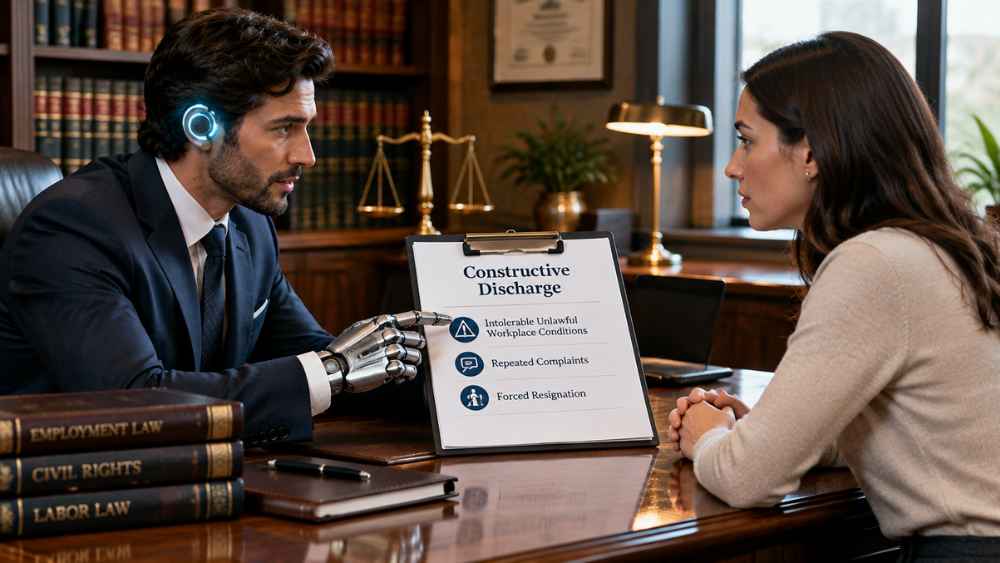
“The employee alleged Constructive Discharge after severe unlawful harassment continued despite repeated complaints and allegedly made continued employment objectively intolerable.”
What Is Constructive Discharge?
Constructive DischargeWrongful TerminationWrongful termination is an unlawful firing that violates a statute, employment contract, or recognized public policy. A firing can feel unfair without being legally wrongful, so the claim must connect the termination to...View definition occurs when unlawful working conditions become so intolerable that a reasonable employee would feel compelled to resign.
The resignation is treated like a dischargeBankruptcy CourtBankruptcy court is the specialized federal court handling bankruptcy cases and related proceedings referred by U.S. district courts. Federal courts have exclusive jurisdiction over bankruptcy cases, including liquidation, repayment, reorganization, claims, automatic-stay disputes,...View definition for specified legal purposes.
Therefore, quitting can sometimes support a termination claim. See Pennsylvania State Police v. Suders.
Standard Constructive Discharge — Sample Contract Language
Suppose a supervisor repeatedly subjects an employee to severe unlawful harassmentEmployment LawEmployment law is the body of federal, state, and local law that governs relationships between employers and employees. It covers wages, discrimination, harassment, leave, safety, benefits, contracts, employee classification, union rights, and termination.View definition despite documented complaints.
What Is the Federal Standard?
The Supreme CourtSupreme CourtThe Supreme Court of the United States is the nation’s highest federal court. It reviews selected cases involving the Constitution and federal law, resolves important federal legal questions, and sits at the top...View definition describes constructive discharge as an aggravated form of workplace discriminationEqual Employment Opportunity Commission (EEOC)The Equal Employment Opportunity Commission (EEOC) is the federal agency that enforces major U.S. employment discrimination laws, investigates charges, promotes voluntary resolution, and may litigate violations.View definition .
The conditions must be objectively intolerable rather than merely unpleasant.
Therefore, subjective dissatisfaction alone is insufficient.
What Does Objectively Intolerable Mean?
The test asks how a reasonable personDuty of CareDuty of care is the legal obligation to act with the care required by the circumstances. In negligence, it establishes the obligation that must be breached before causation and damages can support liability.View definition in the employee’s position would view the working conditions.
Personal sensitivity does not control by itself.
Therefore, courts examine severity and surrounding circumstances.
Must the Employee Actually Resign?
Yes. A constructive-discharge claim generally requires an actual resignation or equivalent departure.
Intolerable conditions without resignation can support other employment claims.
Therefore, the resignation is part of the claim.
Must the Resignation Result From the Conditions?
Yes. The employee must connect the resignation to the allegedly intolerable conditions.
An unrelated departure can defeat constructive-discharge causationBreach of DutyA breach of duty occurs when a person or entity fails to meet a legal duty owed to another person. In negligence cases, breach is usually one element alongside duty, causation, and damages,...View definition .
Therefore, timing and resignation explanations matter.
Is Constructive Discharge a Separate Discrimination Theory?
Constructive discharge often operates as the adverse employment action tied to an underlying statutory violation.
The employee must still prove the relevant discriminationWorkplace HarassmentWorkplace harassment is unwelcome conduct that can violate employment law when it is based on a protected characteristic or protected activity. Federal law generally requires a qualifying job action or conduct severe or...View definition , retaliation, or other legal theory.
Therefore, unfairness alone does not establish federal liability.
Can Harassment Cause Constructive Discharge?
Yes. Severe or pervasiveHostile Work EnvironmentA Hostile Work Environment can arise when unwelcome conduct based on a protected characteristic becomes sufficiently severe or pervasive to alter employment conditions. Federal analysis considers the total circumstances, including frequency, severity, threats,...View definition unlawful harassment can become intolerable enough to compel resignation.
The constructive-discharge threshold remains demanding.
Therefore, not every hostile-work-environment claim becomes constructive discharge.
Can Retaliation Cause Constructive Discharge?
Yes. Retaliatory conditions can support constructive discharge when they become objectively intolerable.
The employee must still prove protected activityWhistleblower ProtectionWhistleblower Protection consists of federal and state laws prohibiting retaliation for specified reporting or protected conduct. There is no single universal statute, and protected activity, filing deadlines, causation standards, procedures, and remedies vary...View definition and required causation.
Therefore, the underlying retaliation elements remain important.
Can Demotion Cause Constructive Discharge?
Potentially. A humiliating or severe demotion can contribute to intolerable conditions.
Ordinary disappointment over reassignmentReasonable AccommodationReasonable Accommodation is a workplace change that enables a protected applicant or employee to obtain equal employment opportunity. Federal duties arise under the ADA, Title VII, and the PWFA, with different rules for...View definition usually is not enough.
Therefore, context and severity control.
Can a Pay Cut Cause Constructive Discharge?
Potentially. A substantial discriminatory pay reduction can contribute to an intolerable environment.
Minor compensation disputes normally do not satisfy the standard alone.
Therefore, magnitude and motive matter.
Can Threats Cause Constructive Discharge?
Yes. Serious threats to safety, livelihood, or unlawful retaliation can support the claim.
The threat must be evaluated objectively.
Therefore, evidence of credibilityCross ExaminationCross Examination is questioning of a witness by an opposing party after direct examination. Federal Rule 611 generally permits leading questions and allows inquiry into the subject of direct testimony and credibility, while...View definition and immediacy matters.
Can Repeated Discrimination Cause Constructive Discharge?
Yes. Persistent discriminatory treatment can cumulatively create intolerable conditions.
Courts assess the total circumstances rather than isolated incidents only.
Therefore, a documented pattern can be important.
Does an Employee Need to Complain Before Resigning?
Not always as a universal element.
However, internal complaints can affect employer defenses, notice, causation, and factual credibility.
Therefore, available reporting procedures can matter significantly.
What Is the Suders Employer Defense?
In harassment cases without an official act precipitating resignation, an employer can sometimes raise the Faragher-Ellerth defense.
The employer must satisfy both parts of that defense.
Therefore, internal prevention and complaintCivil LawsuitA civil lawsuit is a noncriminal court action in which a plaintiff seeks a legal remedy from a defendant. The process can include jurisdiction, pleadings, service, discovery, motions, settlement, trial, judgment, enforcement, and...View definition systems can matter.
What Is an Official Act?
An official act can include a formal employment action such as a demotion, cut in pay, or humiliating reassignment.
Suders limits the affirmative defenseAffirmative DefenseAn Affirmative Defense can defeat or reduce liability even when the opposing party proves the basic claim. Federal Rule 8(c) requires defendants to affirmatively state listed avoidances and other defenses that substantive law...View definition when such an act precipitates the constructive discharge.
Therefore, supervisor conduct can alter the liability framework.
Constructive Discharge vs. Wrongful Termination
Wrongful terminationTermination for CauseTermination for cause is an employment termination based on a contractually or legally defined reason that can affect severance, equity, and other post-employment rights.View definition usually involves an employer expressly ending employment.
Constructive discharge involves resignation caused by legally intolerable conditions.
Therefore, the mechanism differs even when remedies overlap.
Constructive Discharge vs. Hostile Work Environment
A hostile-work-environment claim does not always require resignation.
Constructive discharge requires conditions even more severe enough to compel a reasonable person to leave.
Therefore, constructive discharge is an aggravated outcome.
Constructive Discharge vs. Voluntary Resignation
A voluntary resignation reflects a genuine choice to leave despite tolerable legal conditions.
Constructive discharge treats the choice as legally coerced by intolerable unlawful conditions.
Therefore, the line is highly fact-specific.
Can Poor Management Alone Create Constructive Discharge?
Usually not under federal discrimination statutesPrimary AuthorityPrimary Authority is law issued by an institution with official power to create or state legal rules. Constitutions, statutes, regulations, court decisions, and court rules can be primary authority, while binding effect depends...View definition .
Rudeness, criticism, personality conflict, or unfairness without unlawful conduct may remain legally insufficient.
Therefore, employment law does not guarantee pleasant management.
Can Increased Workload Create Constructive Discharge?
Potentially, when discriminatory or retaliatory workload changes become objectively intolerable.
Ordinary business pressure usually will not suffice.
Therefore, severity and unlawful motive matter.
Can Failure to Accommodate Lead to Constructive Discharge?
Potentially. Repeated unlawful denial of required accommodation can contribute to intolerable working conditions.
The employee must establish the underlying accommodation violation.
Therefore, constructive discharge can arise from cumulative statutory breaches.
Can Sexual Harassment Lead to Constructive Discharge?
Yes. Suders itself involved alleged sexual harassmentQuid Pro Quo HarassmentQuid pro quo harassment occurs when workplace benefits or consequences are tied to accepting or rejecting unwelcome conduct, often through a supervisor's exercise of employment authority.View definition and constructive discharge.
The Supreme Court recognized the objective intolerability standard.
Therefore, sexual harassment can support both hostile-environment and discharge theories.
Can Racial Harassment Lead to Constructive Discharge?
Yes. Severe unlawful racial harassment can compel a reasonable employee to resign.
Employer knowledge and response can affect liability.
Therefore, harassment complaints should be investigated promptly.
When Does the Limitations Period Begin?
For federal constructive-discharge claims, the Supreme Court held that the claim accrues when the employee gives notice of resignation.
The underlying violation can occur earlier.
Therefore, resignation timing matters for deadlines. See Green v. Brennan.
What Did Green v. Brennan Decide?
Green held that a constructive-discharge limitations periodStatute of LimitationsA statute of limitations is a law that sets a deadline for starting a legal claim. The deadline varies by jurisdiction and claim type, and rules about accrual, discovery, tolling, or repose can...View definition begins when the employee resigns.
The Court reasoned that resignation is a necessary element of the claim.
Therefore, the clock does not necessarily start with the employer’s last discriminatory act.
Do EEOC Filing Deadlines Still Apply?
Yes. Federal discrimination claims remain subject to administrative filing deadlines.
Exact timing depends on statuteStatutory LawStatutory law is written law enacted by a legislative body through the formal lawmaking process. Federal and state statutes can create rights, duties, prohibitions, causes of action, procedures, penalties, and remedies, and courts...View definition , jurisdictionLegal DisputeA legal dispute is a disagreement or controversy involving claimed legal rights, duties, liabilities, property, or remedies. It can be resolved through negotiation, mediation, arbitration, administrative proceedings, litigation, or settlement depending on the...View definition , and employee status.
Therefore, workers should calculate deadlines promptly.
What Evidence Supports Constructive Discharge?
Useful evidence can include complaints, emails, texts, evaluations, schedules, pay records, witness statements, and resignation communications.
Medical or safety evidence can also matter.
Therefore, contemporaneous records often become important.
What Should a Resignation Letter Say?
There is no universal required wording.
A clear explanation of the conditions causing resignation can help establish causation.
Therefore, vague departure reasons can create later factual disputes.
Can an Employer Cure the Conditions?
Yes. Prompt effective correction can undermine a claim that resignation remained objectively compelled.
An employee cannot always ignore a reasonable effective remedyCause of ActionA Cause of Action is a recognized set of legal elements supporting a right to judicial relief. Its elements can arise from statutes, constitutions, regulations, or case law, and the claimant generally must...View definition .
Therefore, timing of corrective action matters.
What Remedies Can Be Available?
Available remedies depend on the underlying statute and claim.
They can include back pay, reinstatement, front pay, compensatory damagesTort DefinitionA tort is a civil wrong arising from an act or omission that causes legally recognized injury or harm. Major tort categories include intentional torts, negligence, and strict liability, with remedies commonly including...View definition , or other relief.
Therefore, constructive discharge can materially expand damagesLegal RemedyA legal remedy is the relief a court or other authorized tribunal can provide after a legal right has been violated. Remedies can include damages, injunctions, restitution, specific performance, rescission, declarations, and other...View definition exposure.
Do State Laws Differ?
Yes. State wrongful-discharge, discrimination, wage, whistleblower, and contract doctrines can use different constructive-discharge standards.
Some states recognize broader claims.
Therefore, federal doctrine is only one layer.
Constructive Discharge Example
Suppose a supervisor repeatedly subjects an employee to severe unlawful harassment despite documented complaints.
The employer takes no effective action, and conditions become objectively intolerable.
Therefore, a resignation can support constructive-discharge allegations.
Why Does Constructive Discharge Matter?
The doctrine prevents employers from avoiding discharge liability merely by making unlawful conditions intolerable enough to force resignation.
Its standard remains demanding.
Therefore, both employees and employers should document the events leading to departure.