
Unjust Enrichment
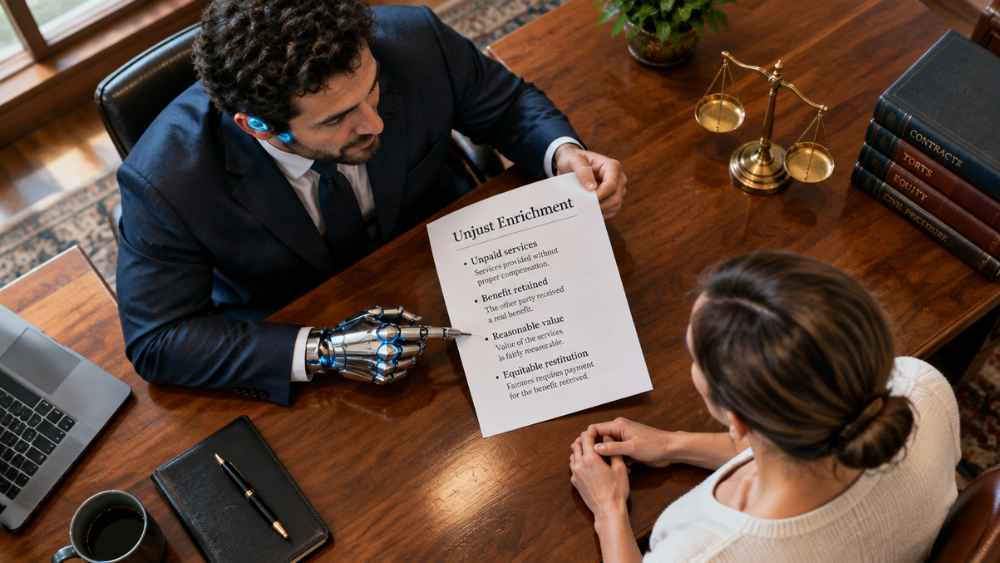
“The plaintiff pleaded Unjust Enrichment in the alternative, alleging that the defendant knowingly retained services without paying their reasonable value.”
What Is Unjust Enrichment?
Unjust EnrichmentImplied ContractAn Implied Contract is an obligation inferred from conduct or circumstances rather than fully expressed in words. A true implied-in-fact contract rests on mutual assent shown by conduct, while an implied-in-law or quasi-contract...View definition is an equitable or restitutionary theory requiring return of a benefit that would be unjust to retain.
Elements vary by state.
Therefore, the doctrine focuses on unjust retention rather than punishment. See Cornell LII on unjust enrichment.
Standard Unjust Enrichment — Sample Contract Language
The recipient knows of the duplicate and has no contractual right to keep it.
What Are Common Elements?
Many jurisdictions require a benefit conferred, knowledge or appreciation of the benefit, and unjust retention without proper payment.
Exact formulations differ.
Therefore, state law controls the elements.
What Counts as a Benefit?
A benefit can include money, services, property, debt dischargeBankruptcy CourtBankruptcy court is the specialized federal court handling bankruptcy cases and related proceedings referred by U.S. district courts. Federal courts have exclusive jurisdiction over bankruptcy cases, including liquidation, repayment, reorganization, claims, automatic-stay disputes,...View definition , improvements, or another measurable advantage.
The plaintiffCivil CourtCivil court is a general term for a court handling noncriminal disputes involving people, businesses, organizations, or government entities. Civil cases can involve contracts, injuries, property, employment, civil rights, and other disputes and...View definition must connect the benefit to the defendant.
Therefore, indirect enrichment can require closer analysis.
What Makes Enrichment Unjust?
Unjustness depends on the circumstances surrounding receipt and retention of the benefit.
A valid gift usually is not unjust enrichment.
Therefore, benefit alone does not create liability.
What Is Restitution?
RestitutionLegal RemedyA legal remedy is the relief a court or other authorized tribunal can provide after a legal right has been violated. Remedies can include damages, injunctions, restitution, specific performance, rescission, declarations, and other...View definition is the remedyCause of ActionA Cause of Action is a recognized set of legal elements supporting a right to judicial relief. Its elements can arise from statutes, constitutions, regulations, or case law, and the claimant generally must...View definition that restores value improperly retained.
Courts can measure restitution by the benefit rather than the claimant’s expected contract recovery.
Therefore, restitution differs from ordinary contract damagesBreach of ContractA breach of contract occurs when a party fails to perform an obligation required by an enforceable agreement. Examples include nonpayment, missed deadlines, defective performance, refusal to perform, or violation of another contract...View definition .
What Is Quasi-Contract?
Quasi-contract is a legal obligation imposed to prevent unjust enrichment even though no actual contract exists.
It is sometimes called a contract implied in law.
Therefore, quasi-contract is not based on mutual assentOffer and AcceptanceOffer and Acceptance describes how parties manifest mutual assent to a contract. A valid offer gives another party power to accept, while acceptance must objectively communicate assent through an authorized method, subject to...View definition .
What Is Quantum Meruit?
Quantum meruit can permit recovery of reasonable value for services under applicable law.
It often overlaps with restitution and implied-contract theories.
Therefore, the precise label depends on jurisdictionLegal DisputeA legal dispute is a disagreement or controversy involving claimed legal rights, duties, liabilities, property, or remedies. It can be resolved through negotiation, mediation, arbitration, administrative proceedings, litigation, or settlement depending on the...View definition .
Can Unjust Enrichment Apply When a Valid Contract Exists?
Often, a valid contract governing the same subject prevents unjust-enrichment recovery.
Courts can still allow alternative pleadingPleadingA pleading is a formal court document stating a party’s claims, defenses, or responses in a civil case. Federal Rules 7 and 8 identify permitted pleadings and govern claims, admissions, denials, affirmative defenses,...View definition before resolving contract validity.
Therefore, contract scope is a threshold issue.
Can a Plaintiff Plead in the Alternative?
Yes under many procedural systems.
A plaintiff can allege both theories when the parties dispute contract validity or scope.
Therefore, alternative pleading does not guarantee double recovery.
Can a Volunteer Recover?
Usually not when a person confers a benefit officiously without request or legal justification.
Emergency and mistake doctrines can create exceptions.
Therefore, the recipient’s opportunity to reject the benefit can matter.
What Is the Gift Principle?
A donor gives a true gift without a reasonable expectation of payment.
The donor generally cannot later demand restitution merely because the recipient benefited.
Therefore, intent at transfer matters.
What Is the Change-of-Position Defense?
Some restitution systems reduce liability when a recipient reasonably changed position in reliance on the benefit.
The defense is context-specific.
Therefore, retention and reliance can affect remedy.
Unjust Enrichment vs. Breach of Contract
Breach enforces a valid contractual promise.
Unjust enrichment imposes restitution when keeping a benefit would be inequitable.
Therefore, the theories protect different legal interests.
Unjust Enrichment Example
Suppose a vendor mistakenly pays the same invoice twice.
The recipient knows of the duplicate and has no contractual right to keep it.
Therefore, restitution can require return of the excess payment.
Why Does Unjust Enrichment Matter?
The doctrine prevents one party from keeping a benefit when no valid legal basis supports retention.
It fills gaps where contract remediesMaterial BreachA Material Breach is a serious contract failure that substantially defeats the other party’s expected benefit. It can excuse further performance, support termination, and trigger damages or other remedies, although materiality depends on...View definition do not fit.
Therefore, facts about benefit, expectation, and fairness are central.