
Contract Lifecycle Management
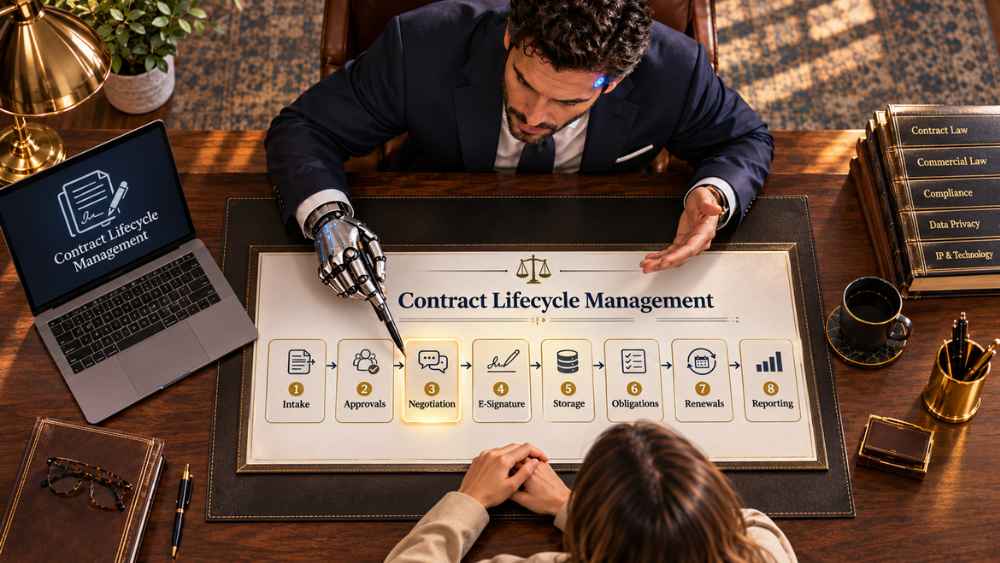
“The company implemented Contract Lifecycle Management to standardize intake, approvals, negotiation, e-signature, storage, obligations, renewals, and reporting.”
What Is Contract Lifecycle Management?
Contract Lifecycle ManagementContract Review SoftwareContract review software helps users examine agreements, identify important provisions, compare language, apply playbooks, suggest redlines, and manage review workflows. Some platforms use AI, while others rely on rules, templates, comparison tools, and...View definition , or CLM, is the end-to-end process for creating, negotiating, executing, storing, monitoring, renewing, and ending contracts.
CLM can refer to the business process or supporting software.
Therefore, it covers more than document storage. See IBM CLM overview.
Standard Contract Lifecycle Management — Sample Contract Language
Suppose a sales contract enters through a structured request form and automatically routes for legal and finance approval.
What Is Contract Intake?
Intake captures the business request, counterparty, contract type, value, risk, owner, and required timing.
Structured intake can trigger the correct workflow.
Therefore, CLM often begins before drafting.
What Is Contract Authoring?
Authoring uses approved templates, clause libraries, data fields, and playbooks to create draft agreements.
Automation can populate repeat terms.
Therefore, standardization reduces drafting variability.
What Is Negotiation Management?
CLM systems can track redlines, comments, versions, issues, and approved fallback positions.
Collaboration tools preserve negotiationAlternative Dispute ResolutionAlternative Dispute Resolution, or ADR, includes negotiation, mediation, arbitration, settlement conferences, and other processes used outside ordinary trial adjudication. Each method differs in neutrality, confidentiality, party control, binding effect, cost, and review.View definition history.
Therefore, version controlLegal Document ManagementLegal document management controls how legal work product is stored, searched, versioned, secured, shared, and retained across matters and teams.View definition becomes part of legal risk management.
What Is Approval Workflow?
Approval workflows route contracts to legal, finance, security, procurement, tax, or business stakeholders based on rules.
Thresholds can depend on value or risk.
Therefore, approvals become auditable rather than informal.
How Does E-Signature Fit?
CLM platforms often integrate with electronic-signature tools for execution.
Signature validity still depends on applicable law and transaction type.
Therefore, workflow automation does not replace legal execution requirements.
What Is a Contract Repository?
A repository stores executed contracts and related metadataRequest for ProductionA Request for Production is a civil discovery request for documents, electronically stored information, tangible things, or inspection access. In federal court, Rule 34 governs requests to parties and sets requirements for particularity,...View definition in a searchable system.
Access controls protect sensitive terms.
Therefore, a repository creates a central contract record.
What Is Obligation Management?
Obligation managementContract IntelligenceContract intelligence converts contract language into structured, searchable data and analytics so organizations can understand obligations, risks, rights, trends, and commercial terms across a contract portfolio.View definition tracks duties, milestones, payments, service levels, notices, and compliance commitments after signature.
Alerts can route tasks to owners.
Therefore, CLM continues after execution.
What Is Renewal Management?
Renewal management tracks expiration, auto-renewal, notice windows, and termination rights.
Missed dates can create unwanted commitments.
Therefore, calendar controls can create direct financial value.
How Is AI Used in CLM?
AI can extract clauses, classify contracts, compare language, summarize terms, suggest playbook positions, and identify obligations.
Human review remains important for legal conclusions.
Therefore, AI should augment rather than hide legal judgmentCivil LawsuitA civil lawsuit is a noncriminal court action in which a plaintiff seeks a legal remedy from a defendant. The process can include jurisdiction, pleadings, service, discovery, motions, settlement, trial, judgment, enforcement, and...View definition .
What Are CLM Data Risks?
Contract repositories can contain pricing, trade secretsNon Disclosure Agreement (NDA)A non disclosure agreement, or NDA, is a contract that protects specified confidential information. It limits who may receive the information and often restricts how the recipient may use or share it.View definition , personal dataPersonally Identifiable Information (PII)Personally Identifiable Information (PII) is information that can distinguish or trace an individual’s identity alone or with other linked or linkable information. Common examples include identifiers, contact details, biometrics, financial information, health information,...View definition , security terms, and privileged material.
Security, retention, access, and vendor controls matter.
Therefore, CLM is also an information-governance system.
What Metrics Can CLM Track?
Teams can measure cycle time, approval delays, deviation rates, renewals, obligations, risk categories, and value leakage.
Metrics can improve process design.
Therefore, CLM supports legal operationsLegal IntakeLegal intake is the structured process for receiving, triaging, and routing legal requests while capturing the information needed for prioritization, assignment, and tracking.View definition as well as legal drafting.
Contract Lifecycle Management Example
Suppose a sales contract enters through a structured request form and automatically routes for legal and finance approval.
After signature, the system tracks renewal and notice dates.
Therefore, one workflow manages the agreement from request through renewal.
Why Does Contract Lifecycle Management Matter?
CLM can reduce missed obligations, inconsistent terms, approval delays, and fragmented contract records.
Its value depends on accurate data and governance.
Therefore, process design matters as much as software.