
Contract Review Software
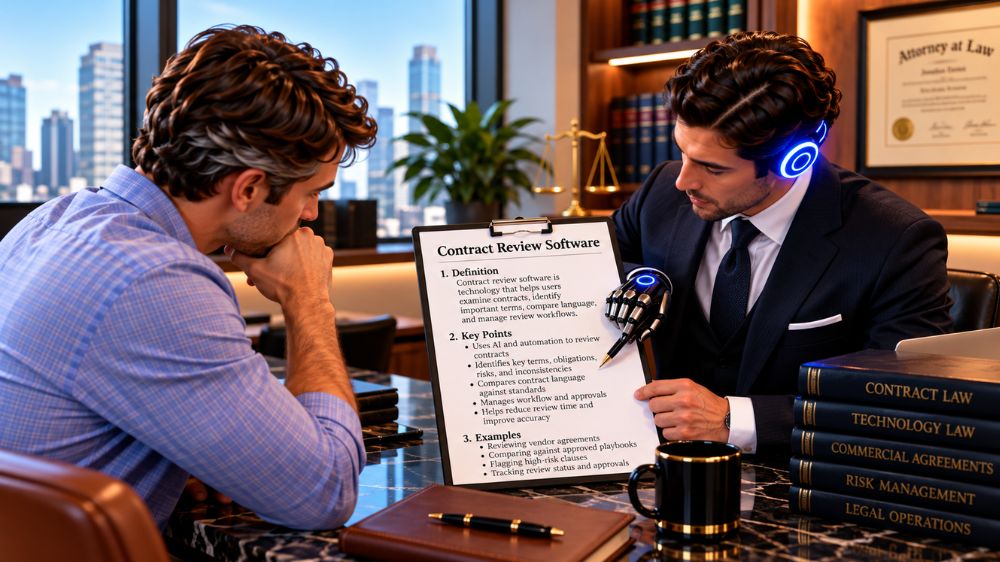
“The procurement team used contract review software to compare a vendor agreement with its approved playbook before escalating higher-risk clauses to legal counsel.”
What Is Contract Review Software?
Contract reviewLegal Document ReviewLegal document review is the structured examination of documents for relevant facts, obligations, legal risk, privilege, evidence, and required action.View definition software is technology that helps users examine contracts, identify important terms, compare language, and manage review workflows.
Some products use artificial intelligence. Others combine rules, templates, search, document comparison, and workflow automation.
Therefore, the phrase describes a broad software category rather than one specific technical approach.
Standard Contract Review Software — Sample Contract Language
Suppose a procurement team receives a new software vendor agreementVendor AgreementA vendor agreement governs a supplier's goods or services and allocates performance, payment, security, IP, liability, compliance, and termination responsibilities.View definition . The review platform compares it with the company’s approved playbook.
What Does Contract Review Software Do?
Contract review software can assist with the first review of an agreement. It can identify clauses, organize issues, and support negotiationAlternative Dispute ResolutionAlternative Dispute Resolution, or ADR, includes negotiation, mediation, arbitration, settlement conferences, and other processes used outside ordinary trial adjudication. Each method differs in neutrality, confidentiality, party control, binding effect, cost, and review.View definition .
For example, the software can highlight indemnificationMaster Service Agreement (MSA)A Master Service Agreement, or MSA, sets recurring legal and commercial terms for an ongoing service relationship. The parties can then use SOWs, order forms, or schedules for project-specific scope, pricing, deliverables, and...View definition , liability, confidentialityEmployment ContractAn employment contract is an agreement defining terms of an employer-employee relationship. It can cover duties, compensation, benefits, equity, confidentiality, intellectual property, restrictive covenants, termination, severance, and dispute procedures while remaining subject to...View definition , renewal, and termination terms.
It can also route higher-risk issues to a lawyer.
What Features Does Contract Review Software Include?
Features vary by platform. Common capabilities can include several review and workflow functions.
- Clause identification.
- Contract summaries.
- Playbook comparison.
- Redline suggestions.
- Document comparison.
- Approval workflows.
- Clause libraries.
- Risk flags.
- Search and filtering.
- Obligation extraction.
- Version tracking.
- Collaboration tools.
Therefore, software can support both legal analysisLegal MemorandumA legal memorandum is an organized written analysis of a legal issue based on facts, research, and relevant authority. It typically frames the question, states a brief answer, presents material facts, analyzes governing...View definition and operational review.
What Is Automated Clause Detection?
Automated clause detection identifies recurring contract provisions without requiring a reviewer to locate every clause manually.
For example, the software can identify governing lawBoilerplate ClauseA boilerplate clause is standardized contract language addressing recurring legal mechanics such as notice, assignment, governing law, waiver, severability, and integration.View definition or assignmentAssignmentAssignment transfers a contractual right or other legal interest from an assignor to an assignee. Most rights can be assigned, but contract restrictions, personal rights, material changes to the obligor’s burden, notice, defenses,...View definition language.
However, unusual drafting can reduce accuracy.
What Is a Clause Library?
A clause libraryContract Lifecycle ManagementContract Lifecycle Management, or CLM, manages contracts from request and drafting through negotiation, approval, execution, storage, obligation tracking, renewal, and termination. CLM software can automate workflows, metadata, alerts, reporting, and integrations.View definition stores approved contract language and fallback provisions.
For example, a legal team can maintain preferred limitation-of-liability wording.
Review software can then compare third-party language with the approved clause.
What Is a Contract Playbook?
A contract playbookAI Contract ReviewAI contract review uses artificial intelligence to examine contracts and help identify clauses, obligations, risks, missing terms, and deviations from approved standards. It can speed routine review, but important legal conclusions and proposed...View definition records preferred positions, fallback terms, escalation rules, and negotiation guidance.
Software can apply the playbook during review.
Therefore, a playbook can help standardize decisions across legal and business teams.
Can Contract Review Software Redline Agreements?
Yes. Many platforms can suggest edits or create redlines based on preferred language.
For example, the software can replace a disfavored renewal clauseRenewal ClauseA Renewal Clause explains whether and how a contract continues after its initial term. It can create automatic or optional renewal, set notice deadlines and renewal periods, change pricing, and interact with consumer...View definition with approved language.
However, reviewers should confirm that the edit works with definitions and related sections.
Can Contract Review Software Compare Versions?
Yes. Version comparison is a common contract-review feature.
It can show additions, deletions, and other changes between drafts.
Therefore, users can focus on what changed during negotiation.
Can Contract Review Software Summarize Contracts?
Many tools can produce summaries of key provisions. AI-enabled products can often create narrative summaries as well.
For example, a summary can list payment terms, renewal dates, notice periods, and liability limits.
However, the original agreement remains the controlling source.
Can Contract Review Software Extract Obligations?
Yes. Some tools extract deadlines, payment duties, renewal requirements, and performance obligations.
For example, a system can identify a requirement to provide notice 60 days before renewal.
Therefore, extracted data can support contract managementContract ManagementContract management organizes agreements across intake, drafting, negotiation, approval, execution, storage, obligations, renewals, and termination.View definition after signature.
Can Contract Review Software Identify Missing Clauses?
Some products can compare a draft with an expected checklist or template. They can then flag missing provisions.
For example, software can flag the absence of a data-security addendum in a vendor agreement.
However, whether a clause is legally necessary depends on the transaction.
Who Uses Contract Review Software?
Law firms, in-house legal departments, procurement teams, sales teams, and contract managers can use contract review software.
Different users need different controls and review depth.
Therefore, role-based workflows can improve implementation.
How Do Legal Teams Use Contract Review Software?
Legal teams often use software to automate repeatable first-pass tasks. Lawyers then focus on higher-risk or unusual provisions.
For example, routine NDAs can follow a standardized playbook.
More complex mergers or financing agreements can receive deeper manual review.
How Do Procurement Teams Use Contract Review Software?
Procurement teams can use review software to identify commercial and risk terms before vendor approval.
For example, the system can flag auto-renewal, minimum commitments, or unfavorable termination language.
Therefore, procurement can escalate legal issues earlier.
How Do Sales Teams Use Contract Review Software?
Sales teams can use guided review tools for standard customer contracts. Approved playbooks can reduce repeated legal questions.
For example, the system can identify when a requested liability term requires legal approval.
However, sales users should not override required legal escalations.
Contract Review Software vs. CLM
Contract lifecycle management, or CLM, covers a broader contract process. It can include drafting, approval, signature, storage, obligations, renewal, and reporting.
Contract review software focuses more specifically on examining contract language.
However, many CLM platforms include review features.
Contract Review Software vs. Document Management
Document management software focuses on storing, organizing, and retrieving files. Contract review software focuses on understanding and evaluating contract content.
Therefore, the two systems can integrate but serve different primary purposes.
Contract Review Software vs. AI Contract Review
Contract review software is the broad product category. AI contract review is one method used within that category.
For example, one platform may use machine learning for clause extraction. Another may rely on rules and templates.
Therefore, buyers should evaluate actual capabilities rather than product labels.
What Are the Benefits of Contract Review Software?
Contract review software can improve speed, consistency, visibility, and workflow control.
Common benefits can include:
- Faster first-pass review.
- Consistent playbook application.
- Clearer escalation rules.
- Reusable approved clauses.
- Better version controlLegal Document ManagementLegal document management controls how legal work product is stored, searched, versioned, secured, shared, and retained across matters and teams.View definition .
- Structured contract dataMachine Readable ContractA Machine Readable Contract represents contractual information in structured form that software can search, validate, analyze, or process. It can preserve human-readable legal prose while adding schemas, metadata, data models, or executable logic.View definition .
- Reduced repetitive work.
However, benefits depend on configuration and adoption.
What Are the Risks of Contract Review Software?
Software can produce incorrect flags or miss important language. It can also create security and confidentiality risks.
For example, a poorly configured system may treat an unusual contract as a standard form.
Therefore, governance and human review remain important.
How Accurate Is Contract Review Software?
Accuracy varies by product, contract type, feature, and configuration.
Clause extraction can perform well on common forms but struggle with unusual drafting or poor scans.
Therefore, organizations should test software against representative documents.
What Security Features Should Contract Review Software Have?
Security expectations depend on the data and organization. Useful controls can include encryption, access management, audit logs, and retention settings.
Organizations should also review hosting, incident responseData Breach NotificationData Breach Notification is legally required notice after qualifying security incidents. GDPR Articles 33 and 34 use regulator and high-risk individual notice rules, while U.S. states apply their own definitions, triggers, timing, content,...View definition , and subcontractor practices.
Therefore, security review should occur before confidential contracts are uploaded.
What Privacy Questions Should Buyers Ask?
Buyers should understand what data the vendor collects and how it uses contract content.
For example, the buyer should ask whether uploaded documents train shared models.
In addition, the buyer should review deletion, retention, location, and subprocessors.
What Integrations Matter?
Contract review software can integrate with word processors, CLM platforms, document repositories, e-signature tools, and business systems.
For example, a Microsoft Word integration can support redlining without changing the reviewer’s normal workflow.
Therefore, integration quality can affect adoption.
How Should Contract Review Software Be Evaluated?
Evaluation should use real contracts and defined review tasks. Buyers should measure both legal quality and workflow performance.
Useful measures can include issue-detection accuracy, review time, false positives, ease of use, and security.
Therefore, a product demo alone may not show production performance.
What Is Human Review in Contract Software?
Human review means a qualified person validates software output before important decisions are made.
For example, a lawyer can confirm a suggested redline before sending it to a counterparty.
Therefore, software can automate tasks without eliminating accountability.
Contract Review Software Example
Suppose a procurement team receives a new software vendor agreement. The review platform compares it with the company’s approved playbook.
The system flags data use, unlimited liability, and automatic renewalTerms and ConditionsTerms and Conditions are contractual rules governing use of a website, app, service, or commercial offering. They can address accounts, payments, acceptable use, intellectual property, disclaimers, liability, suspension, termination, and dispute procedures.View definition . A lawyer reviews those items and approves negotiated changes.
Therefore, software supports triage while legal judgmentCivil LawsuitA civil lawsuit is a noncriminal court action in which a plaintiff seeks a legal remedy from a defendant. The process can include jurisdiction, pleadings, service, discovery, motions, settlement, trial, judgment, enforcement, and...View definition remains with the reviewer.
Why Does Contract Review Software Matter?
Contract review software can make repeatable review faster and more consistent. It can also connect legal standards with business workflows.
However, software quality, configuration, security, and human oversight determine whether those benefits are reliable.
The key questions are practical. What contracts will the tool review? Which issues must it detect? How is accuracy tested? Who approves final decisions?