
AI Contract Review
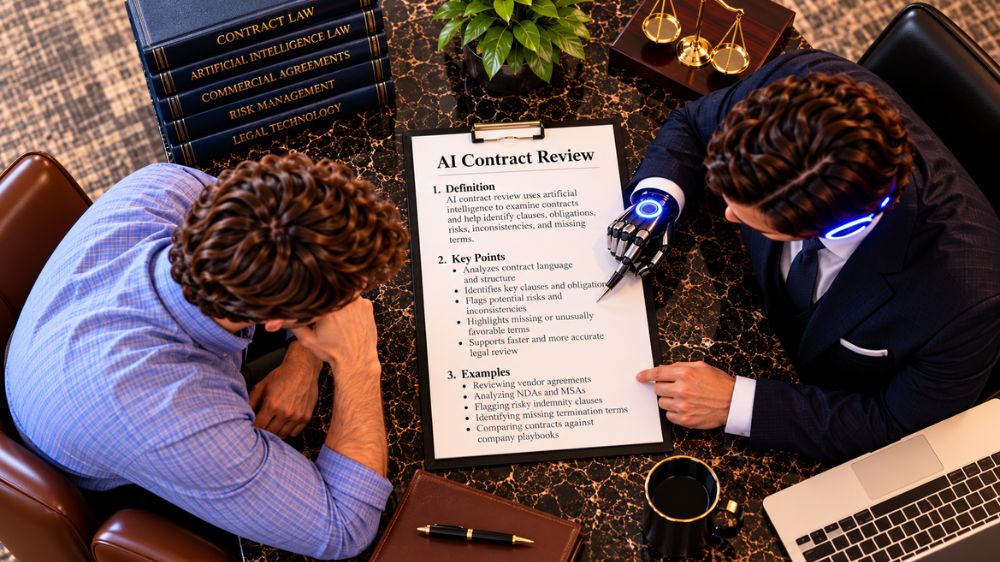
“The legal team used AI contract review to compare a vendor agreement against its playbook before a lawyer verified the flagged risks and proposed redlines.”
What Is AI Contract Review?
AI contract reviewAutomated Contract ReviewAutomated contract review uses software or AI to compare agreements against playbooks, extract key terms, flag deviations, and support faster legal review.View definition uses artificial intelligence to examine contracts and help identify clauses, obligations, risks, inconsistencies, and missing terms.
The technology can accelerate routine review. However, legal judgmentCivil LawsuitA civil lawsuit is a noncriminal court action in which a plaintiff seeks a legal remedy from a defendant. The process can include jurisdiction, pleadings, service, discovery, motions, settlement, trial, judgment, enforcement, and...View definition remains important because contract meaning depends on context, governing lawBoilerplate ClauseA boilerplate clause is standardized contract language addressing recurring legal mechanics such as notice, assignment, governing law, waiver, severability, and integration.View definition , facts, and business goals.
NIST provides a broader framework for managing risks from artificial intelligence systems. See the NIST AI Risk Management Framework.
Standard AI Contract Review — Sample Contract Language
Suppose a company receives a vendor agreementVendor AgreementA vendor agreement governs a supplier's goods or services and allocates performance, payment, security, IP, liability, compliance, and termination responsibilities.View definition . Its AI review tool compares the contract with an approved legal playbook.
How Does AI Contract Review Work?
AI contract review softwareContract Review SoftwareContract review software helps users examine agreements, identify important provisions, compare language, apply playbooks, suggest redlines, and manage review workflows. Some platforms use AI, while others rely on rules, templates, comparison tools, and...View definition receives a contract and analyzes its text. The system can classify clauses, compare language, summarize duties, and flag potential issues.
For example, the software can identify termination, indemnityThird Party ComplaintA third-party complaint uses Rule 14 impleader to bring a nonparty into a lawsuit when that person may be liable to a defending party for all or part of the original claim.View definition , confidentialityEmployment ContractAn employment contract is an agreement defining terms of an employer-employee relationship. It can cover duties, compensation, benefits, equity, confidentiality, intellectual property, restrictive covenants, termination, severance, and dispute procedures while remaining subject to...View definition , assignmentAssignmentAssignment transfers a contractual right or other legal interest from an assignor to an assignee. Most rights can be assigned, but contract restrictions, personal rights, material changes to the obligor’s burden, notice, defenses,...View definition , and governing-law provisions.
Next, a lawyer or business reviewer evaluates the output against the transaction.
What Can AI Find in a Contract?
AI can identify many recurring contract provisions and data points. The exact capability depends on the product and model.
- Party names and effective dates.
- Payment terms and renewal dates.
- Termination rights.
- IndemnificationMaster Service Agreement (MSA)A Master Service Agreement, or MSA, sets recurring legal and commercial terms for an ongoing service relationship. The parties can then use SOWs, order forms, or schedules for project-specific scope, pricing, deliverables, and...View definition clauses.
- Limitations of liability.
- Confidentiality duties.
- Intellectual propertyIntellectual PropertyIntellectual property, or IP, is a group of legal rights that protect certain inventions, creative works, brands, and confidential business information. Major U.S. categories include patents, copyrights, trademarks, and trade secrets.View definition terms.
- Assignment restrictions.
- Governing law and venueLegal DisputeA legal dispute is a disagreement or controversy involving claimed legal rights, duties, liabilities, property, or remedies. It can be resolved through negotiation, mediation, arbitration, administrative proceedings, litigation, or settlement depending on the...View definition .
- Notice requirements.
- Service levels and performance duties.
Therefore, AI can reduce time spent locating common provisions.
Can AI Identify Contract Risks?
Yes, AI can flag language that differs from a playbook or expected standard. It can also highlight missing protections.
For example, a system can flag unlimited liability when company policy requires a negotiated cap.
However, a flagged clause is not automatically legally defective.
What Is an AI Contract Playbook?
A contract playbook contains preferred language, fallback positions, risk rules, and negotiationAlternative Dispute ResolutionAlternative Dispute Resolution, or ADR, includes negotiation, mediation, arbitration, settlement conferences, and other processes used outside ordinary trial adjudication. Each method differs in neutrality, confidentiality, party control, binding effect, cost, and review.View definition guidance.
AI tools can compare contract language against that playbook. Therefore, review can become more consistent across similar agreements.
However, the playbook should reflect current law and actual business policy.
Can AI Redline a Contract?
Many AI contract tools can suggest edits or alternative clauses. Some products can generate redlines directly against the contract text.
For example, the system can propose a liability capLimitation of Liability ClauseA limitation of liability clause sets contractual boundaries on recoverable losses or exposure. Learn how liability caps, exclusions, carve-outs, super caps, and indemnity terms work, with negotiation examples and enforceability considerations.View definition that matches a company standard.
However, a human reviewer should confirm that the proposed edit works with the rest of the agreement.
Can AI Summarize a Contract?
Yes. AI can create a summary of major commercial and legal terms.
For example, a summary can cover payment, term, renewal, termination, liability, and dispute resolution.
However, summaries can omit qualifications or exceptions. Therefore, important decisions should still rely on the contract itself.
What Is Clause Extraction?
Clause extraction means locating and pulling specific provisions from a contract. AI can often perform this task across large contract sets.
For example, a business can extract change-of-control clauses from hundreds of agreements.
Therefore, clause extraction can support diligence and portfolio analysis.
What Is Contract Classification?
Contract classification means identifying the agreement type or grouping contracts by characteristics.
For example, software can classify documents as NDAs, vendor agreements, employment agreements, or leases.
This can help route contracts to the correct review process.
What Is Contract Risk Scoring?
Contract risk scoringAI Contract AnalysisAI contract analysis uses artificial intelligence to extract, classify, compare, summarize, and evaluate contract information. It can analyze individual agreements or entire portfolios for diligence, obligations, renewals, risk trends, and structured contract intelligence.View definition assigns a risk level based on selected clauses or policy rules.
For example, a contract can receive a higher score when it contains uncapped liability and broad indemnity obligations.
However, risk scores depend on the assumptions built into the system.
Can AI Review Third-Party Paper?
Yes. AI can compare a counterparty’s contract against a company’s standard positions.
For example, the system can identify clauses that depart from an approved vendor playbook.
Therefore, AI can help prioritize which provisions need closer legal review.
Can AI Review NDAs?
Yes. NDAs are common candidates for automated review because they often contain recurring provisions.
AI can analyze confidentiality scope, exclusions, term, residuals, compelled disclosureConfidentiality ClauseA Confidentiality Clause limits how specified nonpublic information may be used or disclosed. Strong clauses define protected information, exclusions, permitted recipients, legal-disclosure exceptions, duration, return or destruction duties, and available remedies.View definition , and return-or-destruction duties.
However, unusual transactions can still require detailed legal analysisLegal MemorandumA legal memorandum is an organized written analysis of a legal issue based on facts, research, and relevant authority. It typically frames the question, states a brief answer, presents material facts, analyzes governing...View definition .
Can AI Review Employment Agreements?
AI can assist with employment contractAt Will EmploymentAt will employment generally means either the employer or employee can end the employment relationship at any time. However, discrimination, retaliation, contracts, public-policy rules, and other laws can limit that default rule.View definition contract reviewLegal Document ReviewLegal document review is the structured examination of documents for relevant facts, obligations, legal risk, privilege, evidence, and required action.View definition . It can identify compensation, confidentiality, invention assignmentEmployee Invention Assignment AgreementAn Employee Invention Assignment Agreement requires employees to assign defined company-related inventions and IP while remaining subject to state-law exclusions and ownership rules.View definition , termination, and restrictive covenantEmployee Non Solicitation AgreementAn employee non solicitation agreement restricts specified solicitation of customers, clients, or employees and is governed primarily by state restrictive-covenant law.View definition terms.
However, employment laws vary significantly by jurisdiction.
Therefore, enforceability questions should receive jurisdiction-specific legal review.
Can AI Review Vendor Contracts?
Yes. Vendor agreements often contain repeatable commercial and legal issues.
AI can flag service levels, security duties, data use, liability, indemnity, renewal, and termination terms.
For technology vendors, privacy and cybersecurity provisions can require additional attention.
What Are the Benefits of AI Contract Review?
AI can make routine contract reviewLegal Document ReviewLegal document review is the structured examination of documents for relevant facts, obligations, legal risk, privilege, evidence, and required action.View definition faster and more consistent. It can also help legal teams focus on higher-risk terms.
Common benefits can include:
- Faster first-pass review.
- Consistent clause identification.
- Automated issue spotting.
- Contract summaries.
- Playbook comparison.
- Portfolio-level analysis.
- Reduced repetitive manual work.
However, benefits depend on implementation quality and human oversight.
What Are the Risks of AI Contract Review?
AI systems can make errors, miss clauses, or produce unsupported conclusions. Generative systems can also invent information.
In addition, contract uploads can create confidentiality, privilege, security, and data-governance concerns.
Therefore, organizations should evaluate both legal accuracy and information handling.
What Is an AI Hallucination in Contract Review?
An AI hallucinationAutomated Legal ResearchAutomated Legal Research uses software and AI to search, retrieve, classify, summarize, validate, or synthesize legal authorities. Lawyers still must verify sources, current validity, jurisdiction, quotations, and support for every proposition they use.View definition is generated content that appears plausible but is inaccurate or unsupported.
For example, a system might describe a termination right that does not appear in the contract.
Therefore, reviewers should verify material conclusions against the source document.
Can AI Miss Important Contract Language?
Yes. A system can miss unusual drafting, cross-references, definitions, exhibits, or scanned text.
For example, a liability exception can appear in another section and change the meaning of a general cap.
Therefore, reviewers should consider the entire agreement.
How Does Confidentiality Affect AI Contract Review?
Contracts often contain confidential business, customer, employee, or transaction information. Uploading them to an AI service can create disclosure risk.
Organizations should evaluate vendor terms, access controls, retention, model-training practices, and security.
Therefore, approved tools and documented handling rules are important.
Can AI Contract Review Affect Attorney-Client Privilege?
Potential privilege issues depend on the information, purpose, disclosure, vendor relationship, and governing law.
Lawyers should consider whether sharing privileged material with a technology provider preserves applicable protections.
Therefore, sensitive legal documents deserve careful vendor and confidentiality review.
Do Lawyers Still Need to Review AI Output?
Yes. AI can assist legal work, but it does not replace professional judgment or responsibility.
A lawyer should verify important facts, legal conclusions, and proposed language before relying on the output.
Therefore, AI is best treated as a review tool rather than an autonomous decision-maker.
How Accurate Is AI Contract Review?
Accuracy varies by model, contract type, formatting, training data, and task design.
For example, clause extraction may perform differently from legal risk analysisContract Risk AnalysisContract risk analysis evaluates legal and business exposure created by contract terms and supports negotiation, approvals, controls, and informed risk acceptance.View definition .
Therefore, organizations should test tools on representative contracts before broad deployment.
How Should AI Contract Review Be Tested?
A practical evaluation compares AI output with trusted human review. The test should include common and difficult contract examples.
Organizations can measure missed issues, false flags, extraction accuracy, and review time.
In addition, testing should continue after product or model changes.
What Is Human-in-the-Loop Review?
Human-in-the-loop review means a person checks or approves AI output before consequential use.
For contract work, this can include confirming extracted terms and approving proposed redlines.
Therefore, human review can reduce the risk of silent AI errors.
AI Contract Review vs. Manual Review
Manual review relies primarily on a person reading and analyzing the contract. AI-assisted review adds automated extraction, comparison, or drafting support.
AI can improve speed on repeatable tasks. However, humans remain better suited for context, strategy, negotiation, and novel legal issues.
AI Contract Review vs. Contract Review Software
AI contract review describes the use of artificial intelligence in the review process. Contract review software is the broader product category.
Some contract review software uses AI heavily. Other tools rely more on templates, rules, workflows, or document comparison.
AI Contract Review vs. AI Contract Analysis
AI contract review often focuses on evaluating a specific agreement for issues and proposed changes.
AI contract analysis can be broader. It can include extraction, analytics, portfolio review, diligence, and contract intelligence.
Therefore, the terms overlap but are not always identical.
AI Contract Review Example
Suppose a company receives a vendor agreement. Its AI review tool compares the contract with an approved legal playbook.
The tool flags uncapped liability, auto-renewal, and a broad data-use clause. A lawyer then verifies the clauses and negotiates revisions.
Therefore, AI speeds the first pass while the lawyer controls the legal decision.
Why Does AI Contract Review Matter?
AI contract review can reduce repetitive work and help organizations identify contract issues earlier.
However, accuracy, confidentiality, legal context, and human oversight remain critical.
The key questions are practical. What task should AI perform? How accurate is the tool? What data does it receive? Who verifies the result?