
AI Contract Analysis
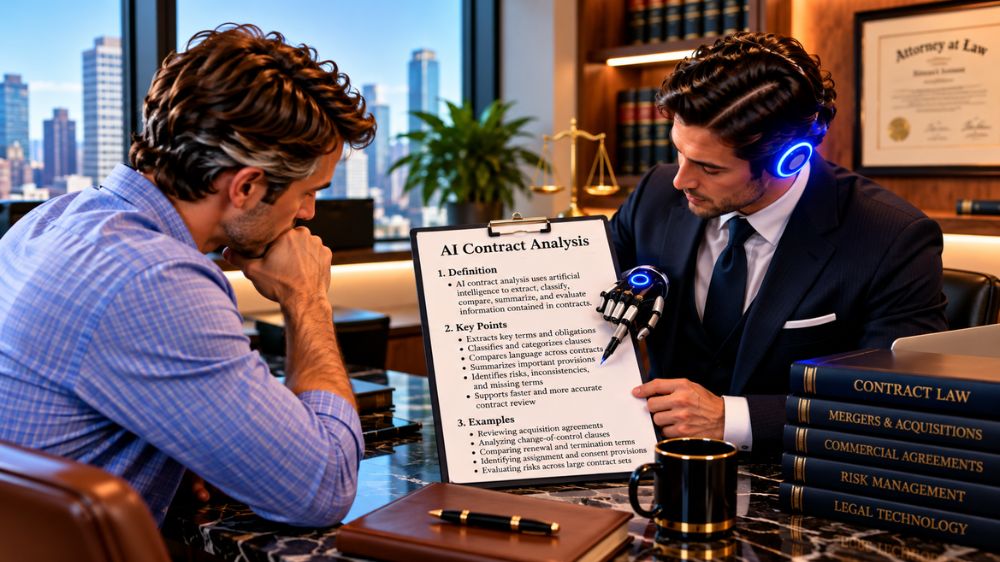
“The acquisition team used AI contract analysis to identify change-of-control, assignment, renewal, and termination provisions across thousands of agreements before lawyers validated the high-risk results.”
What Is AI Contract Analysis?
AI contract analysisContract IntelligenceContract intelligence converts contract language into structured, searchable data and analytics so organizations can understand obligations, risks, rights, trends, and commercial terms across a contract portfolio.View definition uses artificial intelligence to extract, classify, compare, summarize, and evaluate information contained in contracts.
It can analyze one agreement or an entire contract portfolio. Therefore, the term is broader than reviewing one draft for negotiationAlternative Dispute ResolutionAlternative Dispute Resolution, or ADR, includes negotiation, mediation, arbitration, settlement conferences, and other processes used outside ordinary trial adjudication. Each method differs in neutrality, confidentiality, party control, binding effect, cost, and review.View definition changes.
NIST provides general guidance for managing risks associated with artificial intelligence systems. See the NIST AI Risk Management Framework.
Standard AI Contract Analysis — Sample Contract Language
Suppose a company plans an acquisitionMergerA merger is a corporate transaction combining entities under statute so that one survives or a new entity results, with assets and liabilities transferring according to law.View definition and receives 2,000 contracts in a data roomDue DiligenceDue Diligence is the reasonable investigation and verification performed before a major legal, financial, or business decision. Transaction diligence can cover corporate records, contracts, litigation, finance, tax, IP, employment, privacy, cybersecurity, and regulatory...View definition . The legal team uses AI to extract key provisions.
How Does AI Contract Analysis Work?
AI contract analysis converts contract text into structured information or generated insights. The system can identify clauses, parties, dates, obligations, and risk indicators.
For example, it can extract renewal dates from hundreds of customer agreements.
Next, users can search, compare, report, or review the extracted information.
What Can AI Extract From Contracts?
AI can extract many recurring legal and commercial data points. Exact performance depends on the model and document quality.
- Party names.
- Effective dates.
- Contract terms.
- Renewal dates.
- Termination rights.
- Payment obligations.
- Liability caps.
- IndemnityThird Party ComplaintA third-party complaint uses Rule 14 impleader to bring a nonparty into a lawsuit when that person may be liable to a defending party for all or part of the original claim.View definition provisions.
- AssignmentAssignmentAssignment transfers a contractual right or other legal interest from an assignor to an assignee. Most rights can be assigned, but contract restrictions, personal rights, material changes to the obligor’s burden, notice, defenses,...View definition clauses.
- Governing lawBoilerplate ClauseA boilerplate clause is standardized contract language addressing recurring legal mechanics such as notice, assignment, governing law, waiver, severability, and integration.View definition .
- Data protectionData PrivacyData privacy concerns how personal information is collected, used, shared, retained, and controlled. It includes transparency, data minimization, individual rights, vendor management, security, retention, and compliance with laws such as GDPR, CCPA, and...View definition duties.
- Notice periods.
Therefore, AI can turn unstructured agreements into searchable contract data.
What Is Clause Classification?
Clause classification assigns contract text to recognized clause types.
For example, the system can label language as confidentialityEmployment ContractAn employment contract is an agreement defining terms of an employer-employee relationship. It can cover duties, compensation, benefits, equity, confidentiality, intellectual property, restrictive covenants, termination, severance, and dispute procedures while remaining subject to...View definition , indemnity, force majeureForce MajeureForce Majeure is a contract concept that can excuse or delay performance after extraordinary events covered by the agreement. Relief depends on clause wording, causation, notice, mitigation, exclusions, governing law, and the specific...View definition , or governing law.
This makes large contract collections easier to compare.
What Is Contract Data Extraction?
Contract data extraction pulls defined values or terms from agreements into structured fields.
For example, a system can extract contract expirationTermination ClauseA Termination Clause defines when and how parties can end a contract, including cause, convenience, notice, cure periods, fees, and effective dates. Strong clauses also address accrued payments, surviving obligations, confidentiality, data return,...View definition dates into a spreadsheet or database.
Therefore, extracted data can support reporting and obligations management.
What Is Contract Portfolio Analysis?
Contract portfolio analysis evaluates patterns across many agreements.
For example, a legal team can identify all contracts with uncapped liability or automatic renewalTerms and ConditionsTerms and Conditions are contractual rules governing use of a website, app, service, or commercial offering. They can address accounts, payments, acceptable use, intellectual property, disclaimers, liability, suspension, termination, and dispute procedures.View definition .
Therefore, AI can reveal risks that are difficult to see contract by contract.
What Is Contract Intelligence?
Contract intelligence refers to structured insights derived from contract data. It can combine extraction, analytics, search, and reporting.
For example, a dashboard can show renewal exposure by business unit.
However, reliable intelligence depends on accurate source data.
Can AI Compare Contracts?
Yes. AI can compare clauses across contracts or against a standard template.
For example, it can identify which vendor agreements contain nonstandard liability caps.
Therefore, comparison can support negotiation, diligence, and policy compliance.
Can AI Analyze Contract Obligations?
Yes. AI can identify duties involving payment, notices, deliverables, reporting, and renewal.
For example, a system can flag agreements requiring notice 90 days before termination.
However, users should verify extracted duties before relying on automated reminders.
Can AI Analyze Contract Risk?
AI can help identify risk indicators based on selected rules or patterns.
For example, it can flag uncapped indemnity, broad data rights, or one-sided termination rights.
However, legal risk depends on transaction context and governing law.
What Is Contract Risk Scoring?
Contract risk scoringAI Contract ReviewAI contract review uses artificial intelligence to examine contracts and help identify clauses, obligations, risks, missing terms, and deviations from approved standards. It can speed routine review, but important legal conclusions and proposed...View definition assigns a score or category based on defined issues.
For example, a contract can receive a high-risk rating when several clauses depart from company standards.
Therefore, scoring can prioritize review but should not replace legal judgmentCivil LawsuitA civil lawsuit is a noncriminal court action in which a plaintiff seeks a legal remedy from a defendant. The process can include jurisdiction, pleadings, service, discovery, motions, settlement, trial, judgment, enforcement, and...View definition .
Can AI Analyze Contracts During Due Diligence?
Yes. Contract diligence often requires reviewing many agreements under time pressure.
AI can identify assignment, change-of-control, termination, exclusivity, and liability provisions across the data room.
Therefore, it can help legal teams prioritize contracts needing deeper review.
Can AI Find Change-of-Control Clauses?
Yes. Change-of-control terms are common targets in transaction diligence.
For example, a system can identify contracts that require consent after an acquisition.
However, definitions and cross-references can make interpretation complex.
Can AI Find Renewal and Termination Dates?
Yes. AI can extract term, renewal, notice, and termination provisions.
For example, a company can identify agreements approaching an automatic-renewal deadline.
Therefore, contract analysis can support operational planning.
Can AI Analyze Privacy and Security Clauses?
Yes. AI can identify data-processing, security, breach-notification, audit, and cross-border transfer provisions.
For example, a system can flag vendor contracts that lack required security language.
However, privacy compliance still requires legal and factual analysis beyond clause presence.
Can AI Analyze Contract Financial Terms?
AI can extract fees, payment dates, price adjustments, discounts, and other financial provisions.
For example, finance teams can identify contracts with annual price-escalation clauses.
Therefore, contract data can support budgeting and forecasting.
What Are the Benefits of AI Contract Analysis?
AI can make large contract collections more searchable and measurable. It can also reduce repetitive manual extraction.
Common benefits can include:
- Faster diligence.
- Portfolio visibility.
- Automated clause extraction.
- Renewal tracking.
- Risk prioritization.
- Standardized reporting.
- Improved search.
However, benefits depend on data quality and validationTechnology Assisted ReviewTechnology Assisted Review (TAR) uses technology and human judgment to prioritize, classify, and review documents in legal discovery. TAR can include predictive coding, continuous active learning, statistical sampling, validation, and other analytics designed...View definition .
What Are the Risks of AI Contract Analysis?
AI can misclassify clauses, extract incorrect values, or overlook exceptions. Generative tools can also produce unsupported summaries.
In addition, contract repositories often contain confidential and privileged information.
Therefore, accuracy and data governanceData Sharing AgreementA data sharing agreement defines how data may be transferred and used, including purpose, security, privacy, retention, onward sharing, incident response, and deletion obligations.View definition are both critical.
What Is a False Positive?
A false positive occurs when the system flags an issue that is not actually present.
For example, AI may classify a general liability reference as an unlimited liability obligation.
Too many false positives can reduce reviewer trust.
What Is a False Negative?
A false negative occurs when the system misses an issue that is present.
For example, the tool may fail to identify a renewal requirement hidden in an exhibit.
Therefore, false negatives can create silent legal and operational risk.
How Should AI Contract Analysis Be Validated?
Organizations should compare extracted results against trusted human-reviewed samples.
They can measure precision, recall, field accuracy, and error rates for important tasks.
In addition, testing should include unusual formats and difficult contract language.
What Is Precision in Contract Analysis?
Precision measures how often flagged results are correct. High precision means fewer false positives.
For example, if the system identifies 100 indemnity clauses and 95 are correct, precision is high.
What Is Recall in Contract Analysis?
Recall measures how many relevant items the system successfully finds.
For example, high recall means the system misses few indemnity clauses that actually exist.
Therefore, precision and recall measure different kinds of performance.
How Does OCR Affect AI Contract Analysis?
Scanned contracts may require optical character recognition before analysis. Poor OCRHIPAAHIPAA is the Health Insurance Portability and Accountability Act of 1996. Its Privacy, Security, and Breach Notification Rules protect certain health information handled by covered entities and business associates and give individuals important...View definition can introduce missing or incorrect text.
For example, a misread date can create a wrong renewal deadline.
Therefore, document quality should be checked before relying on extracted data.
How Does Confidentiality Affect AI Contract Analysis?
Contract portfolios can contain sensitive pricing, customer, employee, intellectual propertyIntellectual PropertyIntellectual property, or IP, is a group of legal rights that protect certain inventions, creative works, brands, and confidential business information. Major U.S. categories include patents, copyrights, trademarks, and trade secrets.View definition , and litigationLegal DisputeA legal dispute is a disagreement or controversy involving claimed legal rights, duties, liabilities, property, or remedies. It can be resolved through negotiation, mediation, arbitration, administrative proceedings, litigation, or settlement depending on the...View definition information.
Organizations should review vendor security, retention, access, training, and deletion practices.
Therefore, confidential contracts should use approved systems and controlled workflows.
AI Contract Analysis vs. AI Contract Review
AI contract review often focuses on evaluating a specific agreement and suggesting changes.
AI contract analysis can extend across many contracts and emphasize extraction, reporting, analytics, and portfolio insights.
However, the terms often overlap in legal technologyContract Review SoftwareContract review software helps users examine agreements, identify important provisions, compare language, apply playbooks, suggest redlines, and manage review workflows. Some platforms use AI, while others rely on rules, templates, comparison tools, and...View definition products.
AI Contract Analysis vs. Contract Analytics
Contract analyticsLegal AnalyticsLegal Analytics uses data analysis to identify patterns and trends in cases, dockets, judges, motions, contracts, spending, and other legal information. Analytics can support strategy and operations, but it is not legal authority...View definition usually focuses on trends, metrics, and portfolio reporting. AI contract analysis can include those tasks plus text extraction and interpretation.
Therefore, contract analytics can be one output of a broader AI analysis process.
AI Contract Analysis Example
Suppose a company plans an acquisition and receives 2,000 contracts in a data room. The legal team uses AI to extract key provisions.
The system identifies change-of-control, assignment, renewal, and termination terms. Lawyers then validate high-risk contracts and investigate exceptions.
Therefore, AI helps prioritize diligence without replacing legal review.
Why Does AI Contract Analysis Matter?
AI contract analysis can turn large collections of agreements into structured, searchable information.
However, extraction errors, legal context, confidentiality, and model limitations can affect reliability.
The key questions are practical. What information must be extracted? How accurate is the system? Which errors matter most? Who validates the results?