
Privacy Impact Assessment
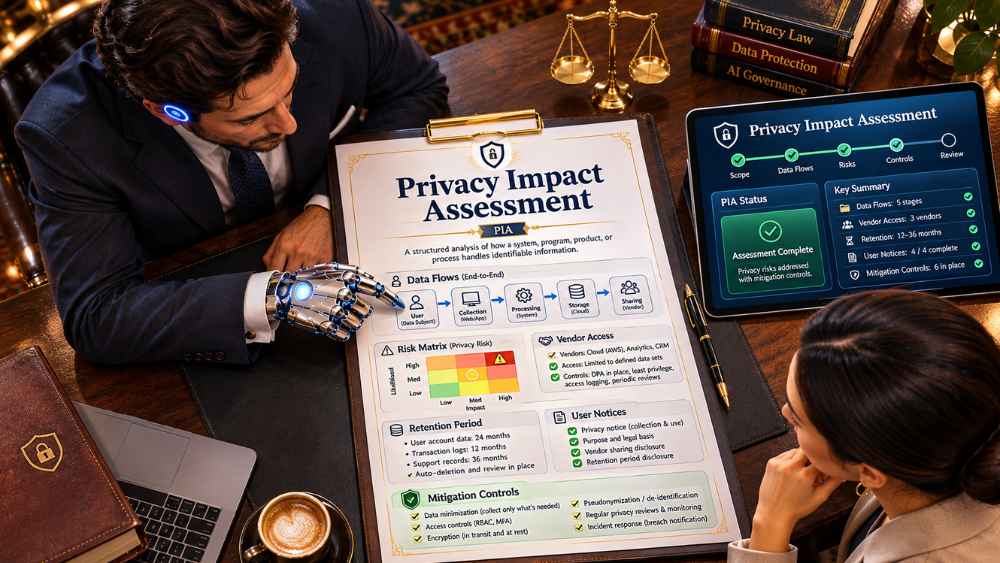
“The privacy team completed a Privacy Impact Assessment before launch, documenting the data flows, vendor access, retention period, user notices, and required mitigation controls.”
What Is Privacy Impact Assessment?
A Privacy Impact Assessment (PIA) is a structured analysis of how a system, program, product, or process handles identifiable information and what privacy risks, legal requirements, and safeguards apply. A PIA can refer to both the assessment process and the document recording its results.
See NIST’s definition of a Privacy Impact Assessment.
Standard Privacy Impact Assessment — Sample Contract Language
A company plans a new customer analytics platform. Before implementation, it maps the personal dataPersonally Identifiable Information (PII)Personally Identifiable Information (PII) is information that can distinguish or trace an individual’s identity alone or with other linked or linkable information. Common examples include identifiers, contact details, biometrics, financial information, health information,...View definition collected, vendor access, retention, international transfers, user choices, security controls, and privacy risks, then records mitigationForce MajeureForce Majeure is a contract concept that can excuse or delay performance after extraordinary events covered by the agreement. Relief depends on clause wording, causation, notice, mitigation, exclusions, governing law, and the specific...View definition actions in a PIA.
Why Is Privacy Impact Assessment Important?
A PIA helps teams identify privacy problems before they become embedded in product design, contracts, data architecture, or operational practice. It also documents accountability for risk and mitigation decisions.
How Does Privacy Impact Assessment Work?
A typical PIA maps data elements, sources, purposes, users, recipients, storage, retention, security, individual choices, access, transfers, and disposal. The assessment then identifies risks and assigns mitigation measures, owners, and review points.
What Rules Govern Privacy Impact Assessment?
PIA requirements vary by legal framework, sector, and organization. NIST describes a PIA as an analysis of information handling used to evaluate privacy risks and protections; specific statutesPrimary AuthorityPrimary Authority is law issued by an institution with official power to create or state legal rules. Constitutions, statutes, regulations, court decisions, and court rules can be primary authority, while binding effect depends...View definition or agency policies can impose additional mandatory elements.
How Is Privacy Impact Assessment Different From Related Concepts?
A PIA overlaps with security assessments but addresses broader privacy questions such as purpose, proportionalityDiscovery RequestA Discovery Request is a formal litigation request for information, documents, admissions, testimony, or inspection. Federal discovery rules govern scope, proportionality, interrogatories, requests for production, requests for admission, subpoenas, objections, privilege, response deadlines,...View definition , transparency, secondary use, retention, and individual impact. A GDPRData PrivacyData privacy concerns how personal information is collected, used, shared, retained, and controlled. It includes transparency, data minimization, individual rights, vendor management, security, retention, and compliance with laws such as GDPR, CCPA, and...View definition Data Protection Impact AssessmentData Protection Impact Assessment (DPIA)A Data Protection Impact Assessment (DPIA) evaluates planned personal-data processing that may create high risk, documenting necessity, proportionality, risks to individuals, mitigations, and any residual-risk concerns.View definition is a more specifically defined high-risk assessment.
What Should Practitioners Check?
Perform the assessment early, map actual data flows rather than intended diagrams, include vendors and subprocessors, review international access, and track mitigation commitments to closure. Reassess when data uses or architecture materially change.
Can AI Assist With Privacy Impact Assessment?
AI can help map data flows, compare contracts, summarize questionnaires, and identify inconsistencies across records. Legal triggers, jurisdiction-specific requirements, risk judgments, and final mitigation decisions require accountable human review.
Privacy Impact Assessment Example
A company plans a new customer analytics platform. Before implementation, it maps the personal data collected, vendor access, retention, international transfers, user choices, security controls, and privacy risks, then records mitigation actions in a PIA.
Why Does Privacy Impact Assessment Matter?
A PIA is most useful as a living privacy-design and governance process. Accurate data mapping and actionable mitigation matter more than simply completing a form.