
DBA
“North Coast Ventures LLC registered the DBA ‘Harbor Bread’ and signed contracts as North Coast Ventures LLC d/b/a Harbor Bread.”
What Is a DBA?
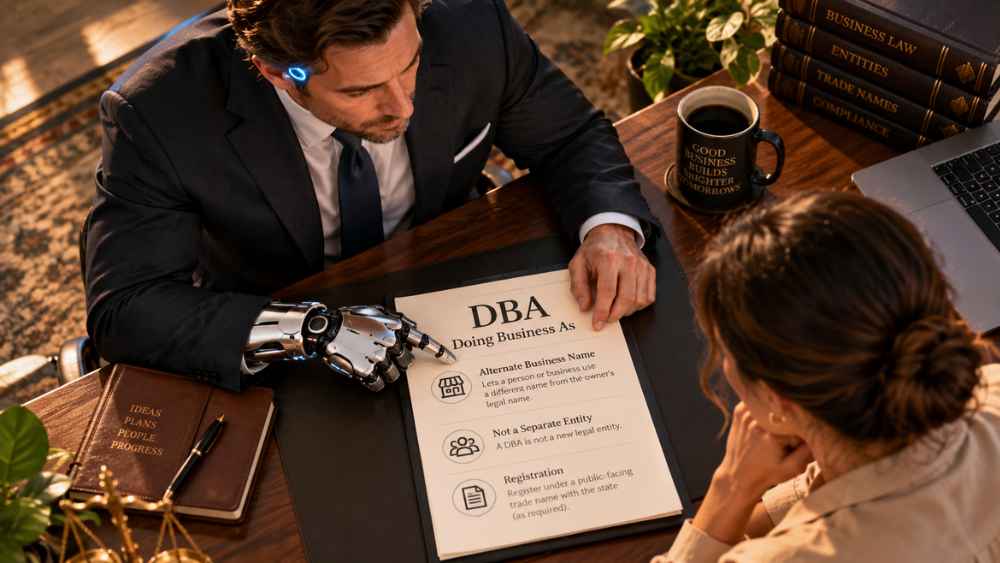
A DBATrade NameA trade name identifies a business or vocation. It can also function as a trademark when used to identify the source of particular goods or services.View definition means Doing Business As.
It is a name a person or business uses publicly that differs from the owner’s legal name.
DBAs are also called trade names, assumed names, or fictitious business names.
Standard DBA — Sample Contract Language
Suppose North Coast Ventures LLC opens a bakery under the name Harbor Bread.
What Does DBA Mean?
DBA identifies the operating name under which a business presents itself to customers.
For example, River City Holdings LLC can operate a shop as River City Coffee.
Therefore, the DBA can differ from the formal entity name.
Is a DBA a Legal Entity?
No. A DBA does not create a corporation, LLC, partnershipBusiness FormationBusiness formation is the legal process of creating and organizing a business entity. It can involve choosing a structure, filing state documents, establishing governance, documenting ownership, obtaining tax identifiers, reviewing licenses, and planning...View definition , or other separate entity by itself.
The legal owner remains the person or entity behind the name.
Therefore, liability protection comes from the business structureSole ProprietorshipA Sole Proprietorship is an unincorporated business owned by one individual and generally has no legal existence separate from the owner. It is simple to form but does not provide an entity-level shield...View definition rather than the DBA.
DBA vs. LLC
An LLC is a state-created legal entity.
A DBA is simply a name used by a person or entity.
Therefore, registering a DBA does not provide LLC liability protection.
DBA vs. Corporation
A corporation is a separate legal entity formed under state law.
A DBA is an alternate business name.
Therefore, corporations can use DBAs without creating new corporations.
DBA vs. Trademark
A DBA registration identifies or records a business name under state or local lawOrdinanceAn Ordinance is a law enacted by a municipality or other authorized local government. Local authority depends on state constitutions, statutes, charters, home-rule rules, Dillon’s Rule principles, and preemption, while ordinances commonly govern...View definition .
A trademark can protect source-identifying brand rights under trademark lawTrademark DefinitionA trademark is a word, phrase, symbol, design, or other source identifier that distinguishes one seller’s goods or services from others. U.S. rights can arise through use, while federal registration can provide additional...View definition .
Therefore, DBA registration alone generally does not create federal trademark protection.
Does a DBA Protect a Business Name?
Usually not by itself. The SBA explains that DBA registration does not itself provide legal brand protection.
Trademark rights depend on trademark law and actual use or registration.
See SBA business-name guidance.
Is a DBA Required?
Requirements depend on state, county, city, business structure, and the name being used.
Many jurisdictions require registration when a business operates under a name different from its legal name.
Therefore, local filing rules should be checked before use.
Who Can Use a DBA?
Sole proprietors, partnerships, LLCs, corporations, and other businesses can use DBAs where permitted.
The underlying owner remains legally responsible according to its business structure.
Therefore, DBA availability is not limited to sole proprietors.
Why Would a Sole Proprietor Use a DBA?
A sole proprietor can use a DBA to operate under a business-facing name instead of a personal name.
For example, “Maria Lopez” can operate as “Lopez Design Studio.”
Therefore, a DBA can support branding without forming an entity.
Why Would an LLC Use a DBA?
An LLC can use a DBA for a product line, store, division, or market-facing brand.
The LLC remains the legal owner.
Therefore, one entity can sometimes operate several brands through DBAs.
Why Would a Corporation Use a DBA?
A corporation can use alternate names for business units or regional brands.
Contracts should still identify the legal corporation accurately.
Therefore, the DBA should not obscure the responsible legal entity.
What Is an Assumed Name?
Assumed nameForeign QualificationForeign Qualification is the process of registering an entity to do business in a state other than its formation state. Requirements vary by jurisdiction and often include a registered agent, state filing, evidence...View definition is a common state-law term for a DBA.
The filing office and rules vary by jurisdictionLegal DisputeA legal dispute is a disagreement or controversy involving claimed legal rights, duties, liabilities, property, or remedies. It can be resolved through negotiation, mediation, arbitration, administrative proceedings, litigation, or settlement depending on the...View definition .
Therefore, searching only for “DBA” can miss local terminology.
What Is a Fictitious Business Name?
Fictitious business name is another term used for a DBA in some states and localities.
Some jurisdictions require newspaper publication after filing.
Therefore, local compliance can extend beyond a form.
What Is a Trade Name?
A trade name can refer to the name under which a business operates.
The term can overlap with DBA but also appears in trademark contexts.
Therefore, statutory definitions should control.
Where Is a DBA Registered?
Registration can occur at the state, county, city, or other local level.
The correct office depends on jurisdiction and business structure.
Therefore, a business should check each location where it operates.
How Do You Register a DBA?
The owner generally files an assumed-name or fictitious-name form with the required office.
The filing can require owner information, business address, legal entity name, and proposed DBA.
Therefore, accurate ownership information is important.
Does a DBA Need to Be Renewed?
Sometimes. Some jurisdictions require renewal after a set period.
Others keep the filing effective until cancellation or business changes.
Therefore, renewal rules should be tracked.
Can a DBA Expire?
Yes, where local law sets an expiration period.
Failure to renew can affect the business’s right to use or enforce the registration.
Therefore, compliance calendars should include DBA deadlines.
Can a DBA Be Changed?
Yes. A business can file a new or amended assumed-name registration where allowed.
It also should update banks, licenses, contracts, websites, and tax records as needed.
Therefore, changing a DBA can require coordinated updates.
Can a DBA Be Canceled?
Yes. Jurisdictions often provide withdrawal, abandonment, or cancellation filings.
Businesses should close obsolete names to keep public records accurate.
Therefore, discontinued brands should be reviewed formally.
Can Two Businesses Use the Same DBA?
Potentially, depending on local name-registration and trademark rules.
DBA approval does not necessarily resolve trademark priorityTrademark SearchA trademark search reviews earlier marks that could conflict with a proposed brand, name, slogan, or logo. Effective clearance normally goes beyond exact USPTO matches and considers similar marks, related goods or services,...View definition .
Therefore, name availability and trademark clearanceLikelihood of ConfusionLikelihood of confusion asks whether consumers are likely to believe that similar marks used for related goods or services come from the same source or are affiliated.View definition are different questions.
Should You Search Trademarks Before Filing a DBA?
Yes, when the DBA will function as a brand.
A local filing does not protect against federal or common-law trademark claims.
Therefore, trademark clearance can prevent expensive rebranding.
Does a DBA Give Trademark Rights?
Not automatically. Trademark rights generally arise from qualifying source-identifying use and applicable registration law.
A DBA filing can be evidence of business-name use but is not a federal trademark registrationTrademark RegistrationTrademark Registration is the federal process for recording qualifying trademark rights with the USPTO. Registration can provide nationwide notice and legal presumptions, but applicants must satisfy ownership, filing-basis, goods or services, examination, publication,...View definition .
Therefore, separate trademark strategy can be needed.
Can a DBA Open a Bank Account?
Often, yes, when the bank accepts the required DBA documentation.
The account still belongs to the underlying person or entity.
Therefore, banks can request formation records, EIN information, and assumed-name certificates.
Does a DBA Need an EIN?
A DBA itself does not create a new tax entity or automatically require a new EIN.
EIN requirements depend on the underlying business and tax circumstances.
Therefore, tax identity should not be confused with branding.
Does a New DBA Require a New EIN?
Usually not solely because a business adopts another trade name.
Entity structure or ownership changes can create separate EIN issues.
Therefore, IRS guidance should be reviewed for structural changes.
How Should Contracts Use a DBA?
Contracts should identify the legal owner and can also state the DBA.
For example, “River City Holdings LLC d/b/a River City Coffee” clearly identifies both.
Therefore, contracts should not name only an unincorporated trade name when legal identity matters.
What Does “d/b/a” Mean?
d/b/a is an abbreviation for “doing business as.”
It links the legal owner to the operating name.
Therefore, d/b/a formatting is common in contracts and court captions.
Can a DBA Be Sued?
A lawsuitLawsuitA lawsuit is a legal dispute brought before a court for a decision or remedy. Civil lawsuits can involve pleadings, service, discovery, motions, settlement, trial, judgment, and possible appeal.View definition can name a business using its DBA depending on procedural law.
However, the underlying person or entity is generally the legal party behind the name.
Therefore, accurate legal identification remains important.
Can a DBA Sue Someone?
Procedural rules vary, but the legal owner ordinarily brings the claim using the proper legal name.
The DBA can be included for clarity.
Therefore, capacity to sue comes from the owner rather than the trade name itself.
Does a DBA Change Taxes?
No, not by itself. Tax treatment generally follows the underlying owner or entity.
A sole proprietor using a DBA remains a sole proprietor unless another tax election or entity change occurs.
Therefore, branding does not automatically change tax classification.
Can an S Corporation Use a DBA?
Yes. A corporation or eligible LLC with an S election can operate under a registered DBA where permitted.
The S election remains a federal tax classification.
Therefore, the DBA does not change S corporationS CorporationAn S Corporation is a qualifying corporation or eligible entity that elects federal tax treatment under Subchapter S. Income, losses, deductions, and credits generally pass through to shareholders, while eligibility rules limit shareholders,...View definition status.
Can a Nonprofit Use a DBA?
Potentially, subject to nonprofit law, donor transparency, licensing, and state assumed-name rules.
The nonprofit entity remains responsible for the activities.
Therefore, public-facing names should be coordinated with governance and tax records.
Does a DBA Affect Business Licenses?
It can. Licensing agencies can require the DBA to appear on permits or applications.
Changing a DBA can require license updates.
Therefore, registration should be coordinated with operational permits.
Does a DBA Affect Sales Tax Registration?
Potentially. State tax agencies can require trade names on sales-tax or seller registrations.
The taxpayer remains the underlying person or entity.
Therefore, tax-account records should be updated when required.
Can a DBA Be Used on Invoices?
Yes. Businesses commonly use DBAs on invoices and marketing materials.
Including the legal entity name can improve transparency in formal transactions.
Therefore, invoicing practices should match contracts and registrations.
Can a DBA Be Used on a Website?
Yes. A website can prominently use a DBA as the brand.
Terms, privacy notices, and legal disclosures should still identify the responsible legal entity where appropriate.
Therefore, consumer-facing branding should not hide ownership.
What Is a DBA Certificate?
A DBA certificate or assumed-name certificate is proof that the name was registered with the required authority.
Banks and licensing agencies can request it.
Therefore, businesses should retain current copies.
DBA Example
Suppose North Coast Ventures LLC opens a bakery under the name Harbor Bread.
The LLC registers the DBA where required and clears the brand for trademark risk.
Contracts identify North Coast Ventures LLC d/b/a Harbor Bread.
Why Does a DBA Matter?
A DBA lets a person or entity use a market-facing name without forming a separate entity for that brand.
However, a DBA does not itself create liability protection or federal trademark rights.
The key questions are practical. Who legally owns the business? Where must the name be registered? Is the brand clear? Which records need updating?