
Patent Pending
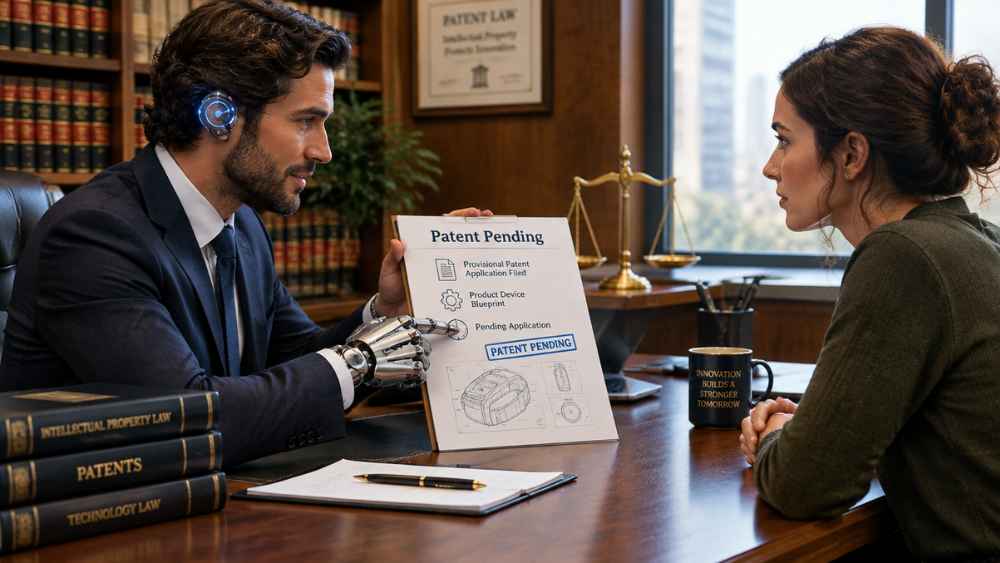
“After filing a provisional patent application covering the device, the startup marked its product Patent Pending while the application remained active.”
What Does Patent Pending Mean?
Patent PendingProvisional Patent ApplicationA provisional patent application can establish an early U.S. filing date for utility or plant inventions, but it is not examined and normally must be followed by a timely nonprovisional application to preserve...View definition means a patent applicationPatent ApplicationA Patent Application is a filing asking the USPTO to examine an invention for patent protection. Provisional and nonprovisional applications differ in purpose, requirements, examination, timing, publication, and their relationship to later patent...View definition covering an invention has been filed and remains pending.
The phrase gives public notice of the application.
Therefore, it does not mean a patent has already been granted. See USPTO Inventors Assistance Center guidance.
Standard Patent Pending — Sample Contract Language
Suppose a startup files a provisional application covering a new device before launch.
Does Patent Pending Create Patent Rights?
No. The phrase itself creates no enforceable patent right.
Patent protection generally begins only when the USPTO grants a patent.
Therefore, “patent pending” is notice rather than a patent.
When Can You Say Patent Pending?
You can use the phrase after filing a patent application covering the invention while that application remains pending.
The application can be provisional or nonprovisional when legally applicable.
Therefore, the filing must be real and still pending.
What Is Patent Applied For?
“Patent applied for” communicates the same basic concept as “patent pending.”
Both phrases tell the public that a patent application has been filed.
Therefore, neither phrase guarantees issuance.
Can a Provisional Application Support Patent Pending?
Yes. Filing a provisional application permits authorized use of “Patent Pending” for the covered invention.
A provisional application is not examined on the merits.
Therefore, it provides filing-date benefits without itself becoming a patent. See USPTO provisional-application guidance.
How Long Does a Provisional Application Remain Pending?
A provisional application ordinarily lasts 12 months from its filing date.
It then becomes abandoned by operation of law.
Therefore, applicants generally file a corresponding nonprovisional application within that period.
Can a Design Invention Use a Provisional Application?
No. U.S. provisional applications are available for utility and plant inventions, not design inventions.
A filed design patent application can still support patent-pending notice while pending.
Therefore, filing strategy depends on patent type.
What Is a Nonprovisional Application?
A nonprovisional application is examined by the USPTO and can mature into an issued patent.
It includes claims and other required application components.
Therefore, nonprovisional prosecution determines whether patent protection ultimately issues.
Does Patent Pending Mean the USPTO Approved the Invention?
No. Filing does not mean the USPTO has found the invention patentable.
The examiner can later reject claims.
Therefore, the label should not imply government approval.
Can Patent Pending Deter Competitors?
Yes, as a practical matter.
The notice warns competitors that patent claims may later issue covering the product or method.
Therefore, businesses often use the phrase during commercialization.
Can You Sue for Patent Infringement While Only Patent Pending?
Generally, no patent-infringement claim exists until a patent issues.
Special provisional-rights rules can sometimes allow later recovery tied to a published application.
Therefore, ordinary infringement enforcement usually waits for grant.
What Are Provisional Rights Under 35 U.S.C. § 154(d)?
Published patent applications can create limited provisional rights in specified circumstances after a patent later issues.
Actual noticeConstructive NoticeConstructive notice is legally imputed knowledge arising from a recognized notice method, such as public recording or other circumstances that the law treats as sufficient notice.View definition and substantially identical claims are important requirements.
Therefore, patent-pending status alone does not create those damagesLegal RemedyA legal remedy is the relief a court or other authorized tribunal can provide after a legal right has been violated. Remedies can include damages, injunctions, restitution, specific performance, rescission, declarations, and other...View definition rights.
Are Patent Applications Published?
Many nonprovisional utility and plant applications publish about 18 months after the earliest claimed filing date.
Exceptions include certain nonpublication requests and application types.
Therefore, some patent-pending applications become publicly searchable.
Are Provisional Applications Published?
Provisional applications are not published as patent application publications by themselves.
Their contents can later become accessible through related-file records.
Therefore, provisional filing can preserve some temporary confidentialityEmployment ContractAn employment contract is an agreement defining terms of an employer-employee relationship. It can cover duties, compensation, benefits, equity, confidentiality, intellectual property, restrictive covenants, termination, severance, and dispute procedures while remaining subject to...View definition .
Can Patent Pending Be Used on Packaging?
Yes, when a qualifying patent application remains pending for the marked invention.
The phrase can appear on products, packaging, websites, or advertising.
Therefore, the notice can travel with commercial materials.
Can Patent Pending Be Used in Advertising?
Yes, when the claim is truthful and connected to a pending application.
False use intended to deceive the public can violate federal law.
Therefore, marketing teams should verify application status.
What Is False Patent Pending Marking?
Federal law prohibits deceptive use of “patent pending” when no application exists or the application is no longer pending.
35 U.S.C. § 292 addresses false marking.
Therefore, expired or abandoned applications should not support continued notice. See 35 U.S.C. § 292.
What Is the Penalty for False Patent Pending Marking?
Section 292 authorizes a federal fine for deceptive false marking.
Competitors suffering competitive injury can also seek compensatory damagesTort DefinitionA tort is a civil wrong arising from an act or omission that causes legally recognized injury or harm. Major tort categories include intentional torts, negligence, and strict liability, with remedies commonly including...View definition .
Therefore, misuse can create both public and private consequences.
When Must Patent Pending Notice Stop?
The phrase should stop when no application covering the invention remains pending.
If a patent issues, patent markingPatent InfringementPatent Infringement occurs when a person performs an unauthorized act covered by the Patent Act, such as making, using, selling, offering to sell, or importing a patented invention. U.S. law also recognizes induced...View definition should use the granted patent information instead.
Therefore, status monitoring is important.
What Happens If a Provisional Application Expires?
The provisional application no longer remains pending after abandonment.
A later nonprovisional application can preserve continuity only when applicable requirements are satisfied.
Therefore, the business should update patent-pending claims carefully.
Can More Than One Application Support Patent Pending?
Yes. An invention or product can relate to multiple pending patent applications.
Businesses should avoid suggesting broader coverage than actually sought.
Therefore, portfolio records should connect products to applications.
Does Patent Pending Cover the Entire Product?
Not necessarily. The pending application can cover only certain features, methods, or combinations.
The claims ultimately define patent scopePatent ClaimA patent claim is a numbered legal statement defining the scope of patent protection and serving as the central unit for examination, validity, infringement, and licensing analysis.View definition if issued.
Therefore, the notice should not be read as blanket protection.
Does Patent Pending Guarantee a Patent?
No. Applications can be rejected, abandoned, or narrowed substantially during prosecution.
Many claims change before issuance.
Therefore, investors and competitors should not treat pending status as granted exclusivity.
Can a Patent Pending Application Be Sold?
Yes. Patent applications and related rights can be assigned.
Assignments can be recorded with the USPTO.
Therefore, ownership can change before a patent issues.
Can a Patent Pending Application Be Licensed?
Yes. Parties can license rights associated with a pending application and future patentsIntellectual PropertyIntellectual property, or IP, is a group of legal rights that protect certain inventions, creative works, brands, and confidential business information. Major U.S. categories include patents, copyrights, trademarks, and trade secrets.View definition .
The agreement should address uncertainty about issuance and claim scope.
Therefore, licensing terms often include prosecution provisions.
What Is Priority?
Priority concerns which filing date an application can rely on for claimed subject matter.
Provisional and foreign filings can affect priority.
Therefore, patent-pending status does not reveal the full priority analysis.
What Is a Filing Date?
The filing date is the date the USPTO recognizes for the submitted application under applicable rules.
It can become critical when comparing prior artPrior ArtPrior art is legally available information used to evaluate whether patent claims are novel and nonobvious, including qualifying patents, publications, public uses, sales, and other disclosures.View definition and competing filings.
Therefore, accurate filing records matter.
Does Public Disclosure Affect Patent Rights?
Yes. Public disclosure can affect patentability in the United States and other countries.
Foreign systems can have stricter noveltyPatent DefinitionA patent is a federal right that can exclude others from making, using, selling, offering, or importing a protected invention. U.S. patents can cover qualifying utility inventions, ornamental designs, and certain plants.View definition rules.
Therefore, businesses should plan filing before public launch.
Can Patent Pending Be International?
Different countries use different patent systems and marking rules.
A U.S. filing does not automatically create a pending application in every country.
Therefore, international marketing should reflect actual filings.
Patent Pending vs. Patented
Patent pending means an application remains under considerationContract LawContract law is the body of law that governs enforceable agreements. It explains how contracts form, what duties they create, how courts interpret them, what counts as a breach, and what remedies may...View definition .
Patented means an issued patent exists.
Therefore, the two labels describe very different legal stages.
Patent Pending vs. Provisional Patent
There is no U.S. “provisional patent.”
There is a provisional patent application, which can support patent-pending notice.
Therefore, calling a provisional filing a granted patent is inaccurate.
Patent Pending Example
Suppose a startup files a provisional application covering a new device before launch.
It begins labeling the device “Patent Pending.”
Therefore, the label is appropriate while the qualifying application remains pending.
Why Does Patent Pending Matter?
Patent-pending notice can signal an active patent strategy and warn competitors of possible future rights.
However, it creates no granted monopoly by itself.
Therefore, businesses should use the phrase accurately and monitor application status.