
Copyright Infringement
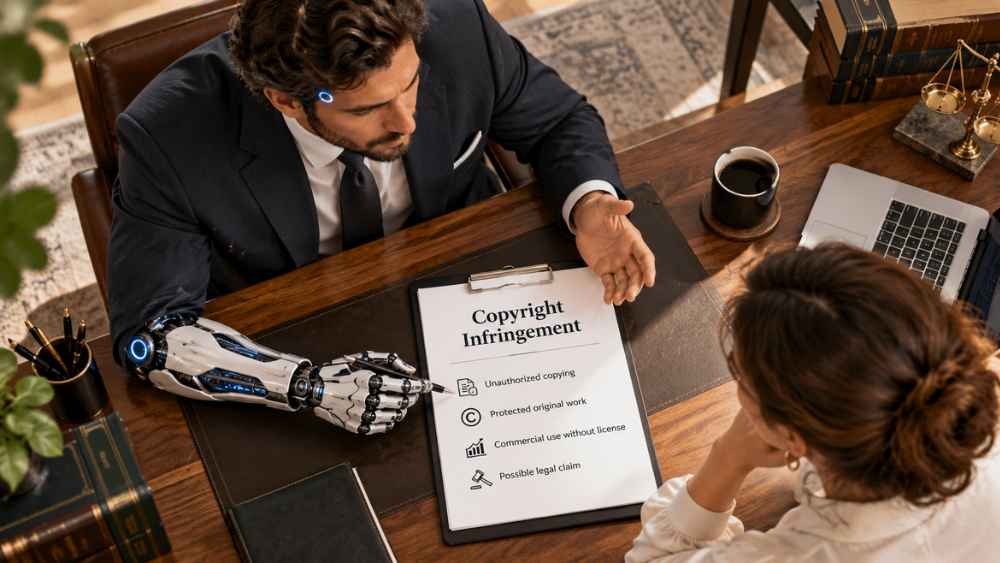
“The photographer alleged copyright infringement after a company copied the protected image and used it in commercial advertising without a license.”
What Is Copyright Infringement?
Copyright infringementCopyright DefinitionCopyright is legal protection for original works of authorship fixed in a tangible medium. It can protect books, music, films, software, photographs, and other creative expression while leaving ideas, facts, and methods outside...View definition occurs when someone violates an exclusive copyright right without authorization or another valid legal basis.
Federal copyright law gives owners exclusive rights involving reproduction, adaptation, distribution, public performance, and public display.
See 17 U.S.C. § 501 and 17 U.S.C. § 106.
Standard Copyright Infringement — Sample Contract Language
Suppose a business copies a photographer’s image from a website and uses it in a paid advertisement without permission.
What Does Copyright Infringement Mean?
Copyright infringement means using protected expression in a way reserved to the copyright owner without permission or a valid defense.
For example, copying and selling an unauthorized digital book can infringe copyright.
Therefore, infringement focuses on protected expression rather than ideas alone.
What Does Copyright Protect?
Copyright protects original works of authorship fixed in a tangible medium.
Examples include books, music, software, photographs, films, illustrationsRestatement of LawA Restatement of Law is an American Law Institute publication that organizes and explains legal doctrine, especially common law. Restatements are persuasive rather than automatically binding, although courts can adopt particular Restatement rules...View definition , and other creative works.
See the U.S. Copyright Office overview.
What Does Copyright Not Protect?
Copyright does not protect ideas, procedures, systems, methods of operation, or facts as such.
It protects original expression of ideas when statutory requirements are satisfied.
Therefore, similarity in an underlying idea does not automatically establish infringement.
What Are the Exclusive Rights Under Section 106?
Section 106 grants several exclusive rights, subject to statutory limitations.
- Reproduction.
- Preparation of derivative works.
- Distribution of copies or phonorecords.
- Public performance for specified works.
- Public display for specified works.
- Digital audio transmission rights for sound recordings.
Therefore, infringement can occur in several different ways.
What Is Direct Copyright Infringement?
Direct infringementPatent InfringementPatent Infringement occurs when a person performs an unauthorized act covered by the Patent Act, such as making, using, selling, offering to sell, or importing a patented invention. U.S. law also recognizes induced...View definition involves violation of an exclusive right by the defendantCivil CourtCivil court is a general term for a court handling noncriminal disputes involving people, businesses, organizations, or government entities. Civil cases can involve contracts, injuries, property, employment, civil rights, and other disputes and...View definition .
The plaintiff generally must prove ownership of a valid copyright and copying of protected elements.
Therefore, liability can exist even without proof of bad intent.
What Does Copying Mean?
Copying means the challenged work was derived from the plaintiff’s protected expression.
Direct evidenceDirect EvidenceDirect Evidence proves a fact without requiring an additional inference about that fact. Examples can include eyewitness testimony, admissions, recordings, photographs, contracts, and other evidence that directly addresses the disputed issue.View definition is rare, so courts can consider access and similarities.
Therefore, proof often relies on circumstantial evidenceCircumstantial EvidenceCircumstantial Evidence is indirect proof that supports a fact through one or more reasonable inferences. It can prove intent, discrimination, negligence, causation, knowledge, possession, fraud, and other issues, and it is not inherently...View definition .
What Is Substantial Similarity?
Substantial similarity is a judicial test used to determine whether protected expression was copied to an actionable degree.
The precise test varies among federal circuits and types of works.
Therefore, similarity analysis can be highly fact specific.
What Is Access?
Access means the alleged infringer had a reasonable opportunity to encounter the protected work.
Access can support an inference of copying.
However, similarity and access do not eliminate the need to identify protectable expression.
What Is Independent Creation?
Independent creation means a person created a similar work without copying the plaintiff’s work.
Copyright does not prohibit independently created similarity.
Therefore, copyright differs from patent lawPatent DefinitionA patent is a federal right that can exclude others from making, using, selling, offering, or importing a protected invention. U.S. patents can cover qualifying utility inventions, ornamental designs, and certain plants.View definition in this respect.
What Is a Derivative Work?
A derivative work recasts, transforms, or adapts a preexisting work in a copyrightable form.
Examples can include translations, film adaptations, or revised versions.
Therefore, unauthorized preparation of a derivative work can infringe.
What Is Distribution Infringement?
Copyright owners generally control distribution of copies or phonorecords to the public, subject to statutory limits.
For example, unauthorized commercial distribution of copied software can infringe.
However, the first-sale doctrine can limit distribution rights for lawfully made copies.
What Is the First-Sale Doctrine?
The first-sale doctrine generally permits the owner of a lawfully made copy to sell or dispose of that copy.
It does not authorize making new copies.
Therefore, reselling a lawful book differs from duplicating it.
What Is Public Performance Infringement?
Some copyrighted works carry an exclusive public-performance right.
For example, unauthorized public performance of a film can implicate copyright.
However, statutory licenses and exemptions can apply.
What Is Public Display Infringement?
Copyright owners can control public display of specified works.
For example, displaying an unauthorized copyrighted image online can implicate the display right.
Therefore, digital use can involve both reproduction and display rights.
What Is Secondary Copyright Liability?
Courts recognize forms of secondary liability for parties who contribute to or benefit from infringement.
Common doctrines include contributory infringement and vicarious liabilityLiability DefinitionLiability means legal responsibility for an act, omission, debt, loss, or other obligation. Liability can arise from negligence, contracts, statutes, strict-liability rules, or responsibility for another person’s conduct.View definition .
Therefore, a defendant need not always make the infringing copy personally.
What Is Contributory Copyright Infringement?
Contributory infringement can arise when a party knowingly contributes materially to another’s infringement.
The doctrine comes from federal case lawCase LawCase law is law developed through judicial decisions. Court opinions interpret statutes, constitutions, regulations, contracts, and prior decisions, and some rulings become binding precedent for lower courts.View definition .
Therefore, knowledge and material contributionThird Party ComplaintA third-party complaint uses Rule 14 impleader to bring a nonparty into a lawsuit when that person may be liable to a defending party for all or part of the original claim.View definition can become central.
What Is Vicarious Copyright Liability?
Vicarious liability can arise when a party has the right and ability to supervise infringement and a direct financial interest.
It does not require the same knowledge showing as contributory liability.
Therefore, control and financial benefit can matter.
What Is Inducement Liability?
Inducement can impose liability when a party distributes a product or service with the objective of promoting infringement.
The Supreme CourtSupreme CourtThe Supreme Court of the United States is the nation’s highest federal court. It reviews selected cases involving the Constitution and federal law, resolves important federal legal questions, and sits at the top...View definition addressed this theory in MGM Studios Inc. v. Grokster, Ltd..
Therefore, purposeful encouragement can create liability.
Is Copyright Infringement Intentional?
Intent is not generally required for basic infringement liability.
However, knowledge and willfulness can affect remedies.
Therefore, an innocent infringer can still face liability.
What Is Willful Copyright Infringement?
Willful infringement can increase statutory damagesStatutory DamagesStatutory damages are money awards set by statute, often used when actual harm is difficult to prove or when legislatures want predictable enforcement remedies.View definition when the defendant knew or recklessly disregarded the copyright owner’s rights.
Courts examine the evidence and governing standard.
Therefore, willfulness can significantly increase exposure.
What Is Innocent Infringement?
An innocent infringer lacks reason to believe the conduct constituted infringement under the statutory standard.
In qualifying cases, a court can reduce statutory damages.
Therefore, innocence affects remedies rather than eliminating infringement automatically.
What Is Fair Use?
Fair use is a statutory limitation on copyright rights.
Courts analyze purpose and characterFair UseFair use is a copyright doctrine that can permit limited use of protected material without permission. Courts weigh four statutory factors involving purpose, the original work, the amount used, and the effect on...View definition , nature of the work, amount used, and market effect.
See 17 U.S.C. § 107.
Does Giving Credit Prevent Copyright Infringement?
No. Attribution does not automatically create permission or fair use.
It can matter ethically or contractually but does not replace copyright analysis.
Therefore, credit alone is not a defense.
Does a Disclaimer Prevent Copyright Infringement?
No. A statement such as “no infringement intended” does not create permission.
Copyright analysis focuses on legal rights, licenses, and statutory limitations.
Therefore, disclaimers do not cure unauthorized use.
How Much Can Be Copied Legally?
There is no universal safe percentage or word count.
Fair use considers both quantity and qualitative importance.
Therefore, even a small but central portion can matter.
Can Educational Use Be Infringement?
Yes. Educational purpose can support fair use but does not guarantee it.
Courts still evaluate all four statutory factors.
Therefore, nonprofit status alone is not decisive.
Can Commercial Use Be Fair Use?
Yes. Commercial purpose weighs in the analysis but does not automatically defeat fair use.
Transformative context and market effects can be important.
Therefore, commercial uses require a full factor analysis.
Can AI Training or AI Output Raise Copyright Issues?
Yes. AI systems can raise questions about training data, reproduction, outputs, licensing, authorship, and fair use.
These issues remain subject to developing statutesPrimary AuthorityPrimary Authority is law issued by an institution with official power to create or state legal rules. Constitutions, statutes, regulations, court decisions, and court rules can be primary authority, while binding effect depends...View definition , cases, and Copyright Office guidance.
Therefore, AI-related copyright analysis should use current law.
Can Software Be Copyrighted?
Yes. Copyright can protect original source code and object code.
However, ideas, methods, functionality, and unprotectable elements remain outside copyright scope.
Therefore, software disputes often require filtration of protected expression.
Can Photographs Be Infringed Online?
Yes. Copying or displaying protected photographs online without permission can infringe.
However, licenses, fair use, and other defenses can apply.
Therefore, publicly visible does not mean public domainPublic DomainThe Public Domain includes works and material not protected by copyright because protection expired or never applied. Public-domain status can depend on publication date, authorship, country, government origin, and whether a later edition...View definition .
Can Music Be Copyright Infringed?
Yes. Musical compositions and sound recordings can carry separate copyrightsIntellectual PropertyIntellectual property, or IP, is a group of legal rights that protect certain inventions, creative works, brands, and confidential business information. Major U.S. categories include patents, copyrights, trademarks, and trade secrets.View definition .
A use can require different permissions depending on reproduction, performance, synchronization, or distribution.
Therefore, music licensing can involve multiple rights holders.
What Is the DMCA?
The Digital Millennium Copyright ActDMCAThe DMCA is the Digital Millennium Copyright Act, a federal copyright law covering online-service-provider safe harbors, notice-and-takedown procedures, counter-notices, designated agents, repeat-infringer policies, anti-circumvention rules, and temporary Section 1201 exemptions.View definition , or DMCA, includes online service-provider safe harbors and notice-and-takedown procedures.
It also contains rules protecting technological copyright controls.
Therefore, the DMCA addresses more than ordinary infringement.
What Is a DMCA Takedown Notice?
A DMCA takedown notice asks a qualifying online service provider to remove or disable access to allegedly infringing material.
The notice must contain statutory information.
Therefore, incomplete notices can create problems.
What Is a DMCA Counter Notice?
A counter notice can seek restoration after material is removed under a DMCA notice.
It requires specified statements and contact information.
Therefore, counter notices have legal consequences and should be used carefully.
What Is Copyright Registration?
Copyright registration creates a public record and provides important enforcement benefits.
For U.S. works, registration generally must occur before filing a federal infringement action.
See U.S. Copyright Office registration guidance.
Does Copyright Exist Without Registration?
Yes. Copyright generally arises automatically when an original work is fixed.
Registration is not required for copyright to exist.
However, registration timing affects litigationLegal DisputeA legal dispute is a disagreement or controversy involving claimed legal rights, duties, liabilities, property, or remedies. It can be resolved through negotiation, mediation, arbitration, administrative proceedings, litigation, or settlement depending on the...View definition and remedies.
What Is the Registration Requirement Before Suit?
Section 411(a) generally requires registration or refusal before a U.S. work owner files an infringement action.
The Supreme Court adopted the registration approach in Fourth Estate Public Benefit Corp. v. Wall-Street.com, LLC.
However, statutory exceptions exist.
What Are Actual Damages?
Actual damagesLiquidated DamagesLiquidated damages are a contractually agreed amount or formula payable after a specified breach. Courts generally enforce them when they reasonably compensate for difficult-to-measure losses rather than operating as an unlawful penalty.View definition compensate proven losses caused by infringement.
The owner can also seek qualifying infringer profits not already included in actual damages.
Therefore, financial evidence can be central.
What Are Statutory Damages?
Copyright owners can elect statutory damages instead of actual damages and profits when statutory requirements are satisfied.
The ordinary range is generally $750 to $30,000 per work.
Therefore, statutory damages can avoid proving exact financial loss.
How High Can Willful Statutory Damages Be?
A court can increase statutory damages to as much as $150,000 per work for willful infringement.
The amount is discretionary within statutory limits.
Therefore, willfulness can materially increase exposure.
Can Statutory Damages Be Reduced for Innocent Infringement?
Yes. A court can reduce statutory damages to as little as $200 per work in qualifying innocent-infringement circumstances.
However, statutory conditions and evidentiary issues apply.
Therefore, innocence does not guarantee the minimum award.
When Are Statutory Damages and Attorney Fees Available?
Section 412Copyright RegistrationCopyright Registration records a copyright claim with the U.S. Copyright Office and creates an official public record. Copyright generally exists upon fixation without registration, but timely registration can affect infringement suits, evidentiary presumptions,...View definition limits statutory damages and attorney feesMotion to CompelA motion to compel asks a court to order required discovery or disclosure when another party or person has not responded adequately. In federal civil cases, Rule 37 generally requires good-faith conference efforts...View definition based on registration timing.
Prompt registration can preserve important remedies for later infringement.
Therefore, creators often benefit from early registration.
Can a Court Award Attorney Fees?
Section 505 allows courts to award reasonable attorney fees to the prevailing party in appropriate cases.
The award is discretionary.
Therefore, fee recovery is not automatic.
Can a Court Issue an Injunction?
Yes. Federal copyright law allows injunctions on terms the court considers reasonable to prevent or restrain infringement.
Courts apply equitable principles.
Therefore, successful plaintiffs do not receive injunctions mechanically.
Can Infringing Copies Be Impounded or Destroyed?
Federal law permits impoundment and disposition of infringing copies and specified materials in qualifying cases.
Therefore, remedies can extend beyond money.
What Is the Copyright Statute of Limitations?
Section 507(b) provides a three-year limitations periodStatute of LimitationsA statute of limitations is a law that sets a deadline for starting a legal claim. The deadline varies by jurisdiction and claim type, and rules about accrual, discovery, tolling, or repose can...View definition for civil copyright actions after the claim accrues.
AccrualCause of ActionA Cause of Action is a recognized set of legal elements supporting a right to judicial relief. Its elements can arise from statutes, constitutions, regulations, or case law, and the claimant generally must...View definition issues can be legally complex.
Therefore, potential plaintiffs should investigate promptly.
Copyright Infringement vs. Plagiarism
Plagiarism is using another person’s work or ideas without proper attribution.
Copyright infringement is a legal violation of copyright rights.
Therefore, conduct can be plagiarism without infringement or infringement without plagiarism.
Copyright Infringement vs. Trademark Infringement
Copyright protects original expression.
Trademark protects source identifiers used in commerce.
Therefore, one image or phrase can raise both issues in some circumstances.
Copyright Infringement Example
Suppose a business copies a photographer’s image from a website and uses it in a paid advertisement without permission.
The photographer owns a valid copyright and did not license the use.
The use can support an infringement claim unless a defense or limitation applies.
Why Does Copyright Infringement Matter?
Copyright infringement law protects creators’ exclusive rights while preserving statutory limitations such as fair use.
However, not every similarity or unauthorized reference is infringement.
The key questions are practical. Is the work protected? Was protected expression copied? Was permission granted? Does a defense or limitation apply?