
Smart Contract
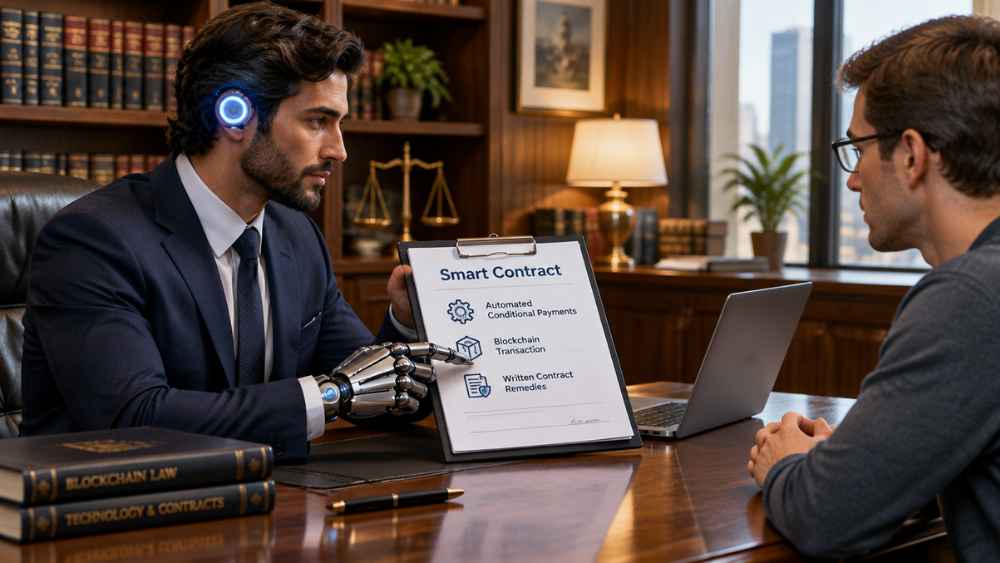
“The parties used a Smart Contract to release payment after verified delivery while a written agreement governed oracle failures, disputes, and legal remedies.”
What Is a Smart Contract?
A Smart Contract is software that automatically performs specified actions when programmed conditions occur.
It can record, transfer, calculate, releaseWaiver DefinitionA waiver is the intentional relinquishment of a known legal right, claim, privilege, or protection. A waiver can be express or implied, although enforceability depends on the right involved, the evidence of intent,...View definition , or restrict digital assets or other information.
Therefore, the term describes automation rather than one uniform legal contract category.
Standard Smart Contract — Sample Contract Language
Suppose a supply agreementSupply AgreementA Supply Agreement governs recurring purchases of goods and defines specifications, pricing, forecasts, orders, delivery, quality, warranties, shortages, and change control.View definition releases payment automatically after a trusted system confirms delivery.
Is a Smart Contract Legally a Contract?
Sometimes. Legal enforceability depends on ordinary contract rules, governing lawBoilerplate ClauseA boilerplate clause is standardized contract language addressing recurring legal mechanics such as notice, assignment, governing law, waiver, severability, and integration.View definition , and the parties’ actual agreement.
Code execution alone does not automatically prove offerOffer and AcceptanceOffer and Acceptance describes how parties manifest mutual assent to a contract. A valid offer gives another party power to accept, while acceptance must objectively communicate assent through an authorized method, subject to...View definition , acceptance, considerationContract LawContract law is the body of law that governs enforceable agreements. It explains how contracts form, what duties they create, how courts interpret them, what counts as a breach, and what remedies may...View definition , capacity, or lawful purpose.
Therefore, legal analysisLegal MemorandumA legal memorandum is an organized written analysis of a legal issue based on facts, research, and relevant authority. It typically frames the question, states a brief answer, presents material facts, analyzes governing...View definition should separate software behavior from contract formation.
How Does E-SIGN Affect Smart Contracts?
Federal E-SIGN law generally prevents denial of contract effect solely because a contract or signature is electronic.
Ordinary legal requirements still apply.
Therefore, electronic form alone does not make a smart contract invalid. See 15 U.S.C. § 7001.
How Does UETA Relate to Smart Contracts?
The Uniform Electronic Transactions Act supports electronic recordsBest Evidence RuleThe Best Evidence Rule generally requires an original writing, recording, or photograph when a party seeks to prove its content. Federal Evidence Rules 1001–1008 define originals and duplicates, permit reliable copies, and provide...View definition , signatures, and automated transactions in adopting states.
It also addresses transactions involving electronic agents.
Therefore, UETADigital SignatureA digital signature is a cryptographic form of electronic signature used to authenticate a signer and verify the integrity of an electronic record.View definition can support automated contractingMachine Readable ContractA Machine Readable Contract represents contractual information in structured form that software can search, validate, analyze, or process. It can preserve human-readable legal prose while adding schemas, metadata, data models, or executable logic.View definition without creating a special blockchain contract law. See Uniform Law Commission UETA materials.
What Is an Electronic Agent?
An electronic agent is software or another automated means used to initiate or respond to electronic records or actions.
The process can operate without contemporaneous human review.
Therefore, automated execution can still have legal consequences.
Can Two Electronic Agents Form a Transaction?
UETA recognizes that contracts can arise from interactions between electronic agents under applicable law.
Human review of every individual step is not always required.
Therefore, automated systems can participate in legally significant transactions.
What Is Blockchain?
A blockchain is a distributed record system that groups and links transactions using cryptographic methods.
Smart contracts often run on blockchain platforms, but they do not require blockchain in every case.
Therefore, smart contract and blockchain are related but distinct concepts.
What Is a Distributed Ledger?
A distributed ledger stores synchronized records across multiple network participants or nodes.
Different architectures use different governance and validationTechnology Assisted ReviewTechnology Assisted Review (TAR) uses technology and human judgment to prioritize, classify, and review documents in legal discovery. TAR can include predictive coding, continuous active learning, statistical sampling, validation, and other analytics designed...View definition methods.
Therefore, legal analysis should identify the specific technology rather than rely on labels.
What Is On-Chain Execution?
On-chain execution means software executes and records activity directly on a blockchain or distributed ledger.
Transaction rules can become difficult to reverseCourt of AppealsA court of appeals is a court that reviews decisions from lower courts. Federal courts of appeals usually examine the existing record for legal error rather than conducting a new trial or hearing...View definition after confirmation.
Therefore, error-handling design matters before deployment.
What Is Off-Chain Performance?
Off-chain performance occurs outside the blockchain while code records, verifies, or triggers some part of the transaction.
Many commercial arrangements combine code with traditional systems.
Therefore, hybrid structures are common.
What Is an Oracle?
An oracle supplies external information to a smart contract.
Examples include market prices, shipment status, weather, or identity data.
Therefore, inaccurate oracle data can trigger incorrect execution.
What Is an Oracle Risk?
Oracle risk arises when the automated system depends on incorrect, delayed, manipulated, or unavailable external information.
The code can execute exactly as designed and still produce the wrong commercial result.
Therefore, contracts should allocate oracle failure risk.
What Is a Hybrid Smart Contract?
A hybrid smart contract combines human-readable legal terms with executable code.
The written agreement can explain rights that code alone cannot express clearly.
Therefore, hybrid drafting often reduces ambiguityContract InterpretationContract interpretation is the legal process of determining what contractual language means and how the agreement applies to the parties' dispute.View definition .
Code vs. Natural-Language Terms
Code specifies machine-executable conditions.
Natural-language terms can address interpretation, discretion, warranties, force majeureForce MajeureForce Majeure is a contract concept that can excuse or delay performance after extraordinary events covered by the agreement. Relief depends on clause wording, causation, notice, mitigation, exclusions, governing law, and the specific...View definition , governing law, and dispute resolutionLegal DisputeA legal dispute is a disagreement or controversy involving claimed legal rights, duties, liabilities, property, or remedies. It can be resolved through negotiation, mediation, arbitration, administrative proceedings, litigation, or settlement depending on the...View definition .
Therefore, important commercial relationships often need both.
What Happens If Code and Contract Text Conflict?
The answerCivil LitigationCivil Litigation is the court process for resolving noncriminal disputes through pleadings, motions, discovery, settlement, trial, judgment, and possible appeal. Federal civil litigation follows the Federal Rules of Civil Procedure, while state systems...View definition depends on the agreement’s priority clause and governing law.
Parties can state whether text, code, or a specific record controls.
Therefore, conflict rules should be drafted before deployment.
What Is Automated Performance?
Automated performance occurs when software performs contractual steps without a new manual instruction.
Examples include payment release, escrow transfer, interest calculation, or access control.
Therefore, automation can reduce delay while increasing design risk.
Can a Smart Contract Make Payment Automatically?
Yes. Code can release digital or conventional payment when programmed conditions occur.
However, payment legality can depend on financial, sanctions, tax, and licensing rules.
Therefore, technical capability does not eliminate regulatory duties.
Can Smart Contracts Use Digital Assets?
Yes. Smart contracts often control tokens, digital assets, or rights represented electronically.
Ownership and transfer rules depend on governing commercial law.
Therefore, token mechanics should be linked to legal rights carefully.
How Do the 2022 UCC Amendments Matter?
The 2022 UCC amendments address emerging technologies, distributed ledgers, virtual currencies, AI, and other digital transactions.
They add Article 12 for certain controllable electronic records.
Therefore, state adoption can affect digital-asset transaction rules. See Uniform Law Commission UCC materials.
What Is a Controllable Electronic Record?
A controllable electronic recordElectronic SignatureAn Electronic Signature is an electronic sound, symbol, or process adopted with intent to sign a record. Federal E-SIGN law generally prevents denial of legal effect solely because a signature or contract is...View definition , or CER, is a digital record meeting Article 12 control requirements where enacted.
Examples can include some virtual assets.
Therefore, CER status depends on statutory definitions rather than blockchain terminology alone.
Do All States Use the Same Smart Contract Law?
No. Contract, electronic-transactions, digital-asset, and commercial-law statutesPrimary AuthorityPrimary Authority is law issued by an institution with official power to create or state legal rules. Constitutions, statutes, regulations, court decisions, and court rules can be primary authority, while binding effect depends...View definition vary by state.
States also adopt uniform laws at different times and sometimes with modifications.
Therefore, governing law should be identified early.
What Is Consideration in a Smart Contract?
Traditional consideration rules can still apply when governing contract law requires consideration.
An automated exchange of value can satisfy consideration in appropriate circumstances.
Therefore, automation does not replace substantive contract doctrine.
What Is Mutual Assent?
Mutual assent concerns whether the parties objectively agreed to the transaction.
Interfaces, signatures, wallet interactions, clickwrapTerms of ServiceTerms of Service are online contractual rules governing access to and use of a website, application, platform, or digital service.View definition terms, and surrounding communications can provide evidence.
Therefore, user experience can affect contract formation.
Can Smart Contracts Be Signed Electronically?
Yes. Electronic signatures can satisfy signature requirements when applicable law and transaction facts support them.
AuthenticationAdmissible EvidenceAdmissible Evidence is evidence a court permits the judge or jury to consider. In federal court, admissibility commonly depends on relevance, Rule 403 balancing, authentication, foundation, hearsay rules, privilege, witness competence, and other...View definition and attribution still matter.
Therefore, wallet signatures and platform records should be evaluated carefully.
What Is Attribution?
Attribution asks whether an electronic action should legally be treated as the act of a particular person.
Credentials, security procedures, device evidence, and surrounding facts can matter.
Therefore, possession of a private key can be important but not always conclusive.
What Is a Private Key?
A private key is secret cryptographic information used to authorize transactions or prove control.
Loss or theft can create major legal and financial consequences.
Therefore, key-management rules should address custody and compromise.
What Is a Smart Contract Bug?
A smart contract bug is a coding defect that produces unintended behavior.
The resulting transaction can still execute automatically.
Therefore, testing, audits, pause functions, and remediation clauses can reduce risk.
What Is a Smart Contract Audit?
A smart contract audit reviews code for security flaws, logic errors, and known attack patterns.
An audit does not guarantee legal enforceability or perfect security.
Therefore, legal and technical review should occur separately.
What Is an Upgrade Mechanism?
An upgrade mechanism allows authorized changes to deployed smart contract code.
It can improve remediation but also create governance and security risks.
Therefore, authorization rules should be transparent.
What Is a Pause or Emergency Stop?
A pause function can temporarily stop specified automated actions after a security incident or error.
The power should have defined triggers and governance.
Therefore, emergency controls can balance automation with risk management.
Can a Smart Contract Be Rescinded?
Potentially. Traditional remedies such as rescissionLegal RemedyA legal remedy is the relief a court or other authorized tribunal can provide after a legal right has been violated. Remedies can include damages, injunctions, restitution, specific performance, rescission, declarations, and other...View definition can apply when governing law permits them.
However, irreversible code execution can make practical restoration difficult.
Therefore, remedyCause of ActionA Cause of Action is a recognized set of legal elements supporting a right to judicial relief. Its elements can arise from statutes, constitutions, regulations, or case law, and the claimant generally must...View definition design should consider technical reversibility.
Can a Court Order Smart Contract Relief?
Yes. Courts can award damages, injunctions, restitution, declarations, or other relief when legal requirements are met.
The code itself does not displace judicial authority.
Therefore, dispute-resolution clauses remain useful.
What Governing Law Should a Smart Contract Use?
Parties can often select governing law through a valid choice-of-law clause.
Mandatory law and conflict-of-laws rules can limit that choice.
Therefore, decentralized technology does not eliminate jurisdiction questions.
What Is a Smart Contract Dispute Clause?
A dispute clause can address courts, arbitrationAlternative Dispute ResolutionAlternative Dispute Resolution, or ADR, includes negotiation, mediation, arbitration, settlement conferences, and other processes used outside ordinary trial adjudication. Each method differs in neutrality, confidentiality, party control, binding effect, cost, and review.View definition , venue, notice, remedies, and emergency reliefEx ParteEx Parte refers to a one-sided request, proceeding, or communication. Courts permit ex parte relief only in authorized circumstances, while professional-conduct rules generally bar private communications with judges unless law or court order...View definition .
It can also define how code records will be interpreted.
Therefore, dispute design should exist before conflict arises.
Smart Contract Example
Suppose a supply agreement releases payment automatically after a trusted system confirms delivery.
The written agreement defines delivery, oracle failure, governing law, and dispute procedures.
Therefore, code automates performance while legal text governs broader rights.
Why Does a Smart Contract Matter?
Smart contracts can automate transactions, reduce manual steps, and create transparent execution records.
However, contract formation, code errors, identity, regulationRegulationA Regulation is a rule issued by a governmental authority, usually an administrative agency, under delegated legal authority. Federal regulations can arise through APA rulemaking, appear first in the Federal Register, and become...View definition , remedies, and governing law still matter.
Therefore, effective smart contracts combine technical design with conventional legal analysis.