
Judicial Review
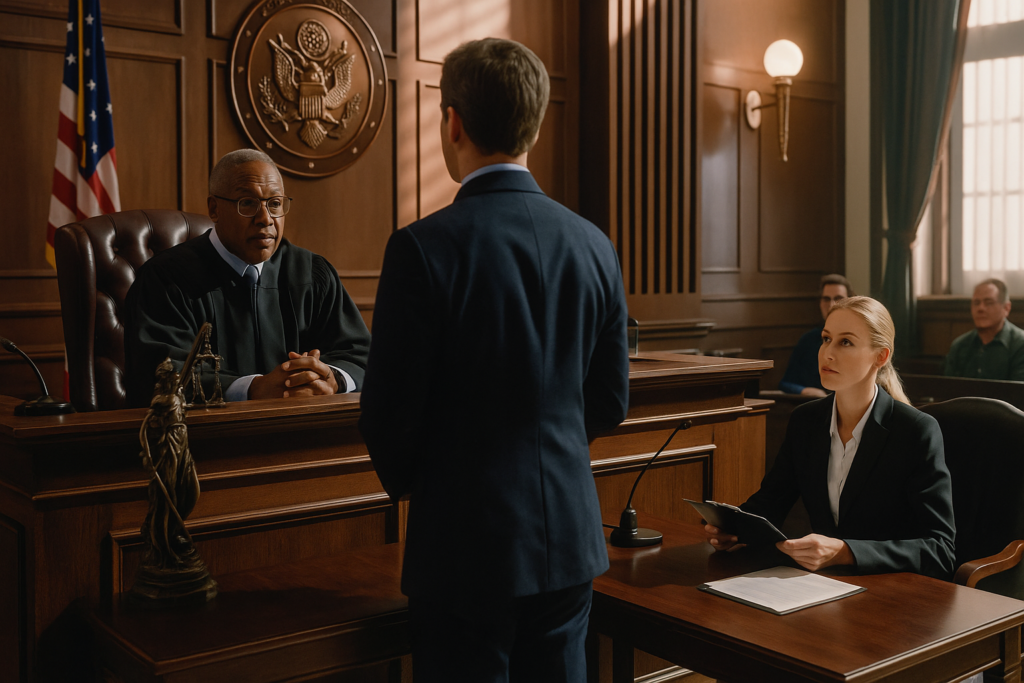
“The federal court exercised judicial review to determine whether the challenged statute violated the Constitution.”
What Is Judicial Review?
Judicial reviewAdministrative CourtAdministrative Court is a broad term for administrative tribunals that adjudicate disputes within agency systems. Federal administrative adjudication can involve ALJs, agency review, exhaustion requirements, and later judicial review under the Administrative Procedure...View definition is the power of courts to examine government actionForce MajeureForce Majeure is a contract concept that can excuse or delay performance after extraordinary events covered by the agreement. Relief depends on clause wording, causation, notice, mitigation, exclusions, governing law, and the specific...View definition and determine whether it complies with higher legal authorityLegal AuthorityLegal authority is a source supporting a proposition of law and can be primary or secondary, binding or persuasive depending on jurisdiction and hierarchy.View definition . In constitutional cases, courts can review laws for constitutionality.
Judicial review is a central feature of the U.S. constitutional system. However, courts exercise it only in cases within their jurisdictionLegal DisputeA legal dispute is a disagreement or controversy involving claimed legal rights, duties, liabilities, property, or remedies. It can be resolved through negotiation, mediation, arbitration, administrative proceedings, litigation, or settlement depending on the...View definition .
Cornell Law School’s Legal Information Institute describes judicial review as court review of government action for legal or constitutional validity. See Cornell LII’s judicial review overview.
Standard Judicial Review — Sample Contract Language
Suppose Congress enacts a federal statuteStatutory LawStatutory law is written law enacted by a legislative body through the formal lawmaking process. Federal and state statutes can create rights, duties, prohibitions, causes of action, procedures, penalties, and remedies, and courts...View definition that restricts protected speech. An affected party files a lawsuitLawsuitA lawsuit is a legal dispute brought before a court for a decision or remedy. Civil lawsuits can involve pleadings, service, discovery, motions, settlement, trial, judgment, and possible appeal.View definition challenging the law.
What Does Judicial Review Mean?
Judicial review means courts can test government action against governing lawBoilerplate ClauseA boilerplate clause is standardized contract language addressing recurring legal mechanics such as notice, assignment, governing law, waiver, severability, and integration.View definition . The reviewing court can examine statutesPrimary AuthorityPrimary Authority is law issued by an institution with official power to create or state legal rules. Constitutions, statutes, regulations, court decisions, and court rules can be primary authority, while binding effect depends...View definition , executive actions, and administrative decisions.
For example, a court can decide whether a statute conflicts with the Constitution.
Therefore, judicial review places legal limits on government power.
Where Does Judicial Review Come From?
The Constitution establishes the federal judicial power. It does not use the term judicial review. Instead, the doctrine developed through constitutional structure and judicial decisionsCase LawCase law is law developed through judicial decisions. Court opinions interpret statutes, constitutions, regulations, contracts, and prior decisions, and some rulings become binding precedent for lower courts.View definition .
The Supreme Court’s 1803 decision in Marbury v. Madison became a foundational statement of judicial review.
Therefore, Marbury is central to U.S. constitutional law.
What Happened in Marbury v. Madison?
Marbury v. Madison involved a dispute over a judicial commission. The Supreme CourtSupreme CourtThe Supreme Court of the United States is the nation’s highest federal court. It reviews selected cases involving the Constitution and federal law, resolves important federal legal questions, and sits at the top...View definition concluded that part of a federal statute conflicted with the Constitution.
The Court explained that the Constitution controls when ordinary legislation conflicts with it.
Therefore, Marbury helped establish the judiciary’s role in constitutional review.
Can Courts Strike Down Laws?
Courts can refuse to enforce laws that violate the Constitution in cases properly before them. This is often described as striking down a law.
However, courts need jurisdiction and a justiciable dispute.
Therefore, judges do not simply review laws whenever they choose.
Can Courts Review Executive Actions?
Yes. Courts can review executive actions when a proper legal claimCause of ActionA Cause of Action is a recognized set of legal elements supporting a right to judicial relief. Its elements can arise from statutes, constitutions, regulations, or case law, and the claimant generally must...View definition exists.
For example, a court may examine whether an executive action exceeds statutory authority or violates the Constitution.
However, jurisdictional and justiciabilityDeclaratory JudgmentA Declaratory Judgment is a court judgment stating the parties’ legal rights or obligations in an actual controversy. Federal declaratory relief arises under 28 U.S.C. §§ 2201–2202 and Rule 57, but it does...View definition limits still apply.
Can Courts Review Agency Decisions?
Yes. Administrative agencies are often subject to judicial review under statutes such as the Administrative Procedure ActAdministrative Law JudgeAn Administrative Law Judge is a federal adjudicator appointed under 5 U.S.C. § 3105 to preside over formal agency proceedings, receive evidence, rule on motions, and issue administrative decisions.View definition .
A reviewing court can examine whether agency action complies with statutory and procedural requirements.
Therefore, judicial review is important in administrative law as well as constitutional law.
What Is the Administrative Procedure Act?
The Administrative Procedure Act, or APAAsset Purchase AgreementAn Asset Purchase Agreement is a contract for the purchase of specified business assets and the negotiated assumption or exclusion of related liabilities.View definition , governs many federal administrative processes. It also provides standards for judicial review of federal agency action.
For example, a court can review whether agency action is arbitrary, capricious, or otherwise contrary to law.
See 5 U.S.C. § 706.
What Is Constitutional Review?
Constitutional review asks whether government action conflicts with the Constitution. It is one form of judicial review.
For example, a court may review a statute under the First Amendment or Equal Protection Clause.
Therefore, constitutional review can involve different constitutional tests.
What Is Statutory Review?
Courts also review whether government actors complied with statutes. This can occur without deciding a constitutional question.
For example, a court may hold that an agency exceeded authority granted by Congress.
Therefore, judicial review is broader than constitutional invalidation alone.
What Is a Standard of Review?
A standard of reviewCourt of AppealsA court of appeals is a court that reviews decisions from lower courts. Federal courts of appeals usually examine the existing record for legal error rather than conducting a new trial or hearing...View definition tells a court how it should evaluate a particular legal issue or government action.
For example, constitutional claims can use strict scrutiny, intermediate scrutiny, or rational-basis review in appropriate contexts.
Administrative review uses other standards.
What Is Strict Scrutiny?
Strict scrutiny is a demanding constitutional standard used in certain cases. The government generally must show a compelling interest and narrow tailoring.
However, strict scrutiny does not apply to every constitutional challenge.
Therefore, identifying the correct standard is essential.
What Is Rational Basis Review?
Rational basis review is a more deferential constitutional standard. It generally asks whether government action is rationally related to a legitimate governmental interest.
However, the exact formulation depends on the claim.
What Is Intermediate Scrutiny?
Intermediate scrutiny falls between rational basis and strict scrutiny. It applies in selected constitutional contexts.
For example, some sex-based classifications receive intermediate scrutiny.
Therefore, different rights and classifications can trigger different levels of review.
What Is Standing?
Standing concerns whether a particular plaintiffCivil CourtCivil court is a general term for a court handling noncriminal disputes involving people, businesses, organizations, or government entities. Civil cases can involve contracts, injuries, property, employment, civil rights, and other disputes and...View definition has a sufficient personal stake to bring a case. Federal courts require constitutional standing.
For example, a plaintiff generally must show injury, causationBreach of DutyA breach of duty occurs when a person or entity fails to meet a legal duty owed to another person. In negligence cases, breach is usually one element alongside duty, causation, and damages,...View definition , and redressabilityStandingStanding is the legal capacity of a party to bring a particular dispute before a court. Federal Article III standing generally requires injury in fact, causation, and redressability, while state-court standing can follow...View definition .
Therefore, a court may never reach the merits if standing is missing.
What Is Ripeness?
Ripeness asks whether a dispute is sufficiently developed for judicial decision. Courts generally avoid deciding premature disputes.
Therefore, a challenge can fail if the alleged harm is too speculative or remote.
What Is Mootness?
Mootness asks whether a live dispute still exists. If later events eliminate the controversy, a federal case can become moot.
However, recognized exceptions can apply.
Therefore, judicial review depends on an ongoing justiciable controversy.
What Is the Political Question Doctrine?
The political question doctrine can make certain disputes inappropriate for judicial resolution. It reflects constitutional and institutional limits on courts.
However, not every politically important dispute is a political question.
Therefore, the doctrine uses legal criteria rather than ordinary political controversy.
Judicial Review and Separation of Powers
Judicial review is closely connected to separation of powers. Courts can check whether legislative and executive actions remain within legal limits.
However, courts also respect powers assigned to the political branches.
Therefore, judicial review involves both authority and restraint.
Judicial Review and Federalism
Judicial review also operates within federalism. Federal courts can review some state actions for consistency with federal law and the Constitution.
State courts can also perform judicial review under state constitutions and laws.
Therefore, judicial review exists in both federal and state systems.
Judicial Review vs. Appeal
An appeal is a request for a higher court to review a lower court decision. Judicial review is a broader concept involving court review of legal validity.
For example, an APA challenge to agency action is judicial review.
Therefore, not every judicial review proceeding is simply an ordinary appeal.
Judicial Review vs. Judicial Activism
Judicial review is an established legal power. Judicial activism is an evaluative label used in debates about judging.
Therefore, the two terms are not legal synonyms.
A court can exercise judicial review without resolving broader debates about judicial philosophy.
Can Congress Limit Judicial Review?
Congress can regulate federal courtFederal CourtA federal court is a court within the U.S. federal judicial system. Federal courts have limited jurisdiction, so they hear only cases authorized by the Constitution or federal law, including many federal-question and...View definition jurisdiction within constitutional limits. Statutes can also define review procedures for agency action.
However, constitutional questions can make jurisdiction-stripping issues complex.
Therefore, the answerCivil LitigationCivil Litigation is the court process for resolving noncriminal disputes through pleadings, motions, discovery, settlement, trial, judgment, and possible appeal. Federal civil litigation follows the Federal Rules of Civil Procedure, while state systems...View definition depends on the statute and constitutional framework.
Judicial Review Example
Suppose Congress enacts a federal statute that restricts protected speech. An affected party files a lawsuit challenging the law.
A federal court determines whether the restriction complies with the First Amendment. If the law is unconstitutional, the court can refuse to enforce it.
Therefore, the case illustrates constitutional judicial review.
Why Does Judicial Review Matter?
Judicial review helps enforce constitutional and statutory limits on government action. Therefore, it is a major check within the U.S. legal system.
However, courts can act only when jurisdiction and justiciability requirements are satisfied.
The key questions are practical. What government action is challenged? What legal rule controls? Does the court have authority to review it?