
Summons
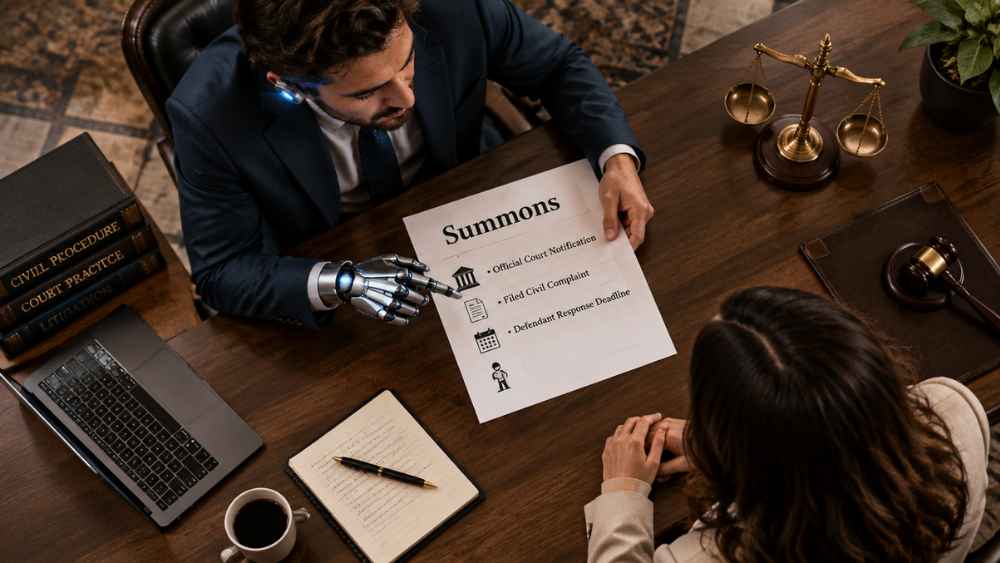
“The clerk issued the summons after the complaint was filed, and the plaintiff arranged service of the summons and complaint on the defendant.”
What Is a Summons?
A summons is an official court document notifying a defendantCivil CourtCivil court is a general term for a court handling noncriminal disputes involving people, businesses, organizations, or government entities. Civil cases can involve contracts, injuries, property, employment, civil rights, and other disputes and...View definition about a filed lawsuitLawsuitA lawsuit is a legal dispute brought before a court for a decision or remedy. Civil lawsuits can involve pleadings, service, discovery, motions, settlement, trial, judgment, and possible appeal.View definition and requiring a response.
In federal civil casesCivil DivisionA Civil Division is a court unit handling noncriminal disputes, with jurisdiction and procedures that vary by court system and locality.View definition , Rule 4 governs summons issuanceCourt ClerkA Court Clerk is a nonjudicial officer who manages filings, dockets, records, notices, fees, jury administration, technology, and other court operations. Clerks can provide neutral procedural information but cannot decide cases, interpret court...View definition and service.
See Federal Rule of Civil Procedure 4.
Standard Summons — Sample Contract Language
Suppose a plaintiff files a federal breach-of-contract complaintCivil LawsuitA civil lawsuit is a noncriminal court action in which a plaintiff seeks a legal remedy from a defendant. The process can include jurisdiction, pleadings, service, discovery, motions, settlement, trial, judgment, enforcement, and...View definition .
What Does a Summons Do?
A summons gives formal noticeLegal NoticeLegal notice is a formal communication of a legal fact, claim, obligation, deadline, proceeding, or intended action given through a recognized method.View definition that a defendant must appear and defend the lawsuit.
It also warns that failure to respond can lead to default judgmentAnswer to ComplaintAn Answer to Complaint is the defendant’s formal pleading responding to a civil complaint. It typically admits or denies allegations, states insufficient knowledge where appropriate, asserts defenses, and can include counterclaims, jury demands,...View definition .
Therefore, a defendant should never ignore a summons.
Who Issues a Federal Summons?
The court clerkClerk of CourtA Clerk of Court manages a court’s major nonjudicial functions, including dockets, records, filings, notices, fees, jury administration, and operational systems. The clerk supports judicial work but does not decide the merits of...View definition signs, seals, and issues a properly completed federal summons.
The plaintiff presents the summons after filing the complaint.
Therefore, the summons carries the court’s official seal and clerk signature.
What Must a Federal Summons Contain?
Rule 4 requires several items in a federal summons.
- Court name.
- Party names.
- Defendant name.
- Plaintiff counsel contact information.
- The response time.
- A default warning.
- The clerk’s signature.
- The court seal.
Therefore, a federal summons uses a standardized structure.
Summons vs. Complaint
A summons notifies the defendant of the lawsuit and response obligation.
A complaint states the plaintiff’s claims, allegations, and requested relief.
Therefore, the documents serve different functions and are usually served together.
What Is Service of Process?
Service of processAffidavit of ServiceAn affidavit of service is a sworn statement documenting how and when legal papers were served and can provide proof of notice for jurisdiction, deadlines, and court procedure.View definition is the formal delivery of legal papers in the manner required by law.
In federal courtFederal CourtA federal court is a court within the U.S. federal judicial system. Federal courts have limited jurisdiction, so they hear only cases authorized by the Constitution or federal law, including many federal-question and...View definition , the server generally delivers the summons with the complaint.
Therefore, proper service is a foundational procedural step.
Who Is Responsible for Service?
The plaintiff is responsible for arranging service in federal civil litigationCivil LitigationCivil Litigation is the court process for resolving noncriminal disputes through pleadings, motions, discovery, settlement, trial, judgment, and possible appeal. Federal civil litigation follows the Federal Rules of Civil Procedure, while state systems...View definition .
The plaintiff must also provide the necessary copies to the server.
Therefore, filing the complaint does not complete service automatically.
Who Can Serve a Federal Summons?
A person who is at least 18 years old and not a party can generally serve a federal summons.
Special rules can require or permit marshal service.
Therefore, the plaintiff usually cannot personally serve the papers.
How Is an Individual Served?
Federal Rule 4 allows several methods for serving individuals in the United States.
Service can follow applicable state law or use specified federal methods.
Therefore, more than one valid method can exist.
What Is Personal Service?
Personal serviceService of ProcessService of Process is the formal delivery of court papers through legally authorized procedures. Federal Rule 4 governs service of the summons and complaint, who may serve, methods for different defendants, waiver, proof,...View definition means delivering the summons and complaint directly to the defendant.
It is one recognized method under Rule 4.
Therefore, direct delivery can establish formal notice.
Can Papers Be Left at a Home?
Yes, under federal rules in qualifying circumstances.
The server can leave copies at the defendant’s dwelling with a resident of suitable age and discretion.
Therefore, the recipient does not always need to be the defendant personally.
Can an Agent Accept Service?
Yes. Service can be made on an agent authorized by appointment or law to receive process.
Businesses often designate registered agents.
Therefore, the plaintiff should confirm the agent’s authority.
How Is a Corporation Served?
Rule 4 and applicable state law provide several methods for serving a corporation.
Federal rules allow service on certain officersCorporation DefinitionA corporation is a legal entity created under state law that is separate from its owners, usually called shareholders. It can own property, enter contracts, incur debts, sue or be sued, and operate...View definition , managing agents, general agents, or authorized agents.
Therefore, corporate service differs from ordinary individual service.
What Is a Registered Agent?
A registered agentArticles of IncorporationArticles of incorporation are the formation document filed with a state to create a corporation. They typically provide basic information such as the corporation’s name, registered agent, share structure, and incorporator, although requirements...View definition is a person or company designated to receive legal process for an entity.
State corporate laws often require entities to maintain one.
Therefore, registered-agent records can guide service.
What Is Waiver of Service?
Waiver of service lets certain defendants accept notice without formal service of a summons.
It can reduce service costs and extend the response period.
Therefore, waiver does not mean the defendant accepts liability.
Does Waiving Service Waive Defenses?
No. Rule 4 states that waiving service does not waive personal-jurisdiction or venueLegal DisputeA legal dispute is a disagreement or controversy involving claimed legal rights, duties, liabilities, property, or remedies. It can be resolved through negotiation, mediation, arbitration, administrative proceedings, litigation, or settlement depending on the...View definition objections.
Other defenses also remain available subject to procedural rules.
Therefore, waiver concerns service mechanics rather than the merits.
How Long Does a Defendant Have to Return a Waiver?
A federal waiver request generally must provide at least 30 days for a U.S. defendant to respond.
A defendant outside a U.S. judicial districtDistrict CourtA U.S. district court is the primary trial court in the federal court system. District courts hear qualifying federal civil and criminal cases, decide motions, conduct trials, and enter judgments that may later...View definition generally receives at least 60 days.
Therefore, the waiver request itself includes timing information.
What Happens If a Defendant Refuses to Waive Service?
A court can require a U.S. defendant without good causeGood CauseGood Cause is a legally sufficient reason for a court to grant relief, modify a schedule, excuse conduct, or issue another order. The required showing depends on the governing rule and often considers...View definition to pay unnecessary service expenses.
The court can also award reasonable expenses for collecting those service costs.
Therefore, waiver rules encourage cooperation without surrendering defenses.
How Long Does a Defendant Have to Answer After Waiving Service?
A defendant who timely waives federal service generally gets 60 days from the waiver-request date to respond.
The period generally becomes 90 days when the request is sent outside a U.S. judicial district.
Therefore, waiver usually provides more time than formal service.
How Long Does a Defendant Have to Answer After Service?
Federal Rule 12 generally requires an answer within 21 days after service of the summons and complaint.
Other statutesPrimary AuthorityPrimary Authority is law issued by an institution with official power to create or state legal rules. Constitutions, statutes, regulations, court decisions, and court rules can be primary authority, while binding effect depends...View definition , parties, or motions can change the deadline.
See Federal Rule of Civil Procedure 12.
What Is the 90-Day Service Rule?
Federal Rule 4(m) generally gives the plaintiff 90 days after filing the complaint to complete service.
If service is late, the court can dismiss without prejudiceLachesLaches is an equitable defense based on unreasonable delay that materially prejudices another party. It differs from a statute of limitations and is subject to important limits when federal statutes establish specific filing...View definition or order service within a specified time.
Therefore, plaintiffs should monitor service deadlines closely.
Can the Service Deadline Be Extended?
Yes. If the plaintiff shows good cause, the court must extend the service period appropriately.
Courts can also have discretion in other circumstances.
Therefore, parties should address missed deadlines promptly.
Does Rule 4(m) Apply to Foreign Service?
Rule 4(m)’s 90-day limit does not apply to certain foreign service categories identified in the rule.
International service can take substantially longer.
Therefore, foreign defendants require specialized planning.
How Is a Foreign Defendant Served?
Rule 4 permits service through internationally agreed means such as the Hague Service Convention where applicable.
Other methods can apply when international agreements allow them.
Therefore, foreign law and treaties can control the process.
What Is the Hague Service Convention?
The Hague Service Convention provides procedures for service abroad between participating countries.
Its requirements can be mandatory when the Convention applies.
Therefore, parties should not handle international service like domestic service automatically.
How Is the United States Served?
Rule 4 contains special procedures for serving the United States, federal agencies, officers, and employees.
Those procedures can require service on multiple recipients.
Therefore, ordinary individual-service rules are insufficient.
How Is a State or Local Government Served?
Rule 4 allows service on a state or local government through specified methods.
Service can involve the chief executive officer or state-law procedures.
Therefore, government defendants require special attention.
What Is Proof of Service?
Proof of serviceMotion for Default JudgmentA Motion for Default Judgment asks a court to enter judgment because an opposing party failed to plead or otherwise defend. Federal Rule 55 separates entry of default from judgment and requires proof...View definition documents that required service occurred.
Unless the defendant waives service, the plaintiff generally files proof with the court.
Therefore, the server should document method, date, and recipient accurately.
What Is an Affidavit of Service?
An affidavit of service is a sworn statementAffidavit DefinitionAn affidavit is a written statement of facts made under oath or affirmation before a person authorized to administer oaths. The signer, called the affiant, swears that the stated facts are true, subject...View definition describing how and when service occurred.
Federal Rule 4 generally requires an affidavitWitness DeclarationA witness declaration is a signed factual statement, often made under penalty of perjury under 28 U.S.C. § 1746 for use in legal proceedings.View definition from a non-marshal server.
Therefore, proof supports the procedural record.
Does Failure to File Proof Invalidate Service?
Not automatically. Rule 4 states that failure to prove service does not itself affect service validity.
The court can permit a party to amend proof.
Therefore, service and proof of service remain related but distinct concepts.
What Is Insufficient Process?
Insufficient process challenges defects in the summons or other process itself.
Rule 12(b)(4) provides this defense in federal court.
Therefore, content defects can matter separately from delivery defects.
What Is Insufficient Service of Process?
Insufficient service of process challenges how the summons and complaint were delivered.
Rule 12(b)(5) provides this defense.
Therefore, the server can still deliver a valid summons improperly.
Can Service Defenses Be Waived?
Yes. A party can waive certain Rule 12 defensesDefendantA Defendant is the person or entity against whom a civil claim or criminal charge is brought. Civil defendants respond to complaints, preserve defenses, challenge jurisdiction, use discovery, assert counterclaims, seek dismissal or...View definition by failing to raise them at the proper time.
Those include personal jurisdictionMotion to DismissA motion to dismiss asks a court to end all or part of a case because of a legal or procedural defect. In federal civil cases, Rule 12 lists grounds including jurisdiction, venue,...View definition , venue, process, and service objections.
Therefore, defendants should evaluate service issues immediately.
What Happens If a Defendant Ignores a Summons?
Failure to respond can lead to entry of default and later default judgment.
The plaintiff still must satisfy applicable procedural requirements.
Therefore, silence can have serious consequences.
What Is Default?
Default occurs when a party fails to plead or otherwise defend as required.
The clerk can enter default under qualifying federal circumstances.
Therefore, default usually precedes default judgment.
What Is Default Judgment?
A default judgment is a judgment entered after a defendant fails to defend properly.
Rules governing damagesLegal RemedyA legal remedy is the relief a court or other authorized tribunal can provide after a legal right has been violated. Remedies can include damages, injunctions, restitution, specific performance, rescission, declarations, and other...View definition , notice, and relief still apply.
Therefore, default does not automatically give a plaintiff every requested remedyCause of ActionA Cause of Action is a recognized set of legal elements supporting a right to judicial relief. Its elements can arise from statutes, constitutions, regulations, or case law, and the claimant generally must...View definition .
Can a Summons Be Amended?
Yes. Rule 4 allows the court to permit amendment of a summons.
The effect of an error depends on the defect and circumstances.
Therefore, minor mistakes do not always require dismissal.
Can One Summons Cover Multiple Defendants?
The clerk must issue a summons or copy for each defendant who will receive service.
Each defendant needs proper service or waiver.
Therefore, multi-defendant cases require individual service tracking.
Summons vs. Subpoena
A summons notifies a defendant of a lawsuit and requires a response.
A subpoenaDiscovery DefinitionDiscovery is the pretrial process for exchanging information and evidence in a lawsuit. Common discovery tools include document requests, interrogatories, requests for admission, depositions, subpoenas, and expert disclosures.View definition commands testimony, document productionRequest for ProductionA Request for Production is a civil discovery request for documents, electronically stored information, tangible things, or inspection access. In federal court, Rule 34 governs requests to parties and sets requirements for particularity,...View definition , or inspection.
Therefore, the documents serve different procedural purposes.
Summons vs. Notice
A summons is formal court process.
An ordinary notice can provide information without invoking the same service rules.
Therefore, actual knowledge of a lawsuit does not always cure defective service.
Summons Example
Suppose a plaintiff files a federal breach-of-contract complaint.
The clerk issues a summons, and a nonparty adult serves the summons with the complaint.
The defendant then calculates the response deadline under Rule 12.
Why Does a Summons Matter?
A summons provides formal notice and begins important procedural obligations for the defendant.
However, service rules differ by defendant type, location, and jurisdiction.
The key questions are practical. Was the summons valid? Was service proper? When is the response due? Which defenses does the defendant need to preserve?