
Document Assembly
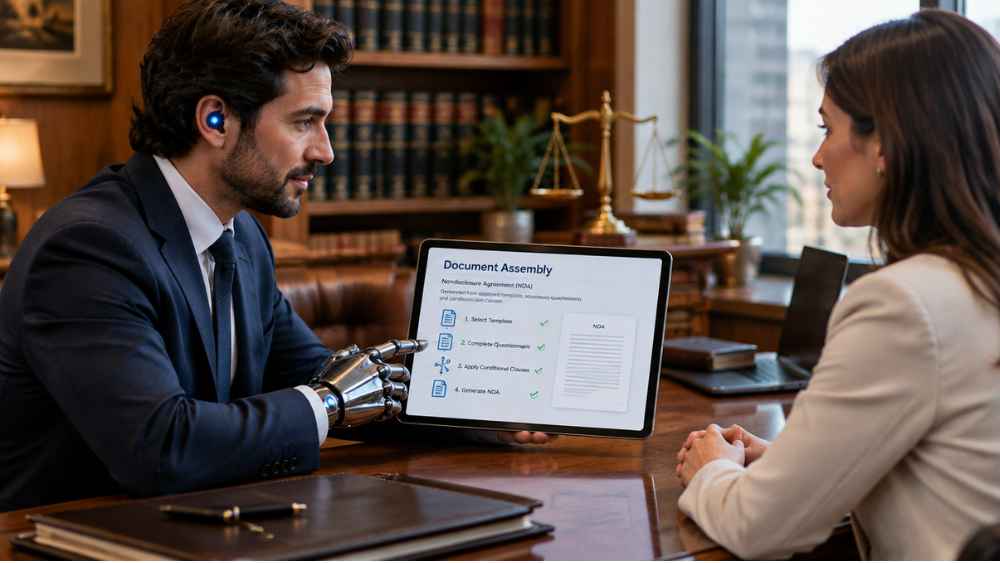
“The legal team used Document Assembly to generate consistent NDAs from an approved template using a structured questionnaire and conditional clauses.”
What Is Document Assembly?
Document AssemblyLegal Document GeneratorA legal document generator creates legal documents from approved templates, structured data, and automated logic, often with optional AI-assisted drafting and review.View definition is software-driven creation of documents from templates, rules, and structured inputs.
It is commonly used for contracts, pleadings, forms, letters, and transactional documents.
Therefore, it is a core legal-automation technique. See ABA Journal overview.
Standard Document Assembly — Sample Contract Language
A questionnaire controls parties, term, governing lawBoilerplate ClauseA boilerplate clause is standardized contract language addressing recurring legal mechanics such as notice, assignment, governing law, waiver, severability, and integration.View definition , and confidentialityEmployment ContractAn employment contract is an agreement defining terms of an employer-employee relationship. It can cover duties, compensation, benefits, equity, confidentiality, intellectual property, restrictive covenants, termination, severance, and dispute procedures while remaining subject to...View definition options.
How Does Document Assembly Work?
A system collects facts through forms, questionnaires, APIs, or existing databases.
Logic then inserts, removes, or changes clauses and fields.
Therefore, one template can generate many tailored documents.
What Is a Document Template?
A template contains standardized language, placeholders, formatting, and conditional logicLegal Document AutomationLegal document automation uses software to generate, assemble, or update legal documents from approved templates, rules, and structured information. It can speed routine drafting while improving consistency, workflow control, and reuse of approved...View definition .
It acts as the reusable foundationDirect ExaminationDirect Examination is questioning of a witness by the party that called the witness. It generally uses nonleading questions to establish personal knowledge, foundation, facts, exhibits, and expert opinions before cross-examination.View definition for generated documents.
Therefore, template quality controls output quality.
What Is Conditional Logic?
Conditional logic changes document content based on supplied facts.
A clause can appear only when specified conditions are met.
Therefore, automation can encode drafting decisions.
What Is Clause Automation?
Clause automation selects or modifies provisions from an approved clause libraryContract Lifecycle ManagementContract Lifecycle Management, or CLM, manages contracts from request and drafting through negotiation, approval, execution, storage, obligation tracking, renewal, and termination. CLM software can automate workflows, metadata, alerts, reporting, and integrations.View definition .
Variables can control names, dates, amounts, jurisdictions, and business terms.
Therefore, clause governance improves consistency.
What Is a Questionnaire?
A questionnaire collects the facts needed to generate the document.
Good questionnaires translate legal drafting choices into understandable questions.
Therefore, user experience affects both speed and accuracy.
Can Document Assembly Use Existing Data?
Yes. Systems can pull information from CRM, matter-management, HR, contract, or case databases.
Integration reduces duplicate data entry.
Therefore, structured source data can improve accuracy.
What Is Document Automation?
Document automation is the broader process of generating, routing, reviewing, signing, and storing documents with technology.
Document assembly usually focuses on creation.
Therefore, assembly can be one stage in a larger workflow.
Document Assembly vs. Word Processing
Word processing helps a person draft and edit a document manually.
Document assembly applies reusable rules to generate tailored content automatically.
Therefore, automation reduces repetitive drafting.
Document Assembly vs. Generative AI
Traditional assembly uses deterministic templates and explicit rules.
Generative AI predicts language from prompts and context.
Therefore, assembly often provides stronger repeatability for standardized legal documents.
Can AI Be Combined With Document Assembly?
Yes. AI can extract facts, suggest clauses, summarize inputs, or assist quality review.
Rule-based templates can still control final structure.
Therefore, hybrid systems can combine flexibility with consistency.
What Are Common Legal Uses?
Common uses include NDAs, engagement letters, incorporation documentsArticles of IncorporationArticles of incorporation are the formation document filed with a state to create a corporation. They typically provide basic information such as the corporation’s name, registered agent, share structure, and incorporator, although requirements...View definition , employment agreements, discoveryCivil CourtCivil court is a general term for a court handling noncriminal disputes involving people, businesses, organizations, or government entities. Civil cases can involve contracts, injuries, property, employment, civil rights, and other disputes and...View definition forms, and routine motions.
High-volume standardized work benefits most.
Therefore, repeated drafting is a strong automation candidate.
What Is a Clause Library?
A clause library stores approved provisions with metadataRequest for ProductionA Request for Production is a civil discovery request for documents, electronically stored information, tangible things, or inspection access. In federal court, Rule 34 governs requests to parties and sets requirements for particularity,...View definition , alternatives, and drafting notes.
Automation can select clauses based on deal or case facts.
Therefore, library governance is central to reliable assembly.
What Is Version Control?
Version controlLegal Document ManagementLegal document management controls how legal work product is stored, searched, versioned, secured, shared, and retained across matters and teams.View definition tracks template changes and identifies the language used at a specific time.
It supports audits and rollback.
Therefore, firms should not overwrite critical templates without history.
What Is Template Governance?
Template governance defines who can create, approve, revise, and retire automated templates.
It also assigns responsibility for legal updates.
Therefore, automation needs ownership rather than unattended code.
How Are Errors Controlled?
Systems can use required fields, validationTechnology Assisted ReviewTechnology Assisted Review (TAR) uses technology and human judgment to prioritize, classify, and review documents in legal discovery. TAR can include predictive coding, continuous active learning, statistical sampling, validation, and other analytics designed...View definition rules, conditional checks, and automated comparisons.
Human legal review remains appropriate for significant documents.
Therefore, speed should not replace quality assurance.
What Are Data-Privacy Risks?
Assembly systems can process client, employee, financial, or health information.
Access controls, encryption, retention, and vendor terms can matter.
Therefore, automation design should follow confidentiality obligationsConfidentiality ClauseA Confidentiality Clause limits how specified nonpublic information may be used or disclosed. Strong clauses define protected information, exclusions, permitted recipients, legal-disclosure exceptions, duration, return or destruction duties, and available remedies.View definition .
What Are Unauthorized-Practice Risks?
A public-facing document tool can raise legal-service and unauthorized-practice questions depending on design and jurisdictionLegal DisputeA legal dispute is a disagreement or controversy involving claimed legal rights, duties, liabilities, property, or remedies. It can be resolved through negotiation, mediation, arbitration, administrative proceedings, litigation, or settlement depending on the...View definition .
Lawyer supervision can be important.
Therefore, product scope should be reviewed before launch.
Can Document Assembly Support E-Signatures?
Yes. Generated documents can flow into electronic-signature systems.
Signature validity depends on applicable law and transaction type.
Therefore, generation and execution should be designed together.
Document Assembly Example
Suppose a firm generates NDAs from one approved template.
A questionnaire controls parties, term, governing law, and confidentiality options.
Therefore, lawyers review tailored output instead of redrafting from scratch.
Why Does Document Assembly Matter?
Document assembly can improve speed, consistency, reuse, and knowledge management.
Its value depends on accurate templates, governed logic, and legal review.
Therefore, automation should standardize judgmentCivil LawsuitA civil lawsuit is a noncriminal court action in which a plaintiff seeks a legal remedy from a defendant. The process can include jurisdiction, pleadings, service, discovery, motions, settlement, trial, judgment, enforcement, and...View definition without hiding it.