
Cross Examination
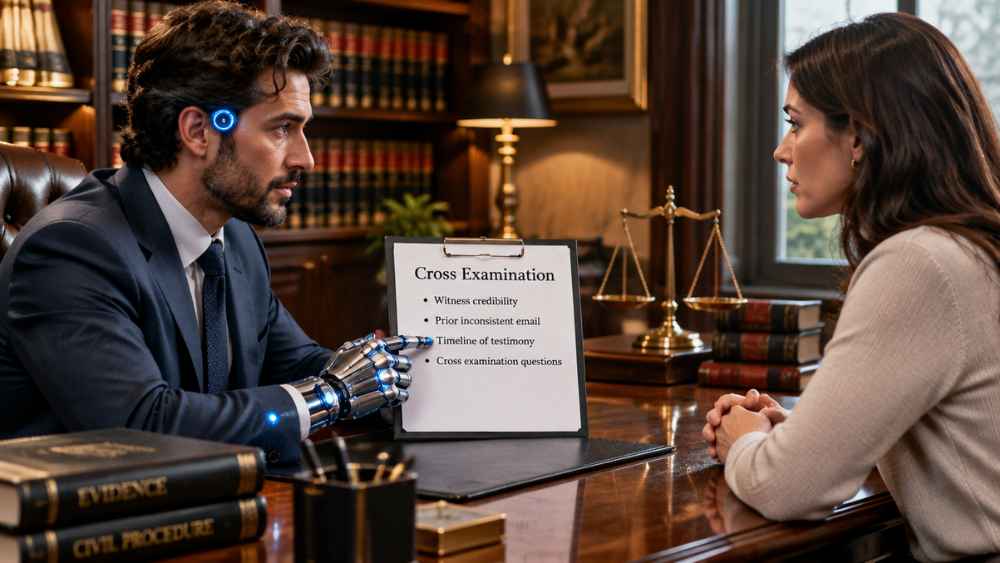
“During Cross Examination, counsel used the witness's prior email to challenge the timeline and test credibility before the jury.”
What Is Cross Examination?
Cross Examination is questioning of a witness by an opposing party after direct examinationDirect ExaminationDirect Examination is questioning of a witness by the party that called the witness. It generally uses nonleading questions to establish personal knowledge, foundation, facts, exhibits, and expert opinions before cross-examination.View definition .
It tests testimony, credibility, perception, memory, and factual accuracy.
Therefore, cross examination is a core adversarial trialLawsuitA lawsuit is a legal dispute brought before a court for a decision or remedy. Civil lawsuits can involve pleadings, service, discovery, motions, settlement, trial, judgment, and possible appeal.View definition tool.
Standard Cross Examination — Sample Contract Language
Suppose a witness testifies that the parties signed a contract on Monday.
What Is the Federal Scope?
Federal Rule of Evidence 611(b) generally limits cross examination to the subject of direct examination and witness credibilityWitness CredibilityWitness credibility is the factfinder's assessment of whether testimony is believable and what weight it deserves, informed by admissible evidence concerning consistency, bias, perception, memory, and truthfulness.View definition .
The judgeJudgeA Judge is a judicial officer who presides over legal proceedings, applies law, manages procedure, rules on motions and evidence, and issues orders or judgments. Trial, appellate, Article III, magistrate, bankruptcy, and state...View definition can permit additional inquiry as on direct.
Therefore, federal scope is broad enough for credibility but not unlimited. See Federal Rule of Evidence 611.
Are Leading Questions Allowed?
Yes. Rule 611(c) ordinarily permits leading questions on cross examination.
They allow the examiner to control the form and sequence of facts.
Therefore, cross differs from ordinary direct examination.
What Is Impeachment?
Impeachment attacks a witness’s credibility or reliability.
Methods include bias, prior inconsistent statements, certain convictions, character for truthfulness, and contradiction.
Therefore, impeachment rules often shape cross examination.
What Is Bias Impeachment?
Bias evidence shows a witness may favor or oppose a party because of interest, relationship, payment, or motive.
Bias is a classic subject of cross examination.
Therefore, counsel can explore financial and relational incentives.
What Is a Prior Inconsistent Statement?
A prior inconsistent statement conflicts materially with the witness’s present testimony.
Federal rules govern when extrinsic evidenceContract InterpretationContract interpretation is the legal process of determining what contractual language means and how the agreement applies to the parties' dispute.View definition can prove the inconsistency.
Therefore, foundation and procedural requirements matter.
Can a Witness Be Asked About Prior Convictions?
Sometimes. Federal Rule of Evidence 609 governs impeachment with criminal convictions.
Different balancing rules apply depending on the conviction and witness.
Therefore, conviction evidence requires rule-specific analysis.
Can Character for Truthfulness Be Attacked?
Federal Rules 608 and 609 regulate attacks on a witness’s character for truthfulness.
Extrinsic evidence limits can apply.
Therefore, not every accusation of dishonesty is admissible.
What Is Contradiction?
Contradiction shows that another fact or piece of evidence conflicts with the witness’s testimony.
Collateral-matter rules can limit extrinsic proof.
Therefore, strategic cross should focus on material contradictions.
Can Cross Examination Use Documents?
Yes. Lawyers can use exhibits, prior statements, records, photographs, and other admissible or foundation-supporting materials.
AuthenticationAdmissible EvidenceAdmissible Evidence is evidence a court permits the judge or jury to consider. In federal court, admissibility commonly depends on relevance, Rule 403 balancing, authentication, foundation, hearsay rules, privilege, witness competence, and other...View definition and hearsay rules can still apply.
Therefore, documents do not bypass evidence rules.
What Is Refreshing Recollection?
A witness can sometimes review a writing or object to refresh present memory under Rule 612.
The adverse party receives specified inspection rightsAudit RightsAudit Rights allow contractual verification of records, controls, payments, facilities, or performance subject to defined scope, notice, frequency, confidentiality, and remedies.View definition .
Therefore, refreshing memory differs from admitting the writing for its truth.
What Is the Confrontation Clause?
In criminal prosecutions, the Sixth Amendment protects the accused’s right to confront adverse witnesses.
Supreme CourtSupreme CourtThe Supreme Court of the United States is the nation’s highest federal court. It reviews selected cases involving the Constitution and federal law, resolves important federal legal questions, and sits at the top...View definition doctrine governs testimonial hearsay and cross-examination rights.
Therefore, criminal cross examination has constitutional significance.
Can a Judge Limit Cross Examination?
Yes. Rule 611 requires reasonable control to promote truth, efficiency, and protection from harassmentEmployment LawEmployment law is the body of federal, state, and local law that governs relationships between employers and employees. It covers wages, discrimination, harassment, leave, safety, benefits, contracts, employee classification, union rights, and termination.View definition or undue embarrassment.
Constitutional limits can restrict excessive curtailment in criminal cases.
Therefore, trial judges balance examination rights with courtroomCourtroomA courtroom is the physical or virtual setting where judges conduct hearings and trials with court personnel, parties, witnesses, jurors, and an official record.View definition control.
What Is Recross Examination?
Recross is additional questioning after redirect examination.
Courts often limit recross to matters raised on redirect.
Therefore, the sequence can continue when new matters emerge.
Cross Examination vs. Direct Examination
The party that called the witness conducts direct examination and generally avoids leading questions.
An opposing party conducts cross examination and ordinarily uses leading questions.
Therefore, the questioning techniques differ.
Cross Examination Example
Suppose a witness testifies that the parties signed a contract on Monday.
On cross, counsel uses the witness’s earlier email stating that signing occurred Wednesday.
Therefore, counsel can explore the inconsistency to test accuracy and credibility.
Why Does Cross Examination Matter?
Cross examination tests evidence before the factfinderBench TrialA bench trial is a trial without a jury in which the judge decides disputed facts and applies the law. Strategy often focuses on precise proof, findings of fact, legal elements, and a...View definition and exposes weaknesses that direct testimony can hide.
It also protects adversarial fairness and criminal confrontation rights.
Therefore, effective cross requires both evidence-law knowledge and factual preparation.