
Machine Readable Contract
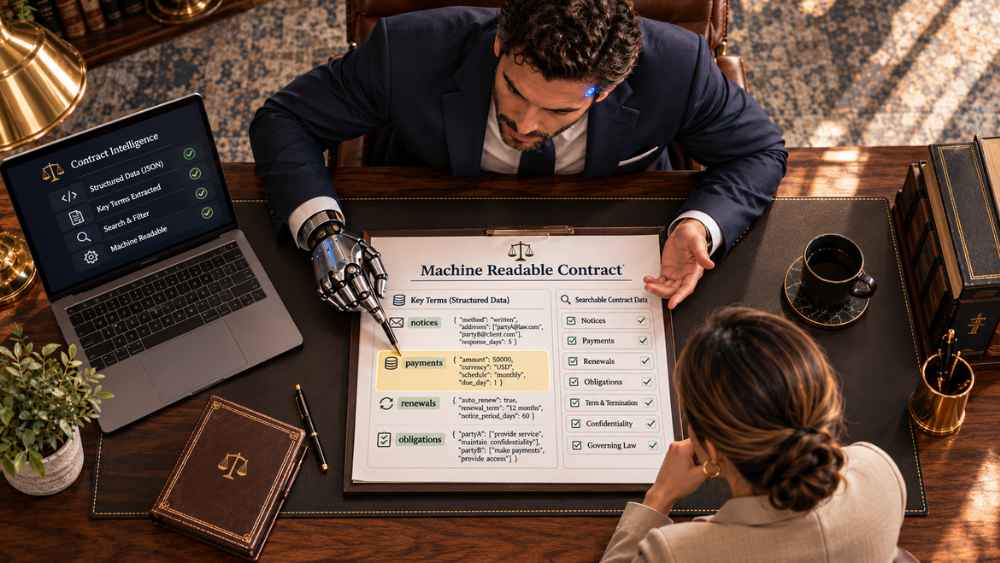
“The company converted key terms into a Machine Readable Contract format so software could track notices, payments, renewals, and obligations.”
What Is a Machine Readable Contract?
A Machine Readable Contract is a contract represented so software can identify, search, validate, or process structured contractual information.
The human-readable legal text can remain controlling.
Therefore, machine readability does not require autonomous execution.
Standard Machine Readable Contract — Sample Contract Language
Suppose a supply agreementSupply AgreementA Supply Agreement governs recurring purchases of goods and defines specifications, pricing, forecasts, orders, delivery, quality, warranties, shortages, and change control.View definition stores renewal date, notice period, price index, and governing lawBoilerplate ClauseA boilerplate clause is standardized contract language addressing recurring legal mechanics such as notice, assignment, governing law, waiver, severability, and integration.View definition as structured fields.
How Can a Contract Become Machine Readable?
A contract can use structured fields, semantic tags, standardized clause identifiers, schemas, or linked data.
The structure exposes meaning to software.
Therefore, digitized text alone is not always enough.
Machine Readable vs. Human Readable
Human-readable text communicates legal meaning to people and courts.
Machine-readable structure exposes selected concepts to software.
Therefore, a well-designed contract can support both forms.
Machine Readable vs. Smart Contract
A smart or automated contractSmart ContractA Smart Contract is software that automatically performs specified actions when programmed conditions occur. Its legal enforceability still depends on ordinary contract law, electronic-transactions law, attribution, governing law, and the parties’ agreement, while...View definition can execute logic or trigger actions automatically.
A machine-readable contract can remain purely descriptive.
Therefore, machine readability is a foundationDirect ExaminationDirect Examination is questioning of a witness by the party that called the witness. It generally uses nonleading questions to establish personal knowledge, foundation, facts, exhibits, and expert opinions before cross-examination.View definition rather than automation itself.
What Is a Data Model?
A data model defines structured concepts such as parties, dates, payments, notices, products, and obligations.
Schemas help systems interpret those fields consistently.
Therefore, modeling improves interoperability.
What Is a Computable Contract?
A computable contract links legal prose with data and executable logic.
The AccordAccord and SatisfactionAccord and satisfaction discharges an existing obligation through a substitute agreement and completed substitute performance.View definition Project describes standardized smart legal contracts using text, models, and logic.
Therefore, computability extends beyond machine-readable text. See Accord Project overview.
What Is Automated Contracting?
Automated contracting uses electronic systems or AI in formation, performance, or administration.
UNCITRAL adopted a Model Law on Automated Contracting in 2024.
Therefore, automation can have legal recognition independent of a particular technical format. See UNCITRAL Model Law on Automated Contracting.
What Are Common Structured Elements?
Common fields include party identifiers, effective dates, renewal dates, payment amounts, governing law, service levels, notice periods, and termination rights.
Clause metadataRequest for ProductionA Request for Production is a civil discovery request for documents, electronically stored information, tangible things, or inspection access. In federal court, Rule 34 governs requests to parties and sets requirements for particularity,...View definition can add risk categories.
Therefore, structure supports analytics and workflow.
How Does Machine Readability Support CLM?
CLMContract Review SoftwareContract review software helps users examine agreements, identify important provisions, compare language, apply playbooks, suggest redlines, and manage review workflows. Some platforms use AI, while others rely on rules, templates, comparison tools, and...View definition systems can extract or ingest structured terms for approvals, alerts, obligations, renewals, and reporting.
Standardized fields reduce manual re-entry.
Therefore, machine-readable contracts improve operational use.
What Is Interoperability?
Interoperability allows different systems to exchange contract data without losing meaning.
Shared schemas and identifiers improve portability.
Therefore, open standards can reduce vendor lock-in.
What Legal Risks Arise?
Structured data can conflict with the signed prose, omit exceptions, or oversimplify legal concepts.
Automation can also propagate modeling errors.
Therefore, documents should define which representation controls.
What Are Audit Trails?
Audit trails record versions, data changes, approvals, signatures, and automated actions.
They support evidence and governance.
Therefore, machine-readable systems should preserve provenance.
Machine Readable Contract Example
Suppose a supply agreement stores renewal date, notice period, price index, and governing law as structured fields.
Software reads those fields to trigger alerts.
Therefore, the contract supports automation without changing its legal prose.
Why Do Machine Readable Contracts Matter?
Machine-readable contracts connect legal agreements with software, analytics, workflows, and automated performance.
Their value depends on accurate modeling.
Therefore, legal text, structured data, and logic should remain synchronized.