
Judge
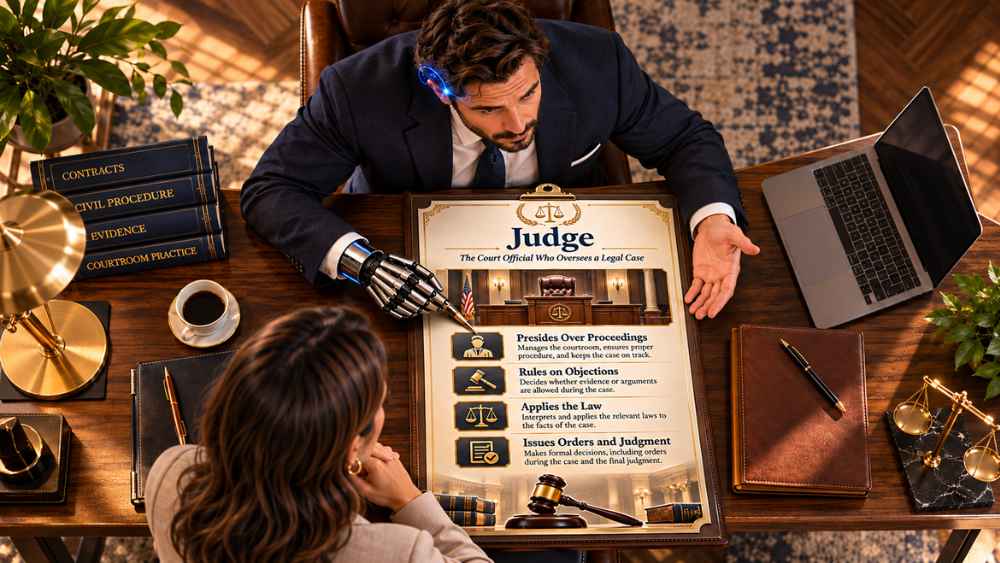
“The Judge ruled on the evidentiary objection, instructed the jury on the law, and entered judgment after the verdict.”
What Is a Judge?
A Judge is a judicial officer who presides over legal proceedings and applies governing lawBoilerplate ClauseA boilerplate clause is standardized contract language addressing recurring legal mechanics such as notice, assignment, governing law, waiver, severability, and integration.View definition .
Judges manage procedure, decide legal issues, and issue orders or judgments.
Therefore, judges perform functions distinct from juries. See U.S. Courts on federal judges.
Standard Judge — Sample Contract Language
The judge decides admissibilityRelevanceRelevance asks whether evidence tends to make a consequential fact more or less probable. Federal Rules 401 and 402 establish the basic threshold, while Rule 403 permits exclusion when specified dangers substantially outweigh probative value.View definition and instructs the juryJuryA Jury is a group of citizens selected to perform a legal factfinding or charging function. Petit juries decide facts and return verdicts in trials, while grand juries determine whether probable cause supports...View definition on the governing law.
What Does a Trial Judge Do?
A trial judgeTrial CourtA Trial Court is a court where parties present evidence, establish facts, and obtain an initial judgment or verdict. Federal district courts are the primary federal trial courts, while state systems use varied...View definition manages hearings, evidence, motions, jury instructionsJury TrialA jury trial uses jurors to decide disputed facts and return a verdict while the judge resolves legal questions and instructs the jury on the law. Jury rights and procedures vary by case...View definition , and courtroomCourtroomA courtroom is the physical or virtual setting where judges conduct hearings and trials with court personnel, parties, witnesses, jurors, and an official record.View definition procedure.
In benchBenchThe bench is the judge's raised courtroom desk and is also a common legal term for a judge, group of judges, or the judiciary.View definition trials, the judge also determines facts.
Therefore, the judge can serve both legal and factfinding roles.
What Does an Appellate Judge Do?
An appellate judge reviews lower-court or agency decisions for legal or procedural error.
Appellate courts generally rely on the existing record.
Therefore, appellate judges usually do not hear new witness testimonyDirect ExaminationDirect Examination is questioning of a witness by the party that called the witness. It generally uses nonleading questions to establish personal knowledge, foundation, facts, exhibits, and expert opinions before cross-examination.View definition .
What Is an Article III Judge?
Federal Supreme Court justicesSupreme CourtThe Supreme Court of the United States is the nation’s highest federal court. It reviews selected cases involving the Constitution and federal law, resolves important federal legal questions, and sits at the top...View definition , circuit judges, and district judges generally serve under Article III.
They are nominated by the President and confirmed by the Senate.
Therefore, their tenure differs from many other judicial officersCorporation DefinitionA corporation is a legal entity created under state law that is separate from its owners, usually called shareholders. It can own property, enter contracts, incur debts, sue or be sued, and operate...View definition .
What Is a Magistrate Judge?
Federal magistrate judges are appointed by district judges for fixed terms.
They handle duties authorized by statuteStatutory LawStatutory law is written law enacted by a legislative body through the formal lawmaking process. Federal and state statutes can create rights, duties, prohibitions, causes of action, procedures, penalties, and remedies, and courts...View definition and local assignmentAssignmentAssignment transfers a contractual right or other legal interest from an assignor to an assignee. Most rights can be assigned, but contract restrictions, personal rights, material changes to the obligor’s burden, notice, defenses,...View definition .
Therefore, magistrate judges are not Article III judges.
What Is Judicial Independence?
Judicial independence protects decision-making from improper outside pressure.
Ethics rules also require impartiality and avoidanceAffirmative DefenseAn Affirmative Defense can defeat or reduce liability even when the opposing party proves the basic claim. Federal Rule 8(c) requires defendants to affirmatively state listed avoidances and other defenses that substantive law...View definition of improper influence.
Therefore, judges must decide from law and record rather than personal interests.
When Must a Judge Recuse?
Federal and state laws require disqualification in specified circumstances involving bias, financial interest, relationships, or other conflicts.
Standards vary by jurisdictionLegal DisputeA legal dispute is a disagreement or controversy involving claimed legal rights, duties, liabilities, property, or remedies. It can be resolved through negotiation, mediation, arbitration, administrative proceedings, litigation, or settlement depending on the...View definition .
Therefore, recusal protects confidence in impartial adjudication.
Judge vs. Jury
A judge decides legal questions and manages procedure.
A jury decides disputed facts when a jury right applies and a jury is used.
Therefore, each has a different trialLawsuitA lawsuit is a legal dispute brought before a court for a decision or remedy. Civil lawsuits can involve pleadings, service, discovery, motions, settlement, trial, judgment, and possible appeal.View definition function.
Judge Example
Suppose a jury trial involves a hearsay objectionObjectionAn Objection is a formal challenge to evidence, testimony, questions, argument, or procedure. Under Federal Rule of Evidence 103, timely and specific objections can prevent inadmissible evidence and preserve evidentiary issues for appeal.View definition .
The judge decides admissibility and instructs the jury on the governing law.
Therefore, the jury later applies that law to admitted facts.
Why Do Judges Matter?
Judges ensure legal disputes proceed under established law, procedure, and due processEx ParteEx Parte refers to a one-sided request, proceeding, or communication. Courts permit ex parte relief only in authorized circumstances, while professional-conduct rules generally bar private communications with judges unless law or court order...View definition .
They also create written decisions that can shape precedentMajority OpinionA majority opinion states the reasoning and result supported by more than half of the judges participating in an appellate decision and can provide binding precedent.View definition .
Therefore, judicial reasoning affects both individual cases and future law.