
Reasonable Person Standard
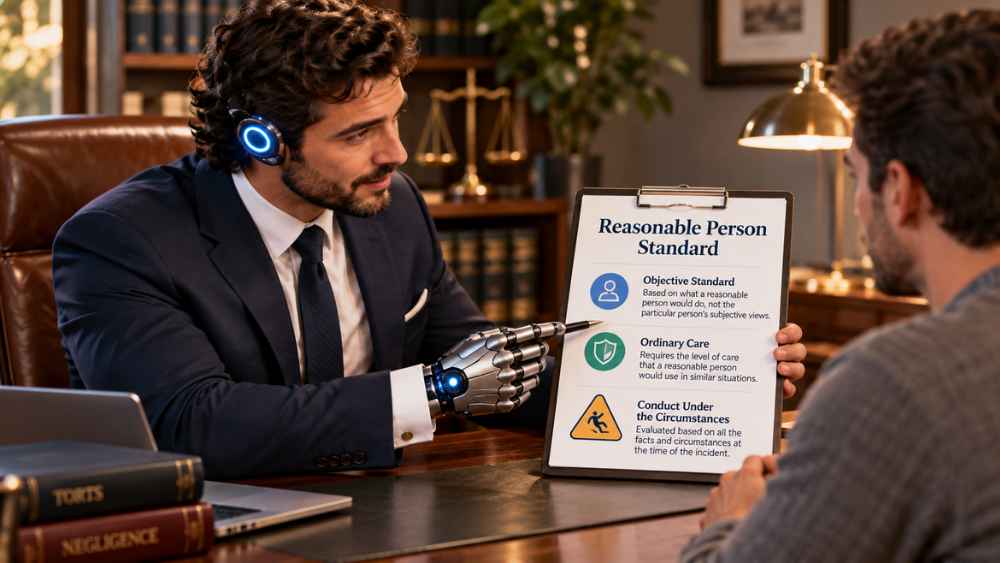
“The jury applied the Reasonable Person Standard to decide whether the store used reasonable care after learning about the spill.”
What Is the Reasonable Person Standard?
The Reasonable Person StandardBreach of DutyA breach of duty occurs when a person or entity fails to meet a legal duty owed to another person. In negligence cases, breach is usually one element alongside duty, causation, and damages,...View definition is an objective legal measure used to evaluate whether conduct was reasonably careful under the circumstances.
It plays a central role in negligence law.
See Cornell LII’s reasonable person overview.
Standard Reasonable Person Standard — Sample Contract Language
Suppose a store employee sees a large spill in a busy aisle.
Why Is the Standard Objective?
The law generally asks how a reasonably prudent person would act in similar circumstances.
It does not simply accept the defendant’s personal judgmentCivil LawsuitA civil lawsuit is a noncriminal court action in which a plaintiff seeks a legal remedy from a defendant. The process can include jurisdiction, pleadings, service, discovery, motions, settlement, trial, judgment, enforcement, and...View definition .
Therefore, sincere mistakes can still be negligent.
What Is a Reasonably Prudent Person?
A reasonably prudent person is a legal reference point rather than a specific real person.
The standard represents ordinary careful behavior under similar circumstances.
Therefore, juries compare conduct with an objective norm.
How Does the Standard Relate to Negligence?
Negligence generally involves failure to use reasonable careDuty of CareDuty of care is the legal obligation to act with the care required by the circumstances. In negligence, it establishes the obligation that must be breached before causation and damages can support liability.View definition .
The reasonable person standard helps determine whether the defendantCivil CourtCivil court is a general term for a court handling noncriminal disputes involving people, businesses, organizations, or government entities. Civil cases can involve contracts, injuries, property, employment, civil rights, and other disputes and...View definition breached a duty.
See Cornell LII’s negligence overview.
What Is Reasonable Care?
Reasonable care is the level of caution a prudent person would use under similar circumstances.
Risk, probability, severity, and available precautions can matter.
Therefore, the required care changes with the situation.
What Is Due Care?
Due care is another term for reasonable or ordinary care in many negligence contexts.
It describes the care expected under the circumstances.
Therefore, due care and reasonable care often overlap.
Is the Reasonable Person Perfect?
No. The standard does not require perfect judgment or complete elimination of risk.
It requires reasonable conduct.
Therefore, an accident can occur without negligence.
Does the Standard Consider the Circumstances?
Yes. The objective person is placed in the defendant’s relevant circumstances.
Weather, visibility, emergency conditions, and physical limitations can matter.
Therefore, objective does not mean context free.
Does Personal Inexperience Lower the Standard?
Usually not for ordinary adult conduct.
An inexperienced adult driver generally faces the same basic standard as an experienced driver.
Therefore, lack of skill often does not excuse unreasonable conduct.
Does Intelligence Affect the Standard?
Ordinary adult negligence generally does not lower the standard for limited intelligence or poor judgment.
The law uses an objective benchmark.
Therefore, subjective inability to appreciate an ordinary risk often is insufficient.
How Are Children Judged?
Children often receive a modified standard based on age, intelligence, experience, and similar circumstances.
State formulations vary.
Therefore, a child is not always measured against an ordinary adult.
What Is the Adult-Activity Exception?
Some jurisdictions hold minors to an adult standard when they engage in dangerous activities typically undertaken by adults.
Operating motor vehicles is a common example.
Therefore, activity type can override the child standard.
How Are Physical Disabilities Treated?
The reasonable person standard accounts for relevant physical characteristics.
For example, a blind person is compared with a reasonably careful blind person under similar circumstances.
Therefore, physical disability changes the factual context.
How Are Mental Disabilities Treated?
Traditional negligence law generally does not reduce the standard for ordinary mental disability.
Jurisdictions can recognize narrow exceptions.
Therefore, mental and physical limitations can receive different treatment.
How Are Professionals Judged?
Professionals often face a specialized standard based on reasonably competent members of the profession.
Examples include doctors, lawyers, accountants, and engineers.
Therefore, ordinary reasonable-person analysis can be supplemented by professional standards.
What Is Professional Negligence?
Professional negligence occurs when a professional fails to meet the applicable professional standard of care.
Expert testimonyExpert WitnessAn expert witness is a person qualified by specialized knowledge, skill, experience, training, or education to provide expert testimony. In federal court, Rule 702 requires reliable, helpful testimony supported by sufficient facts or...View definition is often necessary.
Therefore, specialized knowledge changes the benchmark.
How Are Doctors Judged?
Medical malpracticeNegligence DefinitionNegligence is the failure to use the level of care that a reasonable person would use under similar circumstances. A negligence claim generally focuses on duty, breach, causation, and legally recognized harm.View definition generally asks whether the provider met the professional standard of care.
Medical experts commonly explain that standard.
Therefore, jurors do not rely only on everyday experience.
How Are Lawyers Judged?
Legal malpracticeLegal MalpracticeLegal malpractice is actionable professional negligence or misconduct by a lawyer that breaches a duty and causes the client legally recoverable harm.View definition generally compares an attorney’s conduct with the skill and care expected of competent lawyers.
JurisdictionLegal DisputeA legal dispute is a disagreement or controversy involving claimed legal rights, duties, liabilities, property, or remedies. It can be resolved through negotiation, mediation, arbitration, administrative proceedings, litigation, or settlement depending on the...View definition and practice context matter.
Therefore, professional duties can exceed ordinary-person knowledge.
What Is the Emergency Doctrine?
Some jurisdictions consider whether a person confronted a sudden emergency not of their own making.
The person still must act reasonably in that emergency.
Therefore, the doctrine changes circumstances rather than creating immunity.
Does Custom Define Reasonable Care?
Industry custom can provide evidence of reasonable behavior.
However, custom is not always conclusive.
Therefore, an entire industry can sometimes follow an unreasonable practice.
Can Safety Rules Affect the Standard?
Yes. RegulationsPrimary AuthorityPrimary Authority is law issued by an institution with official power to create or state legal rules. Constitutions, statutes, regulations, court decisions, and court rules can be primary authority, while binding effect depends...View definition , codes, policies, and industry standards can provide evidence of reasonable care.
Their legal effect depends on the jurisdiction.
Therefore, compliance and breach should both be considered.
What Is Negligence Per Se?
Negligence per se can use violation of a safety statuteNegligence Per SeNegligence per se uses a qualifying statutory or regulatory violation to establish or influence the negligence duty-and-breach analysis when the law was designed to prevent the injury at issue.View definition to establish breach or create a presumptionPresumptionA presumption is a legal rule that gives specified facts an evidentiary consequence, often shifting the burden of producing evidence without shifting the ultimate burden of persuasion.View definition .
Requirements vary by state.
Therefore, statutory violation can alter ordinary reasonable-person analysis.
Does Compliance With a Law Prove Reasonableness?
Not always. Compliance can be evidence of care without establishing that every precaution was reasonable.
Additional risks can require more.
Therefore, legal minimums do not always define the full standard.
What Is Foreseeability?
ForeseeabilityProximate CauseProximate cause is a legally sufficient causal connection between conduct and harm. It limits liability when factual causation extends too far and commonly considers foreseeability, directness, scope of risk, intervening events, and superseding...View definition asks whether a reasonable person would anticipate a risk or type of harm.
It affects duty, breach, and causation in different jurisdictions.
Therefore, foreseeable risk helps shape reasonable precautions.
How Does Risk Severity Matter?
Greater potential harm can justify stronger precautions.
A low-probability catastrophic risk can still require attention.
Therefore, reasonableness balances both probability and severity.
How Does Burden of Precautions Matter?
The cost and difficulty of precautions can affect what reasonable care requires.
Simple inexpensive precautions can be expected when they prevent serious risks.
Therefore, feasibility matters.
What Is the Hand Formula?
The Hand Formula is an economic illustration comparing precaution burden with accident probability and expected loss.
It is associated with JudgeJudgeA Judge is a judicial officer who presides over legal proceedings, applies law, manages procedure, rules on motions and evidence, and issues orders or judgments. Trial, appellate, Article III, magistrate, bankruptcy, and state...View definition Learned Hand.
Therefore, it helps explain risk balancing in negligence.
Is the Hand Formula a Mandatory Mathematical Test?
No. Courts and juries do not always calculate negligence numerically.
The formula is often a conceptual tool.
Therefore, ordinary reasonable-care instructions remain broader.
Who Decides What Is Reasonable?
Juries often decide whether conduct met the reasonable person standard.
Judges can decide when facts permit only one legal conclusion.
Therefore, reasonableness is commonly a fact question.
What Evidence Shows Reasonable Conduct?
Evidence can include eyewitness accounts, policies, warnings, training, photographs, expert opinions, and safety records.
The relevant evidenceAdmissible EvidenceAdmissible Evidence is evidence a court permits the judge or jury to consider. In federal court, admissibility commonly depends on relevance, Rule 403 balancing, authentication, foundation, hearsay rules, privilege, witness competence, and other...View definition depends on the claim.
Therefore, context should be documented carefully.
What Is a Reasonable Driver?
A reasonable driver follows traffic rules and adapts to road, weather, and visibility conditions.
Speed legal under normal conditions can still be unreasonable in a storm.
Therefore, circumstances affect driving care.
What Is a Reasonable Property Owner?
Property owners generally must use reasonable care under premises-liability rules applicable in their jurisdiction.
Inspection, warning, and repair duties can vary.
Therefore, property status and visitor status can matter.
What Is a Reasonable Employer?
Employment lawEmployment LawEmployment law is the body of federal, state, and local law that governs relationships between employers and employees. It covers wages, discrimination, harassment, leave, safety, benefits, contracts, employee classification, union rights, and termination.View definition uses several reasonableness standards for investigation, accommodation, safety, and workplace conduct.
The exact test depends on the claim.
Therefore, “reasonable” has different meanings across legal fields.
What Is a Reasonable Consumer?
Consumer-protection law sometimes asks how a reasonable consumer would understand advertising or disclosures.
The focus remains objective.
Therefore, isolated subjective interpretations may not control.
What Is a Reasonable Investor?
Securities law uses a reasonable-investor standard in materiality and disclosure questions.
The benchmark considers information important to investment decisions.
Therefore, reasonable-person concepts extend beyond negligence.
Reasonable Person vs. Reasonable Professional
The reasonable-person standard reflects ordinary community care.
The reasonable-professional standard reflects specialized training and competence.
Therefore, profession-specific expertise changes the benchmark.
Reasonable Person vs. Subjective Good Faith
Subjective good faithBusiness Judgment RuleThe Business Judgment Rule is a judicial presumption protecting qualifying corporate decisions from hindsight review. Its application varies by jurisdiction but commonly depends on informed decision-making, disinterest, independence, good faith, and compliance with...View definition asks what a person actually believed or intended.
The reasonable-person standard asks what objectively careful conduct required.
Therefore, honest belief does not always defeat negligence.
Can Contract Language Use a Reasonable Person Standard?
Contracts can use terms such as reasonable efforts, commercially reasonable, or reasonable satisfactionAccord and SatisfactionAccord and satisfaction discharges an existing obligation through a substitute agreement and completed substitute performance.View definition .
Contract interpretationContract InterpretationContract interpretation is the legal process of determining what contractual language means and how the agreement applies to the parties' dispute.View definition then depends on governing lawBoilerplate ClauseA boilerplate clause is standardized contract language addressing recurring legal mechanics such as notice, assignment, governing law, waiver, severability, and integration.View definition and wording.
Therefore, negligence standards should not be imported automatically.
What Is Commercial Reasonableness?
Commercial reasonableness evaluates conduct against practical business standards in a particular context.
UCC provisions use the concept in several areas.
Therefore, commercial reasonableness is related but distinct.
Reasonable Person Standard Example
Suppose a store employee sees a large spill in a busy aisle.
A reasonable employee would warn customers or arrange prompt cleanup.
Ignoring the known hazard can support a negligence finding.
Why Does the Reasonable Person Standard Matter?
The Reasonable Person Standard gives negligence law an objective benchmark for evaluating conduct.
However, circumstances and specialized standards still matter.
The key questions are practical. What risk existed? What precautions were available? How would a reasonably careful person respond?