
Contributory Negligence
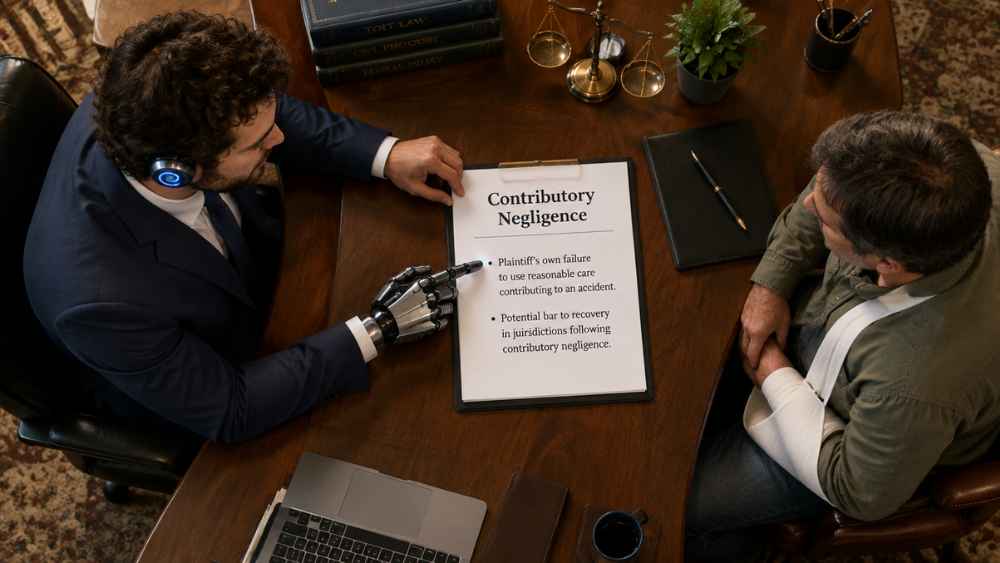
“The defendant raised Contributory Negligence, arguing that the plaintiff’s own lack of reasonable care legally contributed to the accident.”
What Is Contributory Negligence?
Contributory NegligenceAffirmative DefenseAn Affirmative Defense can defeat or reduce liability even when the opposing party proves the basic claim. Federal Rule 8(c) requires defendants to affirmatively state listed avoidances and other defenses that substantive law...View definition is a tort doctrine that can completely bar recovery when the plaintiff’s own negligenceBreach of DutyA breach of duty occurs when a person or entity fails to meet a legal duty owed to another person. In negligence cases, breach is usually one element alongside duty, causation, and damages,...View definition contributed to the injury.
It is much harsher than comparative negligence.
Therefore, even a small share of plaintiff faultComparative NegligenceComparative Negligence reduces a plaintiff’s damages according to the plaintiff’s share of fault. States use pure or modified systems, including 50% and 51% bar rules, while nonparty allocation, strict-liability treatment, medical claims, and...View definition can be decisive. See Cornell LII’s Contributory Negligence overview.
Standard Contributory Negligence — Sample Contract Language
Suppose a pedestrian crosses carelessly while a driver also drives negligently.
How Does Contributory Negligence Work?
The defendantCivil CourtCivil court is a general term for a court handling noncriminal disputes involving people, businesses, organizations, or government entities. Civil cases can involve contracts, injuries, property, employment, civil rights, and other disputes and...View definition argues that the plaintiff failed to use reasonable careReasonable Person StandardThe Reasonable Person Standard is an objective legal measure used to evaluate whether conduct was reasonably careful under the circumstances. It is central to negligence law and can be adjusted for children, physical...View definition for personal safety.
That failure must contribute legally to the injury.
Therefore, plaintiff negligence and causation are both required.
Does Any Plaintiff Fault Bar Recovery?
In a pure contributory-negligence jurisdictionLegal DisputeA legal dispute is a disagreement or controversy involving claimed legal rights, duties, liabilities, property, or remedies. It can be resolved through negotiation, mediation, arbitration, administrative proceedings, litigation, or settlement depending on the...View definition , any legally sufficient plaintiff negligence can bar ordinary negligence recovery.
The rule can apply even when defendant fault is much greater.
Therefore, a 1% fault finding can be outcome-determinative.
Which U.S. Jurisdictions Still Use the Rule?
As of 2026, Alabama, Maryland, North Carolina, Virginia, and the District of Columbia generally retain pure contributory negligence.
Important exceptions and claim-specific statutesPrimary AuthorityPrimary Authority is law issued by an institution with official power to create or state legal rules. Constitutions, statutes, regulations, court decisions, and court rules can be primary authority, while binding effect depends...View definition still apply.
Therefore, local lawOrdinanceAn Ordinance is a law enacted by a municipality or other authorized local government. Local authority depends on state constitutions, statutes, charters, home-rule rules, Dillon’s Rule principles, and preemption, while ordinances commonly govern...View definition should be checked carefully.
Why Did Most States Abandon It?
Critics view the all-or-nothing rule as too harsh when both parties contributed to an accident.
Most states replaced it with comparative fault.
Therefore, contributory negligence is now a minority approach.
Contributory Negligence vs. Comparative Negligence
Contributory negligence can eliminate recovery entirely.
Comparative negligence usually reduces damagesLegal RemedyA legal remedy is the relief a court or other authorized tribunal can provide after a legal right has been violated. Remedies can include damages, injunctions, restitution, specific performance, rescission, declarations, and other...View definition according to plaintiff fault.
Therefore, identical facts can produce dramatically different outcomes by jurisdiction.
What Must a Defendant Prove?
The defendant generally must show plaintiff negligence and a causal contributionThird Party ComplaintA third-party complaint uses Rule 14 impleader to bring a nonparty into a lawsuit when that person may be liable to a defending party for all or part of the original claim.View definition to the harm.
The exact formulation varies.
Therefore, mere careless behavior unrelated to the injury is not enough.
What Is Plaintiff’s Standard of Care?
The plaintiff is generally expected to use reasonable care for personal safety.
Age, disability, emergency, and activity can affect that standard.
Therefore, contributory negligence is not measured by hindsight.
What Is Proximate Cause in Contributory Negligence?
The plaintiff’s negligence must be a legally relevant cause of the injury.
Remote or unrelated carelessness does not automatically bar recovery.
Therefore, causation limits the defense.
What Is Last Clear Chance?
Last clear chance can permit recovery when the defendant had the final effective opportunity to avoid the harm.
Elements vary by jurisdiction.
Therefore, it developed as an exception to the harsh complete bar.
Does Every Contributory Jurisdiction Use Last Clear Chance the Same Way?
No. Courts formulate the doctrine differently and some applications are narrow.
Specific facts about helplessness, awareness, and opportunity can matter.
Therefore, jurisdiction-specific precedentMajority OpinionA majority opinion states the reasoning and result supported by more than half of the judges participating in an appellate decision and can provide binding precedent.View definition is essential.
What Is Willful or Wanton Conduct?
Some jurisdictions limit contributory-negligence defenses when the defendant’s conduct is willful, wanton, or intentional.
The precise rule varies.
Therefore, defendant misconduct can change the analysis.
Does Contributory Negligence Apply to Intentional Torts?
Generally, ordinary contributory negligence is not a defense to intentional torts.
Other defenses can still apply.
Therefore, the nature of the defendant’s conduct matters.
Can It Apply to Gross Negligence?
The answerCivil LitigationCivil Litigation is the court process for resolving noncriminal disputes through pleadings, motions, discovery, settlement, trial, judgment, and possible appeal. Federal civil litigation follows the Federal Rules of Civil Procedure, while state systems...View definition depends on the jurisdiction’s definition of gross negligenceBusiness Judgment RuleThe Business Judgment Rule is a judicial presumption protecting qualifying corporate decisions from hindsight review. Its application varies by jurisdiction but commonly depends on informed decision-making, disinterest, independence, good faith, and compliance with...View definition and available defenses.
Some courts treat aggravated misconduct differently.
Therefore, labels alone do not determine the result.
Can Children Be Contributorily Negligent?
Yes, but courts often use a child-specific standard based on age, intelligence, and experience.
Very young children can receive special presumptions.
Therefore, adult negligence standards do not always apply.
What Is the Adult-Activity Exception?
Some jurisdictions hold children to an adult standard when they engage in dangerous adult activities.
Operating motor vehicles is a common example.
Therefore, activity type can change the standard.
Can Physical Disability Affect the Analysis?
Yes. A person with a physical disability is generally compared with a reasonable personDuty of CareDuty of care is the legal obligation to act with the care required by the circumstances. In negligence, it establishes the obligation that must be breached before causation and damages can support liability.View definition having a similar disability.
The standard remains objective within that context.
Therefore, disability can alter what reasonable care requires.
What About Mental Disability?
Traditional tort lawTort DefinitionA tort is a civil wrong arising from an act or omission that causes legally recognized injury or harm. Major tort categories include intentional torts, negligence, and strict liability, with remedies commonly including...View definition often does not reduce the reasonable-care standard for mental disability.
Jurisdictions can vary.
Therefore, mental and physical disability rules should not be assumed identical.
Can Contributory Negligence Apply in Auto Cases?
Yes. Speeding, distraction, failure to keep lookout, or violating traffic rules can support the defense.
The conduct must contribute to the collision or injury.
Therefore, even minor driving fault can matter greatly in a contributory jurisdiction.
Can It Apply in Premises Liability?
Yes. A property owner can argue that the plaintiff failed to notice or avoid an open danger.
Premises doctrines and exceptions vary by state.
Therefore, local law on duty and knowledge is important.
Can It Apply in Medical Malpractice?
Potentially, but patient conduct must usually relate to the injury-causing treatment or outcome.
Pre-treatment health behavior can receive different treatment.
Therefore, medical causation matters.
Can It Apply in Product Liability?
Some jurisdictions distinguish ordinary negligence from product misuseStrict LiabilityStrict Liability imposes liability without requiring proof of ordinary negligence or intent for specified conduct. Common tort categories include abnormally dangerous activities, certain animal harms, and strict products liability, although causation, damages, defenses,...View definition or assumption of risk.
Statutory product-liability rules can control.
Therefore, product cases need specialized defense analysis.
What Is Assumption of Risk?
Assumption of risk focuses on knowing and voluntary acceptanceOffer and AcceptanceOffer and Acceptance describes how parties manifest mutual assent to a contract. A valid offer gives another party power to accept, while acceptance must objectively communicate assent through an authorized method, subject to...View definition of a known danger.
It is distinct from careless failure to protect oneself.
Therefore, both defenses can arise from the same facts.
What Is Avoidable Consequences?
The avoidable-consequences doctrine concerns unreasonable failure to reduce harm after a wrong occurs.
Contributory negligence usually concerns conduct contributing to the original injury.
Therefore, timing distinguishes the doctrines.
Who Decides Contributory Negligence?
A juryJuryA Jury is a group of citizens selected to perform a legal factfinding or charging function. Petit juries decide facts and return verdicts in trials, while grand juries determine whether probable cause supports...View definition usually decides disputed negligence and causation facts.
A judgeJudgeA Judge is a judicial officer who presides over legal proceedings, applies law, manages procedure, rules on motions and evidence, and issues orders or judgments. Trial, appellate, Article III, magistrate, bankruptcy, and state...View definition can decide when facts permit only one legal conclusion.
Therefore, summary judgmentMotion to DismissA motion to dismiss asks a court to end all or part of a case because of a legal or procedural defect. In federal civil cases, Rule 12 lists grounds including jurisdiction, venue,...View definition can be possible but is fact-dependent.
What Evidence Supports the Defense?
Video, photographs, eyewitness testimonyDirect EvidenceDirect Evidence proves a fact without requiring an additional inference about that fact. Examples can include eyewitness testimony, admissions, recordings, photographs, contracts, and other evidence that directly addresses the disputed issue.View definition , records, expert evidenceAdmissible EvidenceAdmissible Evidence is evidence a court permits the judge or jury to consider. In federal court, admissibility commonly depends on relevance, Rule 403 balancing, authentication, foundation, hearsay rules, privilege, witness competence, and other...View definition , and plaintiff admissions can all matter.
The evidence should connect plaintiff conduct to injury.
Therefore, proof of causation is as important as proof of carelessness.
Can a Statute Change the Common-Law Rule?
Yes. Legislatures can replace contributory negligence with comparative fault or create claim-specific exceptions.
Statutory regimes can also change available defenses.
Therefore, current code provisions should be checked.
Does Contributory Negligence Affect Settlement Value?
Yes. In a contributory jurisdiction, credible evidence of any plaintiff fault can create substantial case risk.
That risk can change settlement positions sharply.
Therefore, fault evidence deserves early investigation.
Contributory Negligence Example
Suppose a pedestrian crosses carelessly while a driver also drives negligently.
A contributory-negligence jurisdiction finds the pedestrian’s negligence legally contributed to the collision.
Therefore, the pedestrian can be barred from ordinary negligence recovery.
Why Does Contributory Negligence Matter?
Contributory negligence remains one of the strongest plaintiff-fault defenses in the jurisdictions that retain it.
Exceptions such as last clear chance can soften the rule.
Therefore, even small fault allegations require serious attention.