
Restraining Order
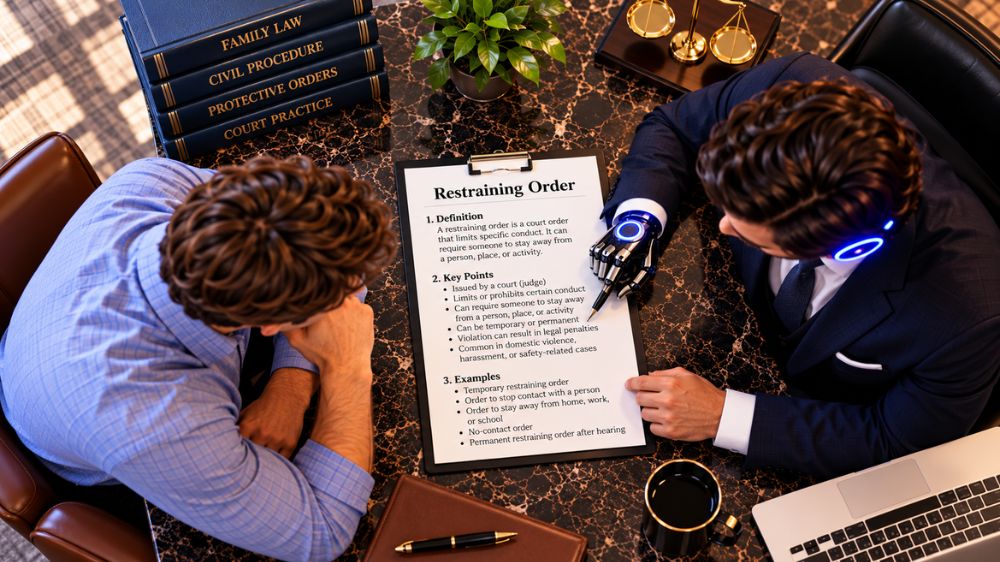
“The court issued a temporary restraining order directing the respondent to stop contacting the protected person until a full hearing could occur.”
What Is a Restraining Order?
A restraining orderTemporary Restraining OrderA Temporary Restraining Order is short-term emergency injunctive relief intended to prevent immediate harm until a court can consider longer-lasting relief. Federal TROs are governed by Rule 65’s notice, duration, and procedural requirements.View definition is a court orderCourt OrderA court order is a legally operative directive or decision issued by a court. Orders can control procedure, resolve motions, require action, prohibit conduct, or provide final or interim relief.View definition that limits specified conduct. It can require someone to stay away from a person, place, or activity.
The phrase can refer to different orders depending on jurisdictionLegal DisputeA legal dispute is a disagreement or controversy involving claimed legal rights, duties, liabilities, property, or remedies. It can be resolved through negotiation, mediation, arbitration, administrative proceedings, litigation, or settlement depending on the...View definition and context. It often includes protective orders in domestic violence, harassmentEmployment LawEmployment law is the body of federal, state, and local law that governs relationships between employers and employees. It covers wages, discrimination, harassment, leave, safety, benefits, contracts, employee classification, union rights, and termination.View definition , or stalking cases.
In federal civil litigationCivil LitigationCivil Litigation is the court process for resolving noncriminal disputes through pleadings, motions, discovery, settlement, trial, judgment, and possible appeal. Federal civil litigation follows the Federal Rules of Civil Procedure, while state systems...View definition , a temporary restraining order, or TRO, is short-term emergency injunctive relief under Rule 65.
Standard Restraining Order — Sample Contract Language
Suppose a person receives repeated threatening messages and unwanted visits. State law allows that person to request a civil protective orderMotion to CompelA motion to compel asks a court to order required discovery or disclosure when another party or person has not responded adequately. In federal civil cases, Rule 37 generally requires good-faith conference efforts...View definition .
What Does a Restraining Order Do?
A restraining order can prohibit contact, threats, harassment, entry onto property, or other specified behavior.
For example, a state courtState CourtA state court is a court established under a state constitution and state law. State courts hear the vast majority of U.S. civil and criminal cases, and their structures, names, procedural rules, and...View definition can order a person not to contact a protected individual.
However, the available terms depend on the statuteStatutory LawStatutory law is written law enacted by a legislative body through the formal lawmaking process. Federal and state statutes can create rights, duties, prohibitions, causes of action, procedures, penalties, and remedies, and courts...View definition and facts.
Who Can Request a Restraining Order?
Eligibility depends on state law or the legal rule governing the case. Different statutesPrimary AuthorityPrimary Authority is law issued by an institution with official power to create or state legal rules. Constitutions, statutes, regulations, court decisions, and court rules can be primary authority, while binding effect depends...View definition cover different relationships and conduct.
For example, a domestic violence law can allow a qualifying family or household member to seek protection.
Other laws can cover stalking, harassment, elder abuse, or workplace violence.
What Is a Temporary Restraining Order?
A temporary restraining order provides short-term protection before a fuller hearing. Courts can issue emergency TROs when legal requirements are met.
Federal Rule 65 governs TROs in federal civil casesCivil DivisionA Civil Division is a court unit handling noncriminal disputes, with jurisdiction and procedures that vary by court system and locality.View definition .
See Federal Rule of Civil Procedure 65.
Can a TRO Be Issued Without Notice?
In federal civil litigation, an ex parte TRO can issue without notice only under narrow conditions.
The applicantLetter of CreditA Letter of Credit is a documentary undertaking by an issuer to pay a beneficiary when a complying presentation is made.View definition must show specific facts indicating immediate and irreparable injury before the other side can be heard.
The applicant’s attorney must also describe notice efforts and explain why the court should excuse notice.
How Long Does a Federal TRO Last?
A federal ex parte TRO generally expires within 14 days after entry unless the court extends it for good causeGood CauseGood Cause is a legally sufficient reason for a court to grant relief, modify a schedule, excuse conduct, or issue another order. The required showing depends on the governing rule and often considers...View definition .
The restrained party can also consent to a longer extension.
Therefore, a federal TRO serves as temporary emergency reliefEx ParteEx Parte refers to a one-sided request, proceeding, or communication. Courts permit ex parte relief only in authorized circumstances, while professional-conduct rules generally bar private communications with judges unless law or court order...View definition .
What Happens After a Temporary Restraining Order?
The court can schedule a hearing on a preliminary injunction or another longer-term order.
At that hearing, both sides can usually present arguments and evidence.
Therefore, an emergency TRO does not necessarily decide the final dispute.
What Is a Protective Order?
A protective order can refer to a court order protecting a person from abuse, threats, harassment, or stalking.
State law determines the available categories and remedies.
Therefore, “protective order” and “restraining order” often overlap but are not identical everywhere.
What Is a Domestic Violence Restraining Order?
A domestic violence restraining order protects qualifying people from abuse or threats in covered relationships.
Possible protections can include stay-away, no-contact, residence, custody, or firearm-related provisions.
However, the exact remedies vary by state.
What Is a Civil Harassment Restraining Order?
A civil harassment restraining order can protect against certain harassment, threats, or stalking outside qualifying domestic relationships.
Not every state uses that exact name.
Therefore, applicants should check local statutes and forms.
What Is a No-Contact Order?
A no-contact order prohibits specified contact with another person. It can arise in civil or criminal proceedings.
For example, a criminal court can impose a no-contact condition during a pending prosecution.
Therefore, a no-contact order is not always the same as a civil restraining order.
What Is a Stay-Away Order?
A stay-away order requires a person to remain a specified distance from another person or location.
For example, the order can cover a home, workplace, or school.
The exact distance and locations depend on the court order.
What Evidence Can Support a Restraining Order?
The required evidence depends on the governing statute. Courts can consider declarations, testimony, documents, messages, photographs, and other admissible evidenceAdmissible EvidenceAdmissible Evidence is evidence a court permits the judge or jury to consider. In federal court, admissibility commonly depends on relevance, Rule 403 balancing, authentication, foundation, hearsay rules, privilege, witness competence, and other...View definition .
For example, threatening messages can support allegations of harassment or threats.
However, the applicant must satisfy the specific legal standard.
What Is Immediate and Irreparable Harm?
Federal Rule 65 uses the concept of immediate and irreparable injury for ex parte TROs.
The applicant must present specific facts showing that harm will occur before the adverse party can be heard.
Therefore, general or speculative concerns may be insufficient.
Is a Restraining Order a Criminal Conviction?
No. A civil restraining order is generally not a criminal conviction.
However, the underlying conduct can also lead to criminal charges.
In addition, violating the order can create criminal or contempt consequences.
What Happens If Someone Violates a Restraining Order?
Violation can lead to serious consequences. Depending on the jurisdiction, penalties can include contempt, arrest, fines, or criminal charges.
Therefore, a person subject to an order should follow its exact terms unless a court changes it.
Can a Restraining Order Affect Firearm Rights?
Yes. Federal and state laws can restrict firearm possession for certain protective orders.
However, coverage depends on the type of order, findings, notice, hearing, and applicable law.
Therefore, firearm consequences require order-specific legal analysisLegal MemorandumA legal memorandum is an organized written analysis of a legal issue based on facts, research, and relevant authority. It typically frames the question, states a brief answer, presents material facts, analyzes governing...View definition .
Can a Restraining Order Affect Child Custody?
It can. Some state protective-order proceedings allow temporary custody or visitation provisions.
However, long-term custody decisions can involve separate family-law standards.
Therefore, emergency protection and final custody are not necessarily the same proceeding.
Can a Restraining Order Be Modified?
Yes, when the governing lawBoilerplate ClauseA boilerplate clause is standardized contract language addressing recurring legal mechanics such as notice, assignment, governing law, waiver, severability, and integration.View definition permits modification. A party can ask the court to change terms based on new facts or circumstances.
However, only the court can modify the order formally.
Therefore, informal agreement between the parties may not cancel legal restrictions.
Can a Restraining Order Be Dismissed?
Sometimes. A protected person or restrained person can ask the court for appropriate relief under local procedures.
The court decides whether legal requirements for termination or modification are met.
Can a Restraining Order Be Extended?
Yes. State courts can often renew or extend protective orders when statutory requirements are met.
Federal TROs use the separate time limits in Rule 65.
Therefore, duration depends on the type of order.
Can a Restraining Order Be Appealed?
AppealCourt of AppealsA court of appeals is a court that reviews decisions from lower courts. Federal courts of appeals usually examine the existing record for legal error rather than conducting a new trial or hearing...View definition rights vary by jurisdiction and order type. A party can appeal some final protective orders under ordinary state appellate procedures.
Federal injunctionCease and Desist LetterA cease and desist letter is a written demand asking a person or business to stop specified allegedly unlawful or harmful conduct. It is generally not a court order, but it can provide...View definition orders can also have special appeal rules.
Therefore, parties should check deadlines immediately.
Restraining Order vs. Injunction
An injunction is a broad equitable order controlling conduct. A restraining order can be one type of injunction or a separate protective order under state law.
Therefore, context determines whether the terms are interchangeable.
Restraining Order vs. Protective Order
Many jurisdictions use the terms restraining order and protective order for similar personal-safety remedies.
However, local lawOrdinanceAn Ordinance is a law enacted by a municipality or other authorized local government. Local authority depends on state constitutions, statutes, charters, home-rule rules, Dillon’s Rule principles, and preemption, while ordinances commonly govern...View definition can assign different meanings, procedures, or durations.
Therefore, the official state form and statute should control terminology.
Restraining Order vs. No-Contact Order
A restraining order often serves as a civil protective remedyCause of ActionA Cause of Action is a recognized set of legal elements supporting a right to judicial relief. Its elements can arise from statutes, constitutions, regulations, or case law, and the claimant generally must...View definition . A no-contact order can also arise in a criminal case.
Therefore, the issuing court and legal proceeding matter.
Restraining Order Example
Suppose a person receives repeated threatening messages and unwanted visits. State law allows that person to request a civil protective order.
The court reviews the evidence and can issue temporary emergency restrictions.
After notice, the court can hold a hearing on longer-term protection.
Why Does a Restraining Order Matter?
A restraining order can provide rapid court protection against threats, harassment, abuse, or other prohibited conduct.
However, requirements and remedies differ significantly among states and case types.
The key questions are practical. Which law applies? What conduct occurred? Is emergency relief needed? What terms and duration can the court order?