
Right of Publicity
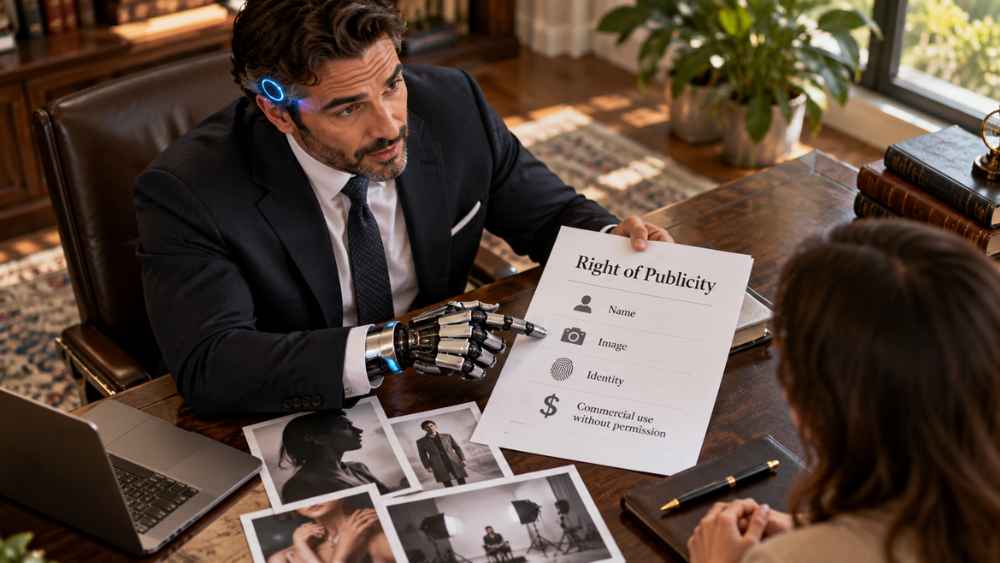
“The athlete asserted a Right of Publicity claim after a company used the athlete’s photograph and name in product advertising without permission.”
What Is the Right of Publicity?
The Right of Publicity protects a person’s identity against unauthorized commercial exploitation under applicable law.
Protected attributes can include name, likeness, voice, image, signature, or other recognizable persona features.
See Cornell LII’s right of publicity overview.
Standard Right of Publicity — Sample Contract Language
Suppose a company uses an athlete's photograph in product advertising without permission.
Is There a General Federal Right of Publicity?
No comprehensive federal right of publicity is currently in force.
Rights primarily arise under state statutesPrimary AuthorityPrimary Authority is law issued by an institution with official power to create or state legal rules. Constitutions, statutes, regulations, court decisions, and court rules can be primary authority, while binding effect depends...View definition and common lawCommon LawCommon law is law developed through judicial decisions rather than created only through statutes or regulations. Courts use precedent to apply and refine common-law rules, although legislatures can modify or replace those rules.View definition .
Therefore, location and governing state law can materially change a claim.
What Is the NO FAKES Act of 2026?
The NO FAKES Act of 2026 is pending federal legislationStatutory LawStatutory law is written law enacted by a legislative body through the formal lawmaking process. Federal and state statutes can create rights, duties, prohibitions, causes of action, procedures, penalties, and remedies, and courts...View definition concerning unauthorized digital replicas.
As of October 2026, it has not become law.
See the Senate-reported text of S.4591.
What Does the Right Protect?
State laws define protected identity attributes differently.
Therefore, a claim should begin with the controlling state statute or common law.
- Name.
- Photograph.
- Likeness.
- Voice.
- Signature.
- Image.
- Persona or identity features recognized by local lawOrdinanceAn Ordinance is a law enacted by a municipality or other authorized local government. Local authority depends on state constitutions, statutes, charters, home-rule rules, Dillon’s Rule principles, and preemption, while ordinances commonly govern...View definition .
Who Can Have a Right of Publicity?
The right is not limited to actors, athletes, or celebrities.
Some states protect any individual whose identity is commercially exploited.
Therefore, fame can affect damagesLegal RemedyA legal remedy is the relief a court or other authorized tribunal can provide after a legal right has been violated. Remedies can include damages, injunctions, restitution, specific performance, rescission, declarations, and other...View definition without always determining liability.
Does a Person Need Commercial Value First?
State law varies.
Some jurisdictions focus on unauthorized commercial use without demanding preexisting celebrity value.
Therefore, commercial-value requirements should not be assumed nationwide.
What Is Commercial Use?
Commercial use generally involves using identity to advertise, promote, sell, or market goods or services.
Purely expressive uses can receive stronger constitutional protection.
Therefore, context matters more than whether money changes hands.
What Is Misappropriation of Likeness?
Misappropriation uses another person’s identity for advantage without required consent.
Some states treat the claim as a privacy tort.
Therefore, terminology differs across jurisdictions.
Right of Publicity vs. Right of Privacy
Privacy lawData PrivacyData privacy concerns how personal information is collected, used, shared, retained, and controlled. It includes transparency, data minimization, individual rights, vendor management, security, retention, and compliance with laws such as GDPR, CCPA, and...View definition protects personal dignity and seclusion interests.
Publicity law protects control over commercial exploitation of identity.
Therefore, the doctrines overlap but serve different interests.
Right of Publicity vs. Trademark
Trademark lawTrademark DefinitionA trademark is a word, phrase, symbol, design, or other source identifier that distinguishes one seller’s goods or services from others. U.S. rights can arise through use, while federal registration can provide additional...View definition protects source identification and consumers from confusion.
Right of publicity protects personal identity from unauthorized commercial exploitation.
Therefore, the same advertisement can implicate both doctrines.
How Can the Lanham Act Apply?
Section 43(a) can address false endorsement or confusing affiliation involving a person’s identity.
It requires marketplace confusion rather than mere commercial appropriation.
See 15 U.S.C. § 1125(a).
What Is False Endorsement?
False endorsement occurs when a commercial use falsely suggests sponsorship, approval, or affiliation.
A celebrity image can create that impression in some advertising.
Therefore, false endorsement focuses on consumer confusion.
Right of Publicity vs. Copyright
Copyright protects original works such as photographs, films, and sound recordings.
Publicity rights protect the identity depicted or captured in those works.
Therefore, permission from the photographer may not resolve publicity rights.
Can a Photograph Trigger Both Rights?
Yes. A photograph can contain copyright owned by one person and publicity rights held by another.
Licensing one right does not automatically license the other.
Therefore, commercial campaigns often need multiple permissions.
Can a Voice Be Protected?
Yes, in jurisdictions protecting voice or recognizable vocal identity.
Imitation can sometimes create liability even without using the original recording.
Therefore, audio advertising requires careful clearance.
Can a Lookalike Create Liability?
Potentially. A lookalike can evoke a recognizable persona without using an actual photograph.
State law and First Amendment rules determine the result.
Therefore, identity can extend beyond exact duplication.
Can a Soundalike Create Liability?
Potentially. A deliberately imitated distinctive voice can implicate publicity or related state-law rights.
Copyright ownershipWork Made for HireA Work Made for Hire is a copyrighted work created by an employee within the scope of employment or a qualifying specially commissioned work meeting strict statutory and written-agreement requirements. The classification determines...View definition of the recording is a separate issue.
Therefore, voice imitation deserves independent review.
Can a Stage Name Be Protected?
Yes. A stage name or professional name can identify a person’s commercial persona.
Trademark rights can also arise in qualifying uses.
Therefore, several legal theories can overlap.
Can a Signature Be Protected?
Some state statutes expressly protect signatures.
California is one prominent example.
Therefore, autograph merchandising can involve publicity rights.
What Does California Civil Code Section 3344 Protect?
California protects specified unauthorized commercial uses of name, voice, signature, photograph, or likeness.
The statute contains consent rules, remedies, and exemptions.
See California Civil Code § 3344.
Do Right of Publicity Laws Vary by State?
Yes. States differ on protected attributes, duration, remedies, defenses, and postmortem rights.
Some rely mainly on common law.
Therefore, nationwide campaigns can require a multi-state review.
What Are Postmortem Publicity Rights?
Postmortem rights continue after death in some states.
Duration and transfer rules differ significantly.
Therefore, deceased personalities can still require licensing.
Can Publicity Rights Be Transferred?
Many states allow licensing, assignmentAssignmentAssignment transfers a contractual right or other legal interest from an assignor to an assignee. Most rights can be assigned, but contract restrictions, personal rights, material changes to the obligor’s burden, notice, defenses,...View definition , inheritance, or other transfers.
The exact rules depend on the jurisdictionLegal DisputeA legal dispute is a disagreement or controversy involving claimed legal rights, duties, liabilities, property, or remedies. It can be resolved through negotiation, mediation, arbitration, administrative proceedings, litigation, or settlement depending on the...View definition .
Therefore, chain of titleIP OwnershipIP ownership is legal ownership of intellectual property rights and depends on the type of IP, creation or use, employment, assignments, and chain of title.View definition can matter in licensing deals.
Can Publicity Rights Be Licensed?
Yes. Individuals commonly license identity for endorsements, merchandise, games, advertising, and entertainment.
License scope can address media, territory, term, and approvals.
Therefore, contracts should define permitted uses precisely.
What Is Consent?
Consent authorizes a particular use of identity.
It can be limited by medium, product, duration, or context.
Therefore, an old releaseWaiver DefinitionA waiver is the intentional relinquishment of a known legal right, claim, privilege, or protection. A waiver can be express or implied, although enforceability depends on the right involved, the evidence of intent,...View definition may not cover a new campaign.
Can Consent Be Implied?
State law can recognize implied consent in some circumstances.
However, written consentCorporate ResolutionA Corporate Resolution formally records an action approved by a corporation's board or stockholders. Resolutions commonly authorize financing, contracts, equity actions, officer appointments, bank accounts, transactions, and delegated signature authority, and they should...View definition reduces uncertainty for commercial uses.
Therefore, businesses should document permission.
What Is Newsworthiness?
Newsworthiness can protect reporting and public-interest uses from publicity claims.
The scope varies among jurisdictions.
Therefore, editorial use differs from product endorsement.
What Is an Expressive Use?
Books, films, art, commentary, parody, and other expressive works can receive First Amendment protection.
States use different balancing tests.
Therefore, commercial sale alone does not make every expressive use actionable.
What Is the Transformative Use Test?
Some courts ask whether a work adds significant creative elements that transform the depicted identity.
California decisions use this approach in some cases.
Therefore, creative transformation can affect the speech balance.
What Is the Rogers Test?
Trademark cases involving expressive works have used versions of the Rogers framework.
However, Supreme CourtSupreme CourtThe Supreme Court of the United States is the nation’s highest federal court. It reviews selected cases involving the Constitution and federal law, resolves important federal legal questions, and sits at the top...View definition trademark decisions have narrowed its use in source-identifying contexts.
Therefore, publicity and trademark defenses should be analyzed separately.
Can Parody Use a Person’s Identity?
Parody can receive substantial First Amendment protection.
However, disguised commercial endorsement can create different concerns.
Therefore, context and messaging matter.
Can Advertising Use a Person’s Identity Without Permission?
Unauthorized advertising use creates significant publicity-right risk.
False endorsement can also apply when consumers may infer sponsorship.
Therefore, advertisers usually seek releases or licenses.
Can Merchandise Use a Person’s Identity?
Merchandise such as shirts, posters, figurines, or products can trigger publicity claims.
Expressive-content defenses can vary by product and state.
Therefore, merchandising requires careful clearance.
Can Video Games Create Publicity Claims?
Yes. Athlete and celebrity depictions have generated major publicity-right litigation.
Courts balance identity rights against expressive protection.
Therefore, realism and creative context can matter.
Can AI Deepfakes Create Publicity Claims?
Yes. Digital replicas can implicate state publicity, privacy, fraud, trademark, or other laws.
However, existing state protection remains inconsistent.
Therefore, AI likeness use requires jurisdiction-specific review.
What Did the Copyright Office Say About Digital Replicas?
In 2024, the Copyright Office identified gaps in existing laws protecting against unauthorized digital replicas.
It recommended a new federal digital-replica right.
See the Copyright Office Digital Replicas Report.
Is the NO FAKES Act Current Law?
No. The 2026 proposal remains pending and would create new federal voice and visual-likeness rights if enacted.
Therefore, current claims still depend primarily on existing state and related federal law.
What Damages Can Be Available?
Remedies vary by state and claim.
They can include actual damagesLiquidated DamagesLiquidated damages are a contractually agreed amount or formula payable after a specified breach. Courts generally enforce them when they reasonably compensate for difficult-to-measure losses rather than operating as an unlawful penalty.View definition , profits, statutory damagesCopyright InfringementCopyright infringement occurs when someone violates an exclusive copyright right without authorization or another valid legal basis. Claims can involve copying, derivative works, distribution, performance, display, or secondary liability, subject to defenses and...View definition , punitive damagesBad FaithBad Faith generally involves dishonesty, improper purpose, unfair dealing, or conscious disregard of a legal duty. Contract, insurance, litigation, bankruptcy, and corporate law use different bad-faith standards and remedies.View definition , or attorney feesMotion to CompelA motion to compel asks a court to order required discovery or disclosure when another party or person has not responded adequately. In federal civil cases, Rule 37 generally requires good-faith conference efforts...View definition where authorized.
Therefore, damages should be researched under the controlling lawChoice of Law ClauseA Choice of Law Clause selects the jurisdiction's substantive law intended to govern a contract or dispute. Courts often honor reasonable governing-law provisions, but conflict-of-laws rules, mandatory statutes, public policy, clause scope, and...View definition .
Can Injunctions Be Available?
Yes. Courts can enjoin qualifying unauthorized uses when equitable requirements are met.
First Amendment concerns can limit relief.
Therefore, remedyCause of ActionA Cause of Action is a recognized set of legal elements supporting a right to judicial relief. Its elements can arise from statutes, constitutions, regulations, or case law, and the claimant generally must...View definition scope matters in expressive cases.
What Evidence Helps Prove a Claim?
Evidence can include the advertisement, audience reach, licensing history, consumer reaction, profits, and consent records.
Expert evidenceAdmissible EvidenceAdmissible Evidence is evidence a court permits the judge or jury to consider. In federal court, admissibility commonly depends on relevance, Rule 403 balancing, authentication, foundation, hearsay rules, privilege, witness competence, and other...View definition can address commercial value.
Therefore, both use and economic impact should be documented.
Right of Publicity Example
Suppose a company uses an athlete’s photograph in product advertising without permission.
Consumers can reasonably view the advertisement as an endorsement.
State publicity law and federal false-endorsement law can both become relevant.
Why Does the Right of Publicity Matter?
The right of publicity gives individuals control over commercial exploitation of identity.
However, state variation and free-speech protections make the doctrine complex.
Therefore, businesses should clear identity rights before advertising, merchandising, or digital-replica uses.