
Injunction Definition
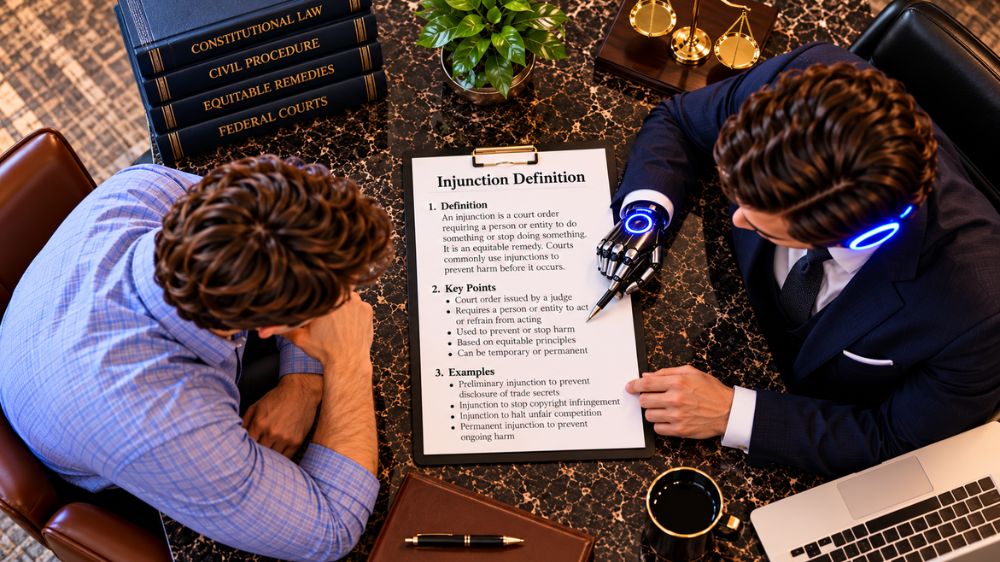
“The company asked the court for a preliminary injunction to prevent disclosure of its trade secrets while the lawsuit was pending.”
What Is an Injunction?
An injunctionCease and Desist LetterA cease and desist letter is a written demand asking a person or business to stop specified allegedly unlawful or harmful conduct. It is generally not a court order, but it can provide...View definition is a court orderCourt OrderA court order is a legally operative directive or decision issued by a court. Orders can control procedure, resolve motions, require action, prohibit conduct, or provide final or interim relief.View definition requiring a person or entity to do something or stop doing something. It is an equitable remedyLegal RemedyA legal remedy is the relief a court or other authorized tribunal can provide after a legal right has been violated. Remedies can include damages, injunctions, restitution, specific performance, rescission, declarations, and other...View definition .
Courts commonly use injunctions when money damages would not adequately prevent or remedyCause of ActionA Cause of Action is a recognized set of legal elements supporting a right to judicial relief. Its elements can arise from statutes, constitutions, regulations, or case law, and the claimant generally must...View definition irreparable harmTemporary Restraining OrderA Temporary Restraining Order is short-term emergency injunctive relief intended to prevent immediate harm until a court can consider longer-lasting relief. Federal TROs are governed by Rule 65’s notice, duration, and procedural requirements.View definition .
Cornell Law School’s Legal Information Institute explains the basic forms of injunctive relief. See Cornell LII’s injunction overview.
Standard Injunction Definition — Sample Contract Language
Suppose a former employee threatens to publish a company’s protected trade secretsNon Disclosure Agreement (NDA)A non disclosure agreement, or NDA, is a contract that protects specified confidential information. It limits who may receive the information and often restricts how the recipient may use or share it.View definition . The company files suit and seeks a preliminary injunction.
What Does Injunction Mean?
An injunction directs future conduct through a court order. It can prohibit harmful conduct or require specific action.
For example, a court can order a company to stop using another business’s protected trade secretTrade SecretA trade secret is qualifying business information that has independent economic value because it is not generally known and is protected by reasonable secrecy measures. Federal and state law can provide remedies for...View definition .
Therefore, an injunction differs from a judgmentCivil LawsuitA civil lawsuit is a noncriminal court action in which a plaintiff seeks a legal remedy from a defendant. The process can include jurisdiction, pleadings, service, discovery, motions, settlement, trial, judgment, enforcement, and...View definition that only awards money.
What Are the Main Types of Injunctions?
Courts commonly discuss three forms of injunctions.
- Temporary restraining order: Short-term emergency reliefEx ParteEx Parte refers to a one-sided request, proceeding, or communication. Courts permit ex parte relief only in authorized circumstances, while professional-conduct rules generally bar private communications with judges unless law or court order...View definition before a fuller hearing.
- Preliminary injunction: Interim relief while the lawsuitLawsuitA lawsuit is a legal dispute brought before a court for a decision or remedy. Civil lawsuits can involve pleadings, service, discovery, motions, settlement, trial, judgment, and possible appeal.View definition continues.
- Permanent injunctionInjunctive ReliefInjunctive relief is an equitable remedy ordering a party to act or stop acting when monetary damages would be inadequate to prevent or remedy the harm.View definition : Final equitable relief after the court resolves the merits.
Each form uses different procedural requirements.
What Is a Temporary Restraining Order?
A temporary restraining order, or TRO, is short-term emergency relief. It can preserve the status quo until a preliminary-injunction hearing.
Federal Rule 65 allows an ex parte TRO only under narrow conditions.
See Federal Rule of Civil Procedure 65.
What Is a Preliminary Injunction?
A preliminary injunction is temporary relief issued before final judgmentTrial CourtA Trial Court is a court where parties present evidence, establish facts, and obtain an initial judgment or verdict. Federal district courts are the primary federal trial courts, while state systems use varied...View definition . It can prevent threatened harm while the court decides the underlying case.
Unlike an ex parte TRO, a federal preliminary injunction requires notice to the adverse party.
What Is a Permanent Injunction?
A permanent injunction is final equitable relief entered after the court resolves the merits.
For example, a court can permanently prohibit continuing infringement after finding liability.
However, a prevailing party does not automatically receive an injunction.
What Must a Party Show for a Preliminary Injunction?
Federal courts generally consider four core factors. The movant addresses likelihood of successPreliminary InjunctionA preliminary injunction is temporary equitable relief issued before final judgment to prevent irreparable harm and preserve meaningful relief while a case proceeds.View definition , irreparable harm, the balance of equities, and the public interest.
Therefore, a strong legal claim alone is not always enough.
What Is Irreparable Harm?
Irreparable harm is injury that money damages cannot adequately remedy. The harm must generally be likely rather than merely speculative.
For example, disclosure of valuable confidential information can create harm that is difficult to reverseCourt of AppealsA court of appeals is a court that reviews decisions from lower courts. Federal courts of appeals usually examine the existing record for legal error rather than conducting a new trial or hearing...View definition .
What Is Likelihood of Success on the Merits?
This factor considers whether the party seeking relief has a sufficient chance of prevailing on the underlying legal claim.
The exact formulation can vary among courts and contexts.
Therefore, parties should check the governing precedentMajority OpinionA majority opinion states the reasoning and result supported by more than half of the judges participating in an appellate decision and can provide binding precedent.View definition .
What Is the Balance of Equities?
The balance of equities compares hardships on both sides. The court considers the harm that granting or denying relief could cause.
For example, the court can compare threatened business harm against the burden of stopping challenged conduct.
What Is the Public Interest Factor?
Courts also consider how the requested injunction would affect the public interest.
For example, public safety, competition, constitutional rights, or enforcement of valid laws can matter.
Therefore, injunctive relief can involve interests beyond the two parties.
What Is an Ex Parte Injunction?
Federal Rule 65 does not allow an ordinary preliminary injunction without notice. However, an ex parte TRO can issue in narrow emergency circumstances.
The applicantLetter of CreditA Letter of Credit is a documentary undertaking by an issuer to pay a beneficiary when a complying presentation is made.View definition must satisfy specific factual and certification requirements.
Therefore, ex parte relief is exceptional.
How Long Does a Federal TRO Last?
Under Rule 65(b), a federal ex parte TRO generally expires within 14 days. The court can extend it for good causeGood CauseGood Cause is a legally sufficient reason for a court to grant relief, modify a schedule, excuse conduct, or issue another order. The required showing depends on the governing rule and often considers...View definition .
The adverse party can also consent to a longer extension.
Therefore, a TRO serves as short-term relief.
What Is an Injunction Bond?
Rule 65(c) generally requires security before a federal courtFederal CourtA federal court is a court within the U.S. federal judicial system. Federal courts have limited jurisdiction, so they hear only cases authorized by the Constitution or federal law, including many federal-question and...View definition issues a preliminary injunction or TRO. The court sets the amount it considers proper.
The security can compensate a wrongfully restrained party for qualifying costs and damages.
However, courts have discretion in applying bond requirements.
What Is a Mandatory Injunction?
A mandatory injunction requires affirmative action. For example, a court may order a party to restore access or perform a specific act.
Courts can scrutinize mandatory relief closely because it changes existing conditions.
What Is a Prohibitory Injunction?
A prohibitory injunction orders a party to stop specified conduct. It often seeks to preserve the status quo.
For example, a court can prohibit disclosure of certain protected information.
What Is Injunctive Relief?
Injunctive relief is the broader category of court-ordered equitable relief involving injunctions.
It can include temporary, preliminary, or permanent orders.
When Are Money Damages Inadequate?
Money damages can be inadequate when compensation cannot fully measure or repair the harm.
For example, loss of unique propertySpecific PerformanceSpecific Performance is an equitable remedy ordering contractual performance when money damages are inadequate. It commonly arises with unique real estate or goods and depends on an enforceable agreement, fairness, feasibility, and equitable...View definition or disclosure of confidential information can support equitable concerns.
However, the specific legal context matters.
Can an Injunction Protect Constitutional Rights?
Yes. Courts can issue injunctions in constitutional cases when the requesting party satisfies equitable requirements.
For example, a plaintiffCivil CourtCivil court is a general term for a court handling noncriminal disputes involving people, businesses, organizations, or government entities. Civil cases can involve contracts, injuries, property, employment, civil rights, and other disputes and...View definition can seek an order preventing enforcement of an unconstitutional government actionForce MajeureForce Majeure is a contract concept that can excuse or delay performance after extraordinary events covered by the agreement. Relief depends on clause wording, causation, notice, mitigation, exclusions, governing law, and the specific...View definition .
However, standingJudicial ReviewJudicial review is the power of courts to examine government action and determine whether it complies with the Constitution, statutes, and other controlling law. It can apply to legislation, executive action, and administrative...View definition , sovereign-immunity rules, and remedial limits can affect relief.
Can an Injunction Stop Trademark or Copyright Infringement?
Yes. Federal intellectual propertyIntellectual PropertyIntellectual property, or IP, is a group of legal rights that protect certain inventions, creative works, brands, and confidential business information. Major U.S. categories include patents, copyrights, trademarks, and trade secrets.View definition statutesPrimary AuthorityPrimary Authority is law issued by an institution with official power to create or state legal rules. Constitutions, statutes, regulations, court decisions, and court rules can be primary authority, while binding effect depends...View definition permit injunctive relief in qualifying cases.
However, courts apply the governing equitable standards rather than treating an injunction as automatic.
Can an Injunction Enforce a Contract?
Sometimes. A court can issue equitable relief when contract damagesBreach of ContractA breach of contract occurs when a party fails to perform an obligation required by an enforceable agreement. Examples include nonpayment, missed deadlines, defective performance, refusal to perform, or violation of another contract...View definition are inadequate and other requirements are met.
For example, restrictive covenants or unique-property agreements can raise injunction issues.
However, enforceability of the underlying contract comes first.
What Happens If Someone Violates an Injunction?
A person who knowingly violates a valid injunction can face contempt proceedings.
Contempt remedies can include coercive sanctions, compensatory relief, or other consequences.
Therefore, parties should take injunction terms seriously.
How Specific Must an Injunction Be?
Federal Rule 65 requires injunctions and restraining orders to state their terms specifically. The order must describe the restrained or required acts in reasonable detail.
Therefore, vague commands can create enforceability problems.
Who Is Bound by an Injunction?
Rule 65 identifies people who can be bound after receiving actual noticeConstructive NoticeConstructive notice is legally imputed knowledge arising from a recognized notice method, such as public recording or other circumstances that the law treats as sufficient notice.View definition . They include parties, certain officersCorporation DefinitionA corporation is a legal entity created under state law that is separate from its owners, usually called shareholders. It can own property, enter contracts, incur debts, sue or be sued, and operate...View definition or agents, and people acting in active concert with them.
However, an injunction does not automatically bind the entire world.
What Are Universal or Nationwide Injunctions?
A universal injunction seeks relief extending beyond the parties before the court. The scope of such relief has been a major federal remedial issue.
In 2025, the U.S. Supreme CourtSupreme CourtThe Supreme Court of the United States is the nation’s highest federal court. It reviews selected cases involving the Constitution and federal law, resolves important federal legal questions, and sits at the top...View definition held in Trump v. CASA that universal injunctions likely exceed federal courts’ traditional equitable authority under the JudiciaryBenchThe bench is the judge's raised courtroom desk and is also a common legal term for a judge, group of judges, or the judiciary.View definition Act.
Therefore, federal courts generally tailor injunctive relief to the parties and injuries before them. Another source can authorize broader relief.
Injunction vs. Restraining Order
A restraining order can refer to a temporary injunction or a protective orderMotion to CompelA motion to compel asks a court to order required discovery or disclosure when another party or person has not responded adequately. In federal civil cases, Rule 37 generally requires good-faith conference efforts...View definition under state law. The exact meaning depends on context.
In federal civil litigationCivil LitigationCivil Litigation is the court process for resolving noncriminal disputes through pleadings, motions, discovery, settlement, trial, judgment, and possible appeal. Federal civil litigation follows the Federal Rules of Civil Procedure, while state systems...View definition , a TRO is one form of emergency injunctive relief under Rule 65.
Therefore, the terms can overlap but are not always identical.
Injunction vs. Damages
Damages compensate for loss with money. An injunction controls conduct through a court order.
Therefore, a plaintiff can sometimes seek both forms of relief.
Can an Injunction Be Appealed?
Federal law permits immediate appeals from certain orders granting, denying, modifying, or dissolving injunctions.
However, appeal rules can be technical.
Therefore, parties should identify appellate deadlines promptly.
Injunction Example
Suppose a former employee threatens to publish a company’s protected trade secrets. The company files suit and seeks a preliminary injunction.
The court considers the merits, irreparable harm, equities, and public interest.
If the company satisfies the requirements, the court can prohibit disclosure while the case proceeds.
Why Does an Injunction Matter?
An injunction can prevent harm that money cannot adequately repair. Therefore, it is one of the most powerful remedies available in civil litigation.
However, courts use equitable standards and procedural safeguards before granting relief.
The key questions are practical. Which harm is threatened? Is money inadequate? What order is necessary? How narrowly can the court tailor the relief?